Why ‘King’ – ‘Man’ + ‘Woman’ = ‘Queen’ (Almost!): Demystifying Vector Math in AI


The Magic Trick of AI
Imagine asking a computer to complete the analogy “man is to king as woman is to.” For decades, this was a profound challenge. Today, advanced AI models can answer it instantly. This capability stems from representing words not as text, but as points in a multidimensional space a concept central to how we at Webmap Network approach intelligent data systems. This brilliant illustration shows how AI models grasp semantic relationships through the power of vector math, which often feels like magic but is built on an elegant mathematical foundation.
From Words to Vectors: The World of Embeddings
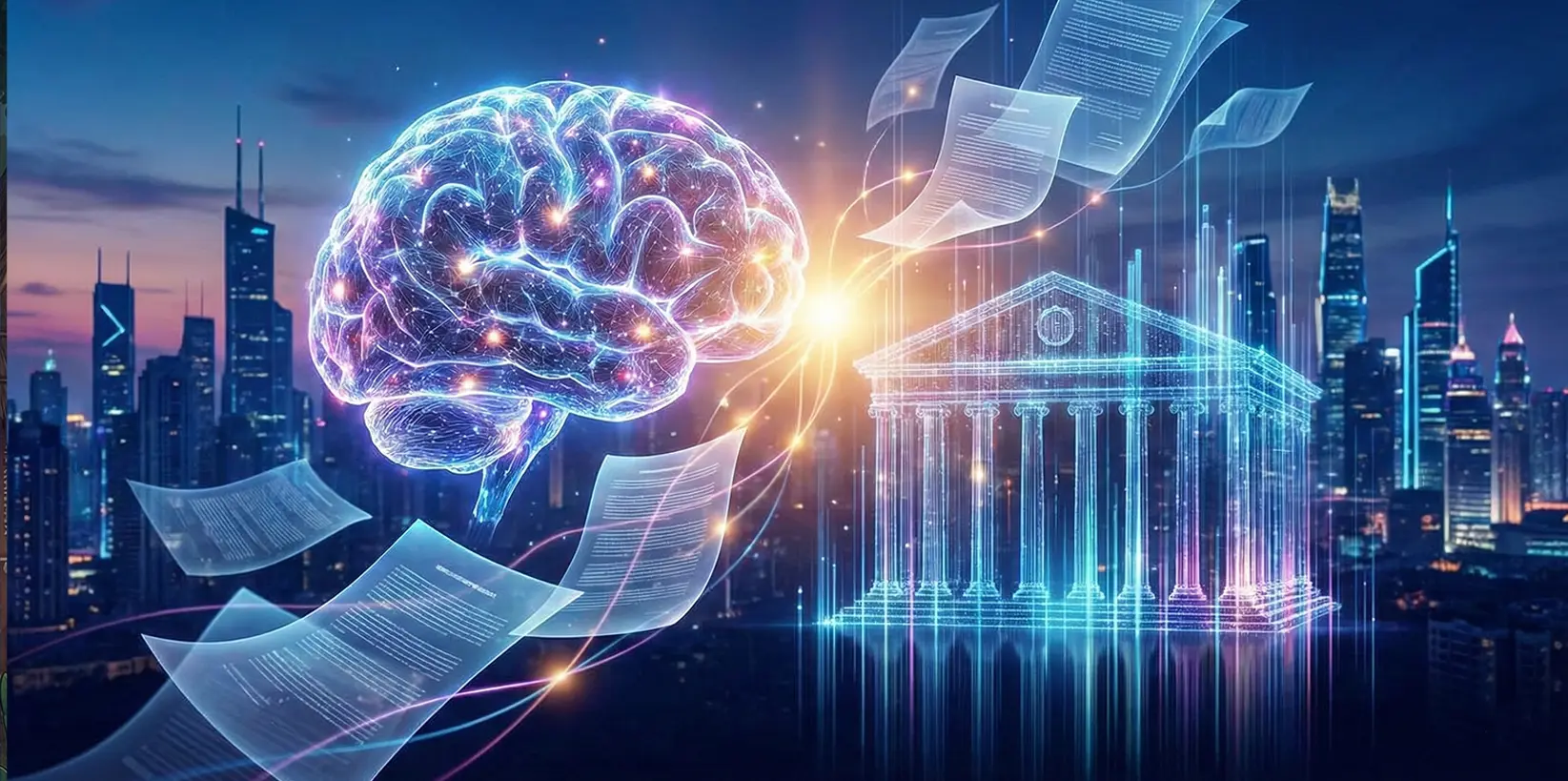
An embedding is a numerical representation of data a word, a sentence, or even an image transformed into a dense vector. This process captures semantic meaning, placing similar concepts close together in a high-dimensional space. Computers process data, which means converting everything into numbers. This is where word embeddings come into play.
- Word Embeddings capture the meaning of individual words. Through training on vast text corpora, these models learn that “cat” and “dog” are closer to each other than either is to “airplane.”
- The Core Idea: The relationships between these vector points are meaningful. Direction and distance in this space represent semantic and syntactic relationships. These vectors are learned through sophisticated algorithms that analyze billions of text examples. The remarkable outcome is that words with similar meanings or contexts end up clustered closer together in this high-dimensional space.
The Famous Equation: A Walkthrough of Vector Arithmetic
Let’s break down the iconic example: king – man + woman ≈ queen.
- Start with Concepts as Vectors: In our model, each word is a unique vector.
V_king = Vector for "king," which points in a direction that encapsulates concepts like royalty, masculinity, and leadership.V_man = Vector for "man," which captures attributes of masculinity, adulthood, and human male identity.V_woman = Vector for "woman," which represents femininity, adulthood, and human female identity.- Perform the Arithmetic:
First, compute (V_king - V_man)
This vector difference conceptually isolates the "royalty" component or the change from "man" to "king," effectively subtracting the "masculine" component that "King" shares with "Man," leaving a vector for "royalty without a specific gender."
Then, add V_woman to this "royalty" vector: (V_king - V_man) + V_woman, which introduces the "feminine" component.- Find the Nearest Neighbor
The resulting vector won't be a perfect word. The AI searches the entire vocabulary for the word vector closest to this new point in space.

The nearest neighbor is, remarkably often, "queen." This demonstrates how vector math allows AI to identify and manipulate relationships between words, like gender, plurality, and verb tense.

This works because the embedding space structures gender and royalty as roughly linear and separable concepts learned from patterns in language data.
The “Almost” Factor: Understanding the Nuances and Limitations
We say “almost” (=) and use “≈” for good reason. This analogy is impressively consistent but not flawless. The “Almost!” in our title is crucial. While the analogy beautifully illustrates the principle, real-world AI is far more complex.
- Bias in Training Data: If the training text contains biases (e.g., “doctor” is closer to “man”), the vector arithmetic will reflect and perpetuate those biases.
- Context Limitations: Simple word embeddings don’t handle polysemy (words with multiple meanings). The vector for “bank” (river) and “bank” (financial) are merged.
- Imperfect Geometry: The relationships are not perfectly linear for all analogies. The space is a statistical approximation of language use, not a perfect logical framework. Vector spaces are often hundreds of dimensions deep, and relationships aren’t always perfectly linear or isolated. Context matters immensely, and models are constantly learning. This equation is a simplification of a fundamentally statistical and high-dimensional process.
Beyond Words: Applications in Search, Recommendations, and LLMs
This principle of vector similarity is the engine behind many AI applications we help implement. The power of word embeddings and vector arithmetic extends far beyond a clever analogy. Its impact is seen in various cutting-edge AI applications:
| Application | How Vector Math & Embeddings Power It |
|---|---|
| Semantic Search | Goes beyond keywords. A search for “canine companion” can find documents about “dogs” because their vector representations are similar. AI understands the meaning of queries, not just keywords, for more relevant results. |
| Recommendation Systems | Movies, products, or songs are converted into vectors. The system recommends items that are “close” to what you’ve liked before. AI recommends items semantically similar to what you like by understanding vector representations. |
| Large Language Models (LLMs) | Models like GPT use embeddings to understand context and relationships between words, enabling coherent text generation and comprehension. |
| Image & Multimodal AI | Images are also converted to vectors, allowing for “search by image” or finding visually similar items. |
| Machine Translation | Preserving semantic meaning and context across languages, not just word-for-word substitution. |
| Sentiment Analysis | Discerning the emotional tone of text by understanding the vector representation of words. |
| Chatbots & Virtual Assistants | Interpreting the intent and meaning behind user queries for more natural and accurate responses. |
Harnessing the Foundational Power
The “king – man + woman” analogy is a beautiful demonstration of how transforming language into a mathematical space allows machines to reason about meaning. At Webmap Network, we see embeddings and vector math as the fundamental substrate for building intelligent, context-aware applications—from revolutionizing search to powering personalized user experiences. It’s not magic; it’s mathematics, data, and insightful engineering. We believe understanding the underlying mechanics of AI is key to unlocking its full potential.
We work with clients to leverage these advanced techniques, from building intelligent search capabilities to crafting bespoke recommendation engines and natural language processing solutions. Our expertise helps businesses navigate the AI landscape, transforming complex concepts into actionable strategies and robust applications that deliver tangible business value.
Conclusion: The Future is Vectorized
The “King – Man + Woman = Queen” analogy is a window into the ingenious mathematical foundation that allows AI to comprehend human language. It highlights how sophisticated algorithms distill meaning into numerical vectors, enabling computers to perform arithmetic that mirrors our intuitive understanding of relationships. As AI evolves, these vectorized representations will become more nuanced, enabling even more powerful and human-like interactions with technology.
Curious about how vector search and embeddings can transform your business data or application?
Contact our team at Webmap Network to explore the possibilities. For further inquiries into how Webmap Network can help your organization leverage the power of AI and machine learning, please reach out to us at connect@webmap.network