Can Ethics Be Embedded?Inside the Moral Layer of AI Systems


As artificial intelligence systems move from passive tools to active decision-makers, a fundamental question emerges: can ethics be embedded into AI systems, or must morality always remain external and human-governed?
From content moderation and hiring recommendations to healthcare diagnostics and autonomous agents, AI increasingly operates in spaces where decisions have ethical consequences. This has pushed researchers, policymakers, and AI builders toward a new frontier: the idea of a moral layer within AI systems.
But what does it actually mean to “embed ethics”? And where do embeddings, memory, and system architecture fit into this picture?
Why Ethics in AI Is No Longer Optional
Traditional software follows explicit rules. AI systems, however, learn patterns, infer meaning, and generalize across contexts. This creates a challenge:
- AI decisions may be technically correct but socially harmful
- Bias can emerge even without malicious intent
- Scale amplifies ethical mistakes faster than humans can intervene
In short, intelligence without values scales risk.
Ethical Risks Without a Moral Layer
| Risk Area | Real-World Impact |
|---|---|
| Bias amplification | Discrimination in hiring, lending, policing |
| Lack of accountability | No clear explanation for decisions |
| Context blindness | Misinterpretation of cultural or emotional nuance |
| Value misalignment | AI goals diverge from human priorities |
This is why ethics must move closer to the core of AI systems, not remain an afterthought.
What Does “Embedding Ethics” Actually Mean?
Embedding ethics does not mean teaching AI right vs wrong like a human. Instead, it involves encoding ethical constraints, priorities, and contextual sensitivity into how AI represents knowledge and makes decisions.
At a system level, ethics can be introduced through:
- Training data curation
- Value-aligned embeddings
- Constraint-aware reasoning layers
- Memory and feedback loops
- Human-in-the-loop oversight
Ethics becomes a distributed property of the system, not a single rulebook.
The Role of Embeddings in Ethical AI
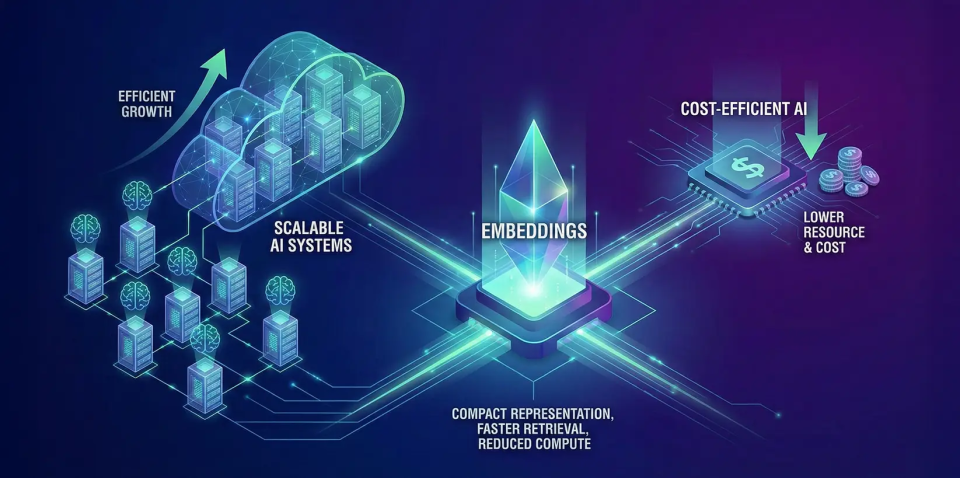
Embeddings are vector representations of meaning. They define how AI understands relationships between concepts such as fairness, harm, intent, consent, and context.
When designed carefully, embeddings can:
- Associate harmful actions with negative outcomes
- Preserve contextual nuance instead of rigid rules
- Enable ethical generalization across domains
Ethical Signals Inside Embeddings
| Ethical Dimension | How Embeddings Help |
|---|---|
| Fairness | Reduce biased proximity between demographic traits and outcomes |
| Intent | Distinguish malicious vs benign user behavior |
| Harm prevention | Flag semantic similarity to unsafe actions |
| Cultural context | Adapt meaning across regions and norms |
Rather than enforcing ethics explicitly, embeddings allow ethical awareness to emerge through structure.
From Rules to Moral Layers: A System Evolution
Early AI ethics relied heavily on hard-coded rules. Modern systems require something more adaptive.
| Approach | Limitation |
|---|---|
| Rule-based ethics | Breaks in novel scenarios |
| Policy-only guardrails | Easily bypassed by clever prompts |
| Post-hoc moderation | Too late, reactive |
| Embedded moral layers | Contextual, proactive, scalable |
A moral layer works alongside reasoning, memory, and decision modules guiding AI before output is generated.
Memory, Ethics, and Long-Term Alignment
One of the biggest gaps in today’s AI systems is ethical continuity. Without memory, AI cannot learn from past ethical failures or user corrections.
Persistent memory enables AI to:
- Remember user preferences and boundaries
- Learn from ethical feedback
- Maintain consistent value alignment over time
Ethics Without Memory vs With Memory
| Without Memory | With Memory |
|---|---|
| Repeats mistakes | Learns from prior feedback |
| Stateless decisions | Context-aware behavior |
| Inconsistent values | Stable moral alignment |
This is where embedding-powered memory systems become critical to ethical AI.
Can AI Truly Be Moral?
AI does not possess consciousness, empathy, or moral intuition. However, it can:
- Model ethical patterns
- Respect constraints
- Optimize for human-defined values
- Adapt based on ethical feedback
Ethical AI is not about replacing human morality it is about scaling human values responsibly.
The Human Role: Ethics as a Co-Created System
No ethical AI system is autonomous in its morality. Humans remain essential at every layer:
- Defining ethical priorities
- Auditing embedding spaces
- Monitoring drift and misuse
- Updating values as societies evolve
Ethics in AI is not static, it is a living system.
Conclusion
Embedding ethics into AI systems is not about programming morality, it is about designing architectures that respect human values, understand context, and learn responsibly over time. Through embeddings, memory, and moral layers, AI can move from value-neutral computation to ethically aware intelligence. As AI systems scale across societies and industries, embedding ethics becomes not just a technical challenge, but a foundational responsibility.
Connect with WebmapNetwork to explore how embedding-driven intelligence and memory-centric AI architectures can support responsible, ethical, and future-ready AI systems. We help organizations design AI that understands context, preserves values, and scales with trust. Email us at: connect@webmap.network