How Embeddings Enable Scalable and Cost-Efficient AI Systems

1. What are Embeddings?
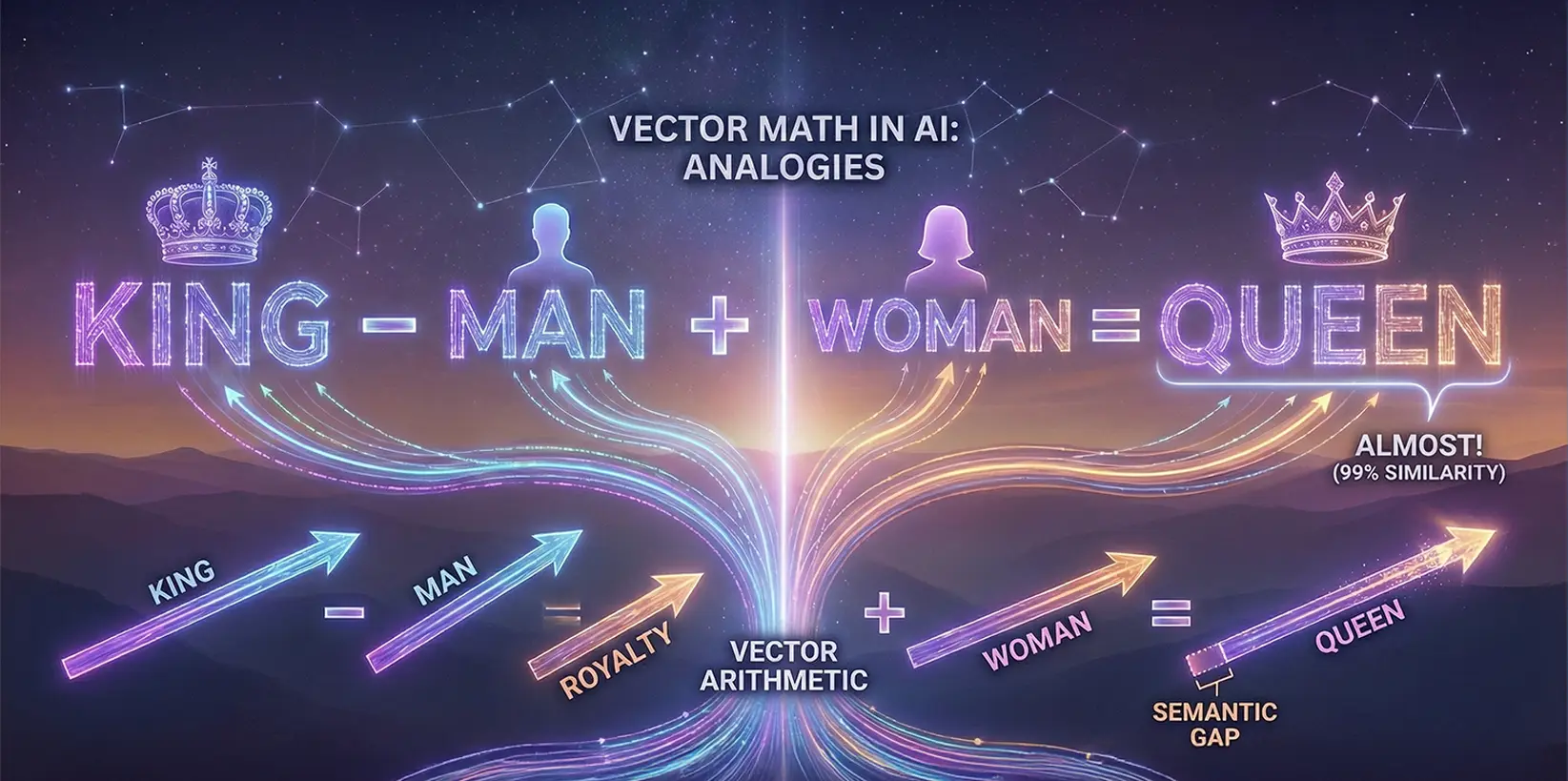
An embedding is a numerical representation of real-world objects such as words, phrases, sentences, images, audio, or user preferences converted into a lower-dimensional vector space. This conversion allows AI systems to grasp subtle meanings, context, and relationships within complex data in a way machines can comprehend. Unlike traditional methods, embeddings capture semantic and syntactic relationships between data points. For example, an embedding can represent that “bird-nest” and “lion-den” are analogous pairs, while “day-night” are opposites. This process is largely automated, with AI systems generating and utilizing these embeddings during training.
2. The Dual Advantage: Scalability and Cost-Efficiency
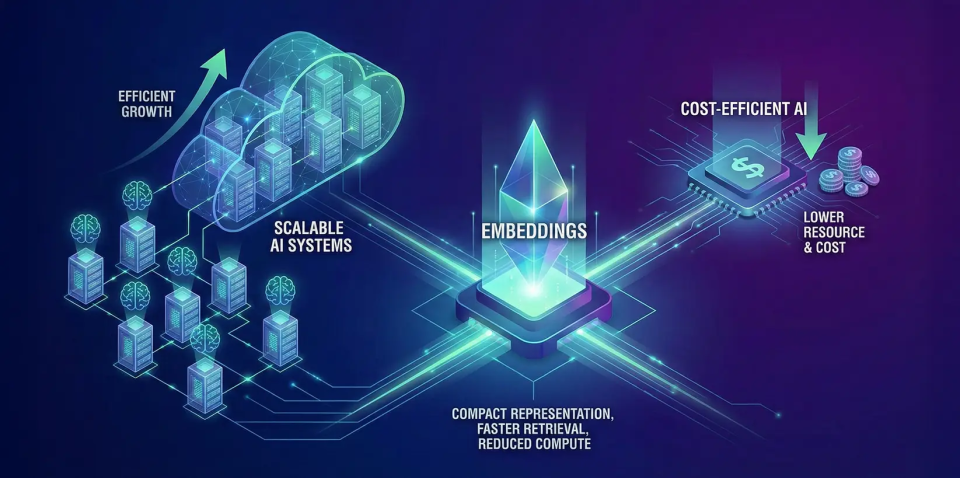
Embeddings offer a strategic advantage by directly addressing two critical concerns in AI development.
2.1 Enabling Scalability
The primary contributions of embeddings to system scalability are:
| Mechanism | Scalability Benefit |
|---|---|
| Dimensionality Reduction | Converts high-dimensional data (e.g., images with thousands of pixels) into compact, meaningful numerical vectors. This reduces the number of dimensions by identifying patterns, allowing AI models to require less computational power and time to learn, analyze, and infer accurately. |
| Efficient Data Processing | With data transformed into dense vector representations, AI algorithms can process and compare information far more efficiently, which is crucial for tasks like similarity searches across massive datasets. |
| Vector Databases and Infrastructure | Specialized databases (e.g., Pinecone, Weaviate) store, index, and retrieve embeddings rapidly. Modern serverless architectures automatically adjust resources based on workload, supporting billions of vectors with low latency and eliminating manual capacity planning. |
2.2 Driving Cost-Efficiency
Embeddings contribute to cost-efficiency through several key mechanisms:
| Mechanism | Cost-Efficiency Benefit |
|---|---|
| Reduced Computational Resources | Simplifying complex data into lower-dimensional vectors decreases the computational resources (CPU, GPU, memory) required for downstream AI tasks, lowering operational costs. |
| Optimized Model Performance | High-quality embeddings capture data nuances effectively, improving model performance. This leads to more accurate predictions, reducing errors and the need for costly manual interventions or re-training. |
| Advancements in Embedding Models | Newer, more efficient models (e.g., OpenAI’s text-embedding-3-small and text-embedding-3-large) have delivered significant cost reductions (up to 5×) for embedding generation alongside improved performance. |
| Cost Savings with Serverless Architectures | Serverless vector databases, which separate compute from storage and scale dynamically, can provide up to 50× cost reduction compared to older, pod-based deployments that require continuous resource provisioning. |
3. Applications of Embeddings
Embeddings are fundamental to a wide array of scalable and cost-efficient AI applications:
- Natural Language Processing (NLP):
- Computer Vision: Image embeddings enable high-precision tasks like object detection, image recognition, and visual search by capturing visual relationships.
- Recommendation Systems: Embeddings of user preferences and item features allow for highly personalized and efficient recommendation engines that scale to millions of users and products.
- Fraud Detection: Transforming diverse data into a shared embedding space helps identify subtle anomalies and patterns indicative of fraudulent activities more accurately and quickly.
4. Summary of Benefits
The following table summarizes how embeddings contribute to scalability and cost-efficiency in AI systems:
| Feature | Scalability Benefit | Cost-Efficiency Benefit |
|---|---|---|
| Dimensionality Reduction | Processes larger datasets with fewer resources. | Reduces computational power and time required for tasks. |
| Semantic Understanding | Improves model accuracy across vast and diverse data. | Leads to more effective AI applications, reducing errors. |
| Vector Databases | Handles billions of vectors; scales resources automatically. | Up to 50× cost reduction with serverless architectures. |
| Efficient Processing | Faster retrieval and comparison of data points. | Less time spent on computation, lowering infrastructure costs. |
| Model Advancements | Supports more complex AI tasks at scale. | Significantly reduces the cost of embedding generation. |
Conclusion
In summary, embeddings serve as a vital component in recommendation systems, improving accuracy while simultaneously lowering operational costs. By harnessing their capabilities, organizations can enhance user engagement and optimize resource allocation effectively.Ready to unlock the true potential of your data with AI solutions built on a foundation of deep understanding? Contact Webmap Network today to discuss how high-quality embeddings can transform your business. We’re here to guide you through further discussions, solution development, and understanding our services regarding this crucial topic.Email us at connect@webmap.network.