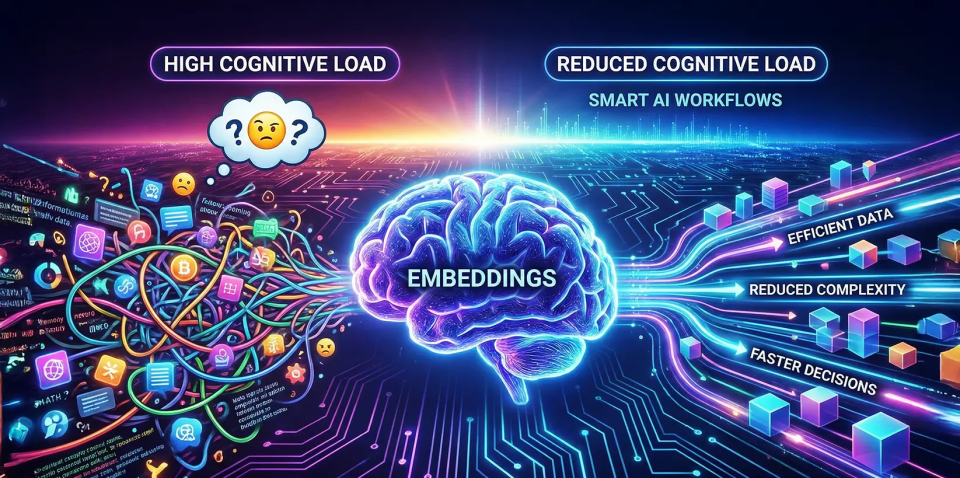
The Vector Backbone: Standardizing Embeddings for National AI Systems


India built world-class Digital Public Infrastructure (DPI).
From Aadhaar for identity
to UPI for payments
to ONDC for digital commerce
Each layer standardized a core digital function.
Now a new question emerges:
If AI becomes Digital Public Infrastructure…
what becomes its foundational layer?
The answer is clear.
Embeddings.
The Core Idea
If AI is India’s next digital public good,
then embeddings are its invisible highways connecting every dataset, service, and citizen interaction.
Embeddings convert language into numerical vectors.
Those vectors allow:
- Search across languages
- Policy document similarity
- Grievance classification
- Legal reasoning
- Public knowledge assistants
Without shared embeddings, AI systems remain isolated silos.
With standardized embeddings, they become interoperable infrastructure.
Why This Is a Different Angle
Today, most embeddings are:
- Built by private companies
- Optimized for commercial use
- Non-interoperable
- Model-specific
That’s fine for startups.
But infrastructure is different.
Imagine if every bank had its own incompatible payment network.
UPI unified them.
Similarly, India could unify semantic representation layers.
Embeddings move from being a “model feature”
to become a national AI backbone component.
Everyday Analogy: Roads vs Private Driveways
Private embedding models are like private driveways.
They work well within one building.
But public infrastructure requires highways.
Highways:
- Connect cities
- Standardize traffic rules
- Enable interoperability
- Scale nationally
Public infrastructure embeddings would act as semantic highways.
1️) Embedding Interoperability
Here’s the technical challenge.
If:
- Ministry of Health uses Model A
- Ministry of Agriculture uses Model B
- Judiciary uses Model C
Their vector spaces won’t align.
A document embedded in one space cannot easily be compared in another.
This creates semantic fragmentation.
What’s Needed?
- Standard embedding schemas
- Vector normalization standards
- Public evaluation benchmarks
- Alignment protocols
Without interoperability, AI cannot operate across departments.
2️) National Multilingual Embedding APIs
India is multilingual by default.
Public AI systems must handle:
- Hindi
- Tamil
- Bengali
- Marathi
- Tribal dialects
- Legal English
A National Multilingual Embedding API would:
- Standardize semantic encoding
- Provide cross-language vector alignment
- Enable consistent representation across services
Everyday Analogy: A Common Power Plug
Imagine if every state used a different voltage standard.
Devices wouldn’t work everywhere.
A shared embedding API acts like a standardized power grid for AI systems.
3️) Public Vector Index for Governance
Instead of each department building isolated vector databases:
India could maintain:
- Public governance vector indices
- Inter-ministry searchable knowledge graphs
- Unified policy embeddings
This would enable:
- Cross-state grievance clustering
- Similar policy detection
- Redundancy identification
- Public information retrieval
It reduces duplication.
It increases semantic coherence.
4️) Cross-Model Vector Compatibility
One of the hardest research problems:
Can embeddings from different models be mapped into a shared space?
If successful:
- Ministries could upgrade models without breaking compatibility
- Private vendors could plug into public systems
- AI vendors could compete without fragmentation
This is similar to how UPI allowed multiple banks and apps to operate on a unified protocol.
Vector space alignment becomes a national strategic capability.
5️) Government-Grade Embedding Benchmarks
If embeddings become infrastructure, they must be evaluated.
India-specific datasets are critical:
- Legal case archives
- Healthcare advisories
- Agricultural extension programs
- Regional language corpora
- Parliamentary debates
Public embedding benchmarks ensure:
- Fairness
- Accuracy
- Regional coverage
- Bias monitoring
Infrastructure must be audited.
Embeddings cannot remain opaque.
6️) Embeddings for Citizen Services
Imagine:
- Multilingual grievance portals
- AI-powered public assistants
- Cross-state scheme discovery
- Smart agricultural advisory systems
All require semantic search.
All depend on embeddings.
Without high-quality shared embeddings, citizen AI services remain inconsistent.
With standardized embeddings, services become:
- More accessible
- More inclusive
- More scalable
Strategic Impact
| Dimension | Impact |
|---|---|
| Governance | Cross-ministry interoperability |
| Efficiency | Reduced duplication of AI efforts |
| Innovation | Open APIs for startups |
| Inclusion | Multilingual fairness |
| Sovereignty | Public control over semantic layer |
This is not only about digital sovereignty.
It is about interoperability at scale.
From UPI to Unified Embedding Interfaces
UPI standardized payments.
Aadhaar standardized identity.
ONDC standardized digital commerce.
Public Infrastructure Embeddings could standardize:
Semantic representation across AI systems.
This transforms embeddings from:
“Model-specific numerical vectors”
into
“A national semantic protocol layer.”
The Long-Term Vision
If India builds:
- National Multilingual Embedding APIs
- Public Vector Standards
- Alignment Research Programs
- Open Benchmarking Frameworks
It could define global standards for AI public infrastructure.
Just as UPI influenced digital payments worldwide,
a national embedding layer could influence AI governance globally.
Final Thoughts
Digital infrastructure is not built on interfaces alone.
It is built on standards.
India proved this with identity, payments, and commerce layers.
The next frontier is intelligence infrastructure.
If AI becomes part of the Digital Public Stack, then the semantic layer must be treated with the same seriousness as financial rails or identity systems.
Embeddings are no longer just internal model components.
They are emerging as:
- Interoperability protocols
- Multilingual bridges
- Governance enablers
- Infrastructure-grade semantic highways
The real opportunity is not merely building better models.
It is designing a shared vector backbone that allows ministries, states, startups, and citizens to operate on a unified semantic standard. Because in the coming decade, public AI will not scale through isolated systems. It will scale through aligned representations. And whichever nation standardizes its embedding layer first
will define how intelligent public infrastructure operates globally.
To explore how structured embedding architectures power interoperable AI systems, visit WebmapNetwork or connect with us at connect@webmap.network.