The ABCs of AI: Understanding Vectors as the Language of Machines

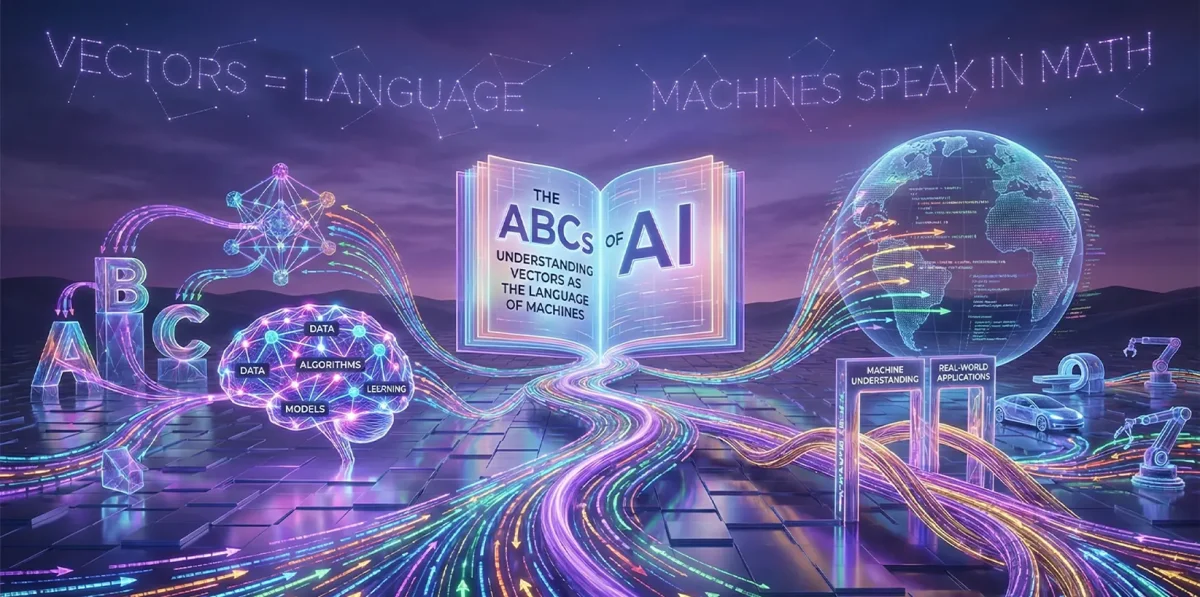
At Webmap Network, we believe in demystifying the complex world of Artificial Intelligence to help businesses truly harness its transformative power. While AI often conjures images of advanced robots or intricate algorithms, its foundational strength lies in elegant mathematical concepts. Today, we’re diving into one such cornerstone: vectors, the silent language that enables machines to understand, process, and interact with our world. For machines to process, analyze, and learn from our world, we must translate our complex, messy data words, pictures, sounds into a format they can compute. This translation results in vectors, the essential language of machines.
What Exactly is a Vector? The Core Concept
In its simplest form, a vector is a mathematical object possessing both magnitude (size) and direction. Think of it like an arrow on a map: it points somewhere, and it has a specific length. In the realm of AI, this abstract concept becomes incredibly tangible. Instead of just geographical points, vectors represent data points in a multi-dimensional space.
Imagine representing a car: its speed, color, and engine power could each be a dimension. A specific car would then be a point a vector in this 3D space. In AI, vectors are essentially lists of numbers that capture various features or attributes of data. This process, known as vectorization, transforms raw data like text, images, or audio into a structured numerical format that machines can compute.
- A single word like “king” might be represented as a list of, say, 300 numbers: [0.12, -0.45, 0.87, …].
- An image is broken down, and its features (edges, colors, textures) are each assigned numerical values, creating a massive vector.
By converting diverse data into this uniform numerical format, we create a common ground where a machine can “see” a word and a picture as comparable mathematical entities. This is the first, crucial step in enabling AI to work with our world.
From Vectors to Embeddings – Adding Meaning
While a simple vector is a translation, an embedding is a translation with deep understanding. Embeddings are high-dimensional vectors created by neural networks through training on massive datasets. Their magic lies in how they position data points in a virtual space.
In a well-trained embedding space:
- Semantically similar words (like “king” and “queen”) are placed close together.
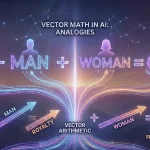
- The vector relationship king – man + woman might closely equal the vector for queen
- Images of cats, regardless of breed or angle, will cluster in one region, while dog images cluster in another.
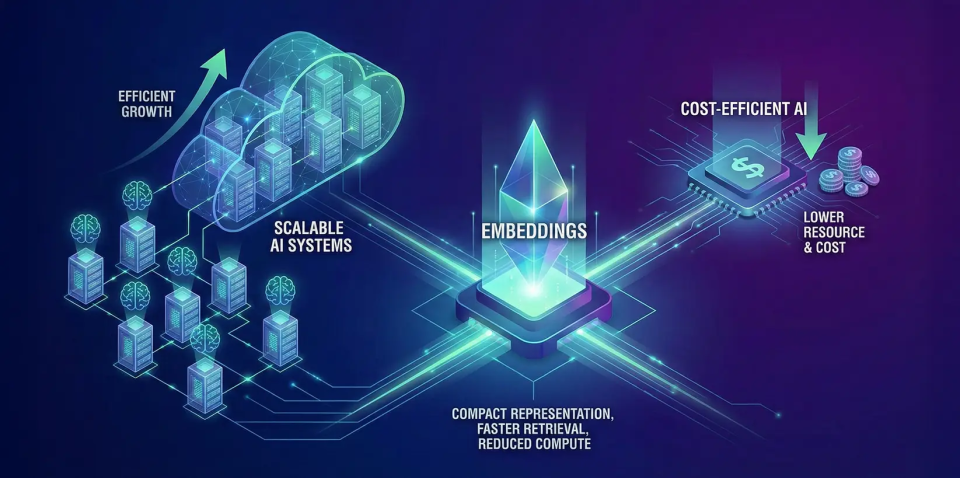
This spatial arrangement means the vectors themselves encode meaning, context, and relationships. Embeddings achieve dimensionality reduction, taking incredibly complex, high-dimensional raw data and distilling it into a dense, meaningful representation that is efficient for machines to process and compare.
Why Vectors Are Crucial for AI
The power of vectors in AI stems from their ability to translate the messy, analog human world into the precise, mathematical world of computers.
| Key Reason | Description |
|---|---|
| Universal Data Representation | Vectors provide a standardized way to represent virtually any type of information. Whether it’s the sentiment of a customer review, the features of an image, or the pitch of an audio clip, vectors can encode it. |
| Understanding Relationships | In a well-designed vector space, data points that are semantically similar or related will be positioned closer to each other. This proximity allows AI models to infer meaning and relationships that would otherwise be invisible. |
| Enabling Complex Operations | Once data is vectorized, algorithms can perform mathematical operations like calculating distances, similarities, and patterns. This forms the backbone for advanced AI functionalities, from content personalization and improved search to sophisticated recommendation engines and generative AI. |
How AI Uses This Language to Learn & Understand
Once data is expressed in this vector language, AI models can perform tasks by leveraging a simple yet powerful principle: vector similarity. Models calculate the distance between vectors (e.g., using cosine similarity) to determine how alike they are. This ability to measure semantic closeness is what allows AI to power intelligent search, personalized experiences, and nuanced content moderation. It’s the practical outcome of teaching machines to speak in vectors.
| Application | How Vector Language is Used |
|---|---|
| Semantic Search & NLP | Your query is converted into a vector. The system finds and ranks documents whose vector representations are closest to your query’s vector, going beyond keyword matching to understand intent. Word embeddings (a specialized type of vector) capture semantic meaning, enabling AI to understand context, translate languages, analyze sentiment, and power chatbots and search engines. |
| Recommendation Systems | A user’s past behavior (clicks, views) forms a “user vector.” This vector is compared to “item vectors” (for products, movies, articles) to find the closest matches and suggest relevant content. Services like Netflix or Amazon use vectors to represent user preferences and compare them against movies or products, suggesting items you’re likely to enjoy. |
| Customer Support Chatbots | A customer’s question is embedded. The bot searches a knowledge base of pre-embedded answers to find the vector with the highest similarity, retrieving the most contextually appropriate response. |
| Image Recognition | An input image is converted to a vector. This vector is compared against a database of labeled image vectors to identify the object, scene, or person. Vectors represent the pixels and features of images, enabling AI to identify objects, recognize faces, and power self-driving cars. |
| Beyond (Fraud Detection, Research, etc. | Vectors provide the framework for AI to analyze complex datasets and make intelligent decisions in fields like finance and healthcare. |
Harnessing the Power of Vectors
At Webmap Network, we are at the forefront of leveraging vector-based AI solutions to drive innovation for our clients. We understand that turning raw data into actionable insights requires a deep comprehension of how machines “think.” Our expertise in designing and implementing vector-powered systems allows us to build intelligent solutions that:
- Enhance Data Analysis: By transforming your disparate data into coherent vector spaces, we unlock deeper insights and predictive capabilities.
- Personalize User Experiences: We create highly customized recommendation engines and intelligent search functionalities that resonate with your users.
- Streamline Operations: From automating complex classification tasks to optimizing information retrieval, our vector-based AI solutions boost efficiency across your organization.
We empower businesses to not just adapt to the AI revolution, but to lead it, by building bespoke solutions that translate your unique challenges into vector-solvable problems.
Building a Future in Vector Space
Vectors and embeddings are more than just mathematical curiosities; they are the foundational language that allows AI to interpret, reason, and interact with human-generated data. By transforming our world into a numerical landscape where distance equals relevance, we unlock unprecedented capabilities in automation, insight, and user experience. As AI continues to evolve, a clear understanding of vectors will remain paramount for anyone seeking to build and deploy truly intelligent systems.
At Webmap, we specialize in architecting and implementing intelligent solutions built on this very principle. From designing sophisticated embedding models to building scalable vector search systems, we help businesses speak the language of the future. We’re excited to partner with you to navigate this vector-powered future, creating smarter, more intuitive, and highly effective AI solutions tailored to your specific needs.
Ready to translate your data challenges into AI-powered solutions? Let’s discuss how vector technology can transform your operations. Reach out to our team for further discussions, custom solution development, and service inquiries.
Contact us at: connect@webmap.network