Find Out More :
Explore the Knowledge of "#SemanticSearch" !
Liquid Context (Elastic Embeddings): When Meaning in AI Becomes Fluid
In most AI systems today, meaning is treated as something fixed. A word, concept, or idea is represented by a single vector in a high-dimensional mathematical space. But real conversations don’t work that way. Meaning constantly shifts depending on context, previous sentences, tone, and surrounding information. This is where a new research direction called Liquid … Continue reading “Liquid Context (Elastic Embeddings): When Meaning in AI Becomes Fluid”


The “Map of Everything”: A Layman’s Guide to Embeddings
Imagine you walk into a giant invisible warehouse. This warehouse is enormous. Inside it, every idea, word, image, concept, emotion, object, and memory exists as a tiny floating spark of light. There is a spark for: Every concept you can think of has its own spark somewhere in this space. But the real magic isn’t … Continue reading “The “Map of Everything”: A Layman’s Guide to Embeddings”

Mapping the AI Mind: How Semantic Geodesics Are Redefining Machine Reasoning
Introduction The way artificial intelligence understands the world is undergoing a fascinating re-evaluation. Researchers and engineers are moving beyond the idea of flat data storage to map the actual “currents” of meaning inside AI embedding spaces. This concept, known as semantic geodesics, explores the non-linear pathfinding models use to connect entirely unrelated concepts. From the … Continue reading “Mapping the AI Mind: How Semantic Geodesics Are Redefining Machine Reasoning”

Sparse vs Dense: The Embedding Architecture Debate of 2026
In 2026, one debate dominates AI retrieval systems: Sparse vs Dense Embeddings. But here’s the real twist. It’s no longer about choosing one. It’s about designing hybrid architectures that combine both. To understand why this matters, let’s break it down simply. What Are Sparse Embeddings? Sparse embeddings are keyword-focused representations. They rely heavily on: If … Continue reading “Sparse vs Dense: The Embedding Architecture Debate of 2026”

From Tokens to Documents: The Layers of Embedding Intelligence
Embeddings are how AI understands meaning. But not all embeddings are the same. Some work at the word level.Some at the sentence level.Some represent entire documents. Understanding these layers is important because the type of embedding you use directly impacts how well your AI system performs. Think of embeddings like zoom levels on a camera. … Continue reading “From Tokens to Documents: The Layers of Embedding Intelligence”

Next-Gen Multilingual & Universal Embeddings
How AI Is Learning to Understand the World in 100+ Languages As AI systems expand globally, language diversity has become one of the biggest barriers to true intelligence. Traditional NLP models struggled outside a handful of high-resource languages, forcing developers to build separate pipelines for each region.Next-generation multilingual and universal embeddings are changing that paradigm. … Continue reading “Next-Gen Multilingual & Universal Embeddings”

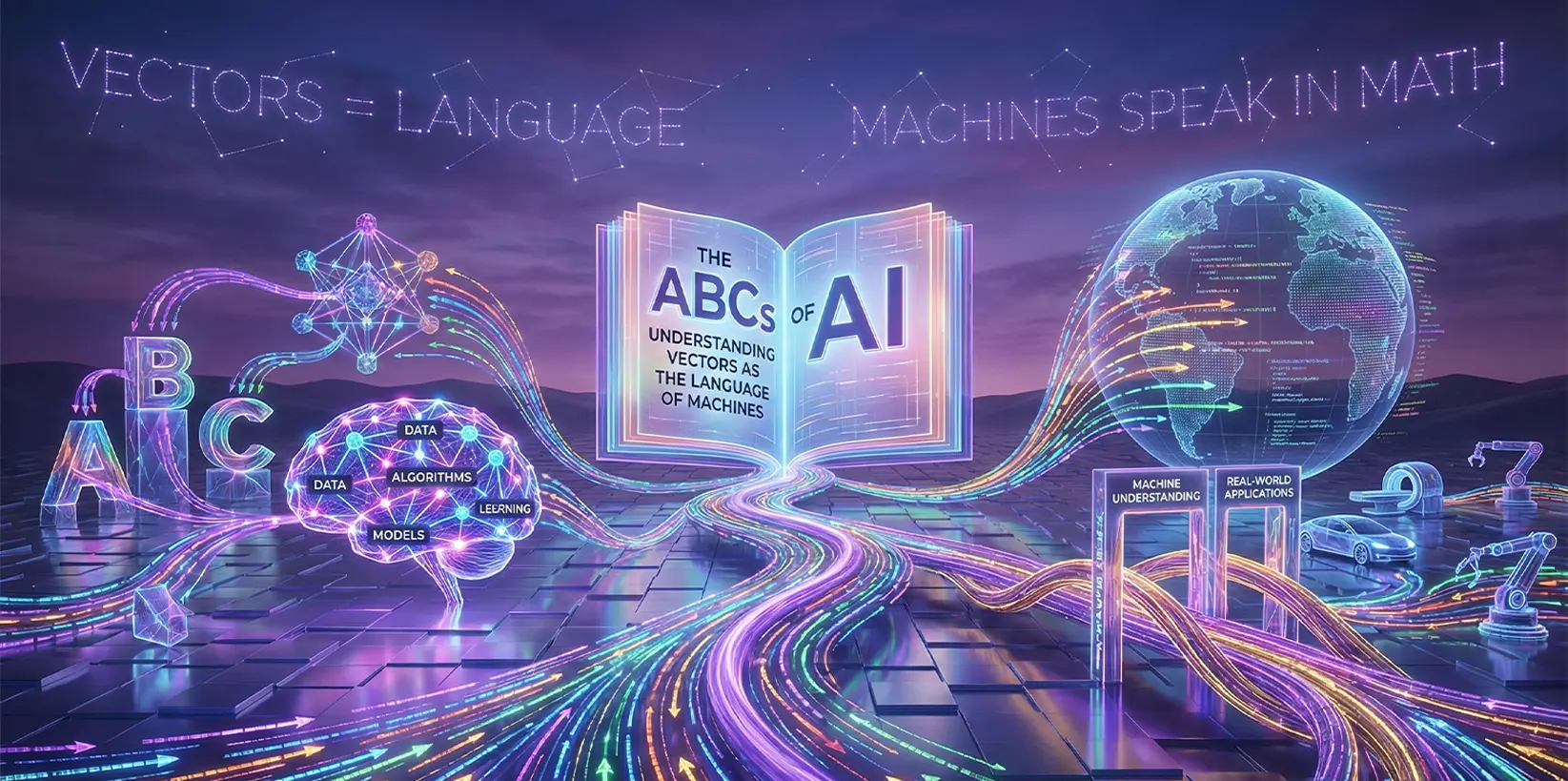
The ABCs of AI: Understanding Vectors as the Language of Machines
At Webmap Network, we believe in demystifying the complex world of Artificial Intelligence to help businesses truly harness its transformative power. While AI often conjures images of advanced robots or intricate algorithms, its foundational strength lies in elegant mathematical concepts. Today, we’re diving into one such cornerstone: vectors, the silent language that enables machines to … Continue reading “The ABCs of AI: Understanding Vectors as the Language of Machines”