Mapping the AI Mind: How Semantic Geodesics Are Redefining Machine Reasoning

Introduction
The way artificial intelligence understands the world is undergoing a fascinating re-evaluation. Researchers and engineers are moving beyond the idea of flat data storage to map the actual “currents” of meaning inside AI embedding spaces. This concept, known as semantic geodesics, explores the non-linear pathfinding models use to connect entirely unrelated concepts.
From the perspective of WebMap Network observations, this development matters right now because it holds the key to solving AI hallucinations and improving contextual reasoning. As enterprises feed massive volumes of unstructured data into their systems, understanding how an AI travels from point A to point B is no longer just an academic exercise… it is a business necessity for deploying reliable AI agents.
The Anatomy of Semantic Pathfinding
What the Development Is
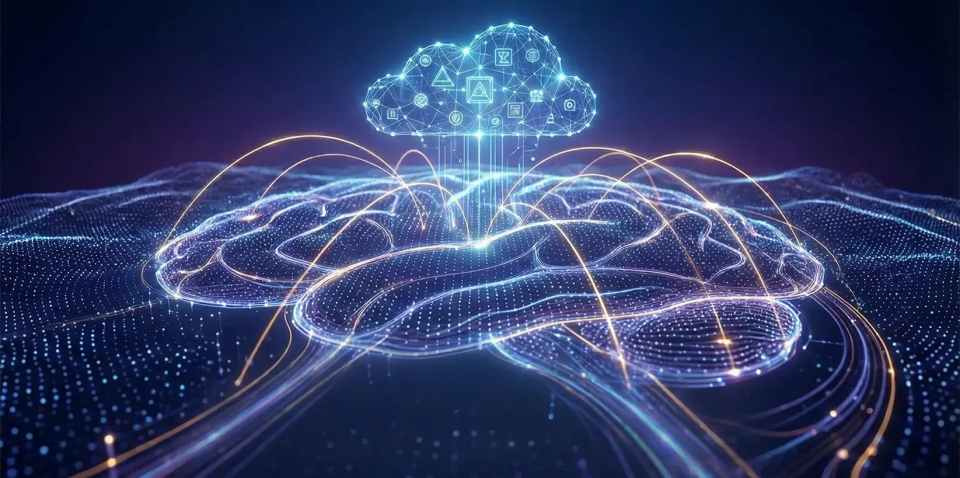
In traditional computing, data is stored in flat, Euclidean structures where the shortest distance between two points is a straight line. However, modern AI embedding spaces are highly complex, curved manifolds. If you draw a straight mathematical line between the concept of an “Apple” and the concept of “Justice” in this space, the line often passes through empty, meaningless void space, resulting in AI hallucinations.
Semantic geodesics represent the “scenic route.” Instead of a straight line, the AI follows the high-density bridges of human knowledge. The path naturally flows along a curve of meaning: Apple … Fruit … Knowledge … Law … Justice. This traces the geodesic flow, mirroring how human cognition connects disparate dots.
Why It Is Important
This non-linear pathfinding is crucial for AI interpretability. When we study the geodesic flow, we are essentially mapping the natural currents of meaning that a model has built during training. It allows developers to see exactly how an AI arrived at a specific conclusion. If an AI agent gives an unexpected answer, tracing its semantic geodesic reveals whether it took a logical bridge or fell into a data void.
Industry or Market Impact
The enterprise AI sector is heavily impacted by this understanding, particularly in the realm of Retrieval-Augmented Generation (RAG). Systems that rely on simple keyword matching or flat vector searches often miss the nuance of complex queries. By optimizing for semantic geodesics, AI tools can navigate vast corporate knowledge bases more accurately, retrieving documents that answer the true intent of a prompt rather than just matching its vocabulary.
India and Global Implications
On a global scale, semantic geodesics explain why AI models behave differently across cultures. The “scenic route” from one concept to another changes based on the linguistic and cultural data the model ingested. For the Indian tech ecosystem, which operates across multiple languages and deep cultural contexts, mapping these high-density bridges is vital for building localized, culturally aware AI systems that reason natively rather than just translating Western logic.
Future Outlook
The future of AI infrastructure will heavily involve tools that visualize and manipulate these semantic pathways. We will likely see a shift from merely training models to actively pruning and shaping their embedding manifolds, ensuring that the natural currents of meaning align with factual accuracy and enterprise security guidelines.
Analysis Section
WebMap Network Insights
At WebMap Network, our observations indicate that the mastery of semantic geodesics is what separates passive data storage from active intelligence. When an intelligent ingestion engine processes thousands of web pages and documents, it is essentially building a localized embedding space.
Trends and Long-Term Meaning
The trend is moving rapidly toward multi-model orchestration. Different Large Language Models (LLMs) map their semantic spaces differently. One model might take a direct, highly technical path between two concepts, while another takes a creative, abstract route. The long-term meaning of this is that the most powerful AI platforms will be those that can preserve context while switching between these different geodesic “maps”… allowing users to leverage the best pathfinding strategy for their specific query.
Conclusion
The exploration of semantic geodesics proves that the shortest path is not always the smartest. As we continue to map the curved spaces of AI cognition, we unlock the ability to build systems that reason with the depth, context, and nuance of the human mind.