Why Enterprises Need Knowledge Bases, Not File Storage

For years, enterprises have focused on storing data. The idea was simple the more files you save, the more knowledge your organization has. Companies invested in storage systems, cloud drives, and document management tools to keep everything सुरक्षित and accessible. But today, this approach is starting to show its limitations. Even though organizations have more data than ever before, they still struggle to find answers quickly, make decisions efficiently, and use their information effectively. This raises an important question: if companies already have so much data, why does it still feel so difficult to use it?
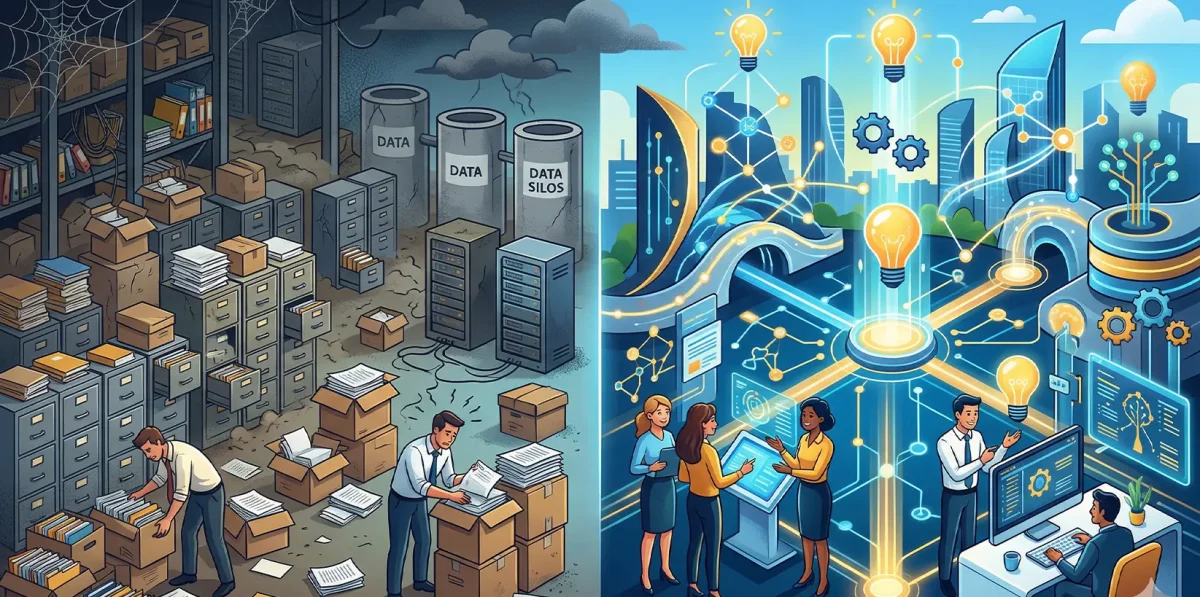
The answer lies in the difference between storing information and understanding it. File storage systems are designed to keep data, not to organize meaning. When a document is uploaded, it simply sits in a folder, waiting to be opened. A report may contain valuable insights, but unless someone reads and interprets it, that value remains hidden. Over time, as more files are added, the system becomes cluttered. Information gets scattered across multiple locations, and finding the right piece of data becomes time-consuming. This creates a situation where data exists, but knowledge does not.
In the past, this was manageable because the volume of data was limited. Employees could manually search, read, and connect information when needed. But in today’s environment, the scale has changed. Enterprises deal with thousands of documents, reports, spreadsheets, and datasets. Manually going through them is no longer practical. Even with AI tools, the problem continues if the data is not structured properly. When raw files are directly used, AI often struggles to understand context, leading to incomplete or inconsistent outputs. This is where traditional file storage begins to break down.
To solve this, enterprises need to move from storing files to building knowledge systems. A knowledge base does not just keep documents; it processes and organizes them. Information is extracted, structured, and connected in a way that machines can understand. Relationships between data points are created, context is preserved, and everything becomes searchable in a meaningful way. Instead of opening multiple files and trying to piece together information, users can directly access clear and relevant answers. The system does not just store data, it understands it.
This shift becomes even more important in the age of AI. Modern workflows require fast, accurate, and context-aware responses. Teams cannot afford to spend hours searching for information or verifying scattered data. They need systems that can instantly provide insights based on structured knowledge. When data is organized properly, AI can retrieve precise information instead of guessing. This improves decision-making, reduces errors, and saves time. The focus moves from managing data to using it effectively.
Another important aspect is how knowledge systems change the way people work. In a file-based approach, employees depend heavily on manual effort searching, reading, and interpreting. In a knowledge-based system, much of this effort is reduced. The system does the heavy lifting by organizing and connecting information. This allows teams to focus more on analysis, strategy, and execution rather than searching for data. Productivity improves not because people work harder, but because the system works smarter.
To understand this better, think of file storage as a warehouse and a knowledge base as a smart system inside that warehouse. In a warehouse, everything is stored, but finding a specific item can take time. In a smart system, every item is labeled, connected, and instantly accessible. The difference is not in the quantity of items, but in how they are organized and used. This is exactly the shift enterprises need to make.
Looking ahead, the role of data in organizations will continue to evolve. Companies that rely only on file storage will face increasing complexity and slower workflows. On the other hand, those that adopt knowledge-based systems will gain speed, clarity, and better decision-making capabilities. The future is not about having more data, but about having systems that can understand and use that data effectively.
This is where structured AI systems like Webmap come into the picture. Instead of treating data as isolated files, Webmap focuses on building a continuous knowledge flow. By organizing information, maintaining context, and allowing interaction across multiple AI models, it helps enterprises move beyond storage and into true intelligence. It creates an environment where data is not just saved, but actively used to generate insights and drive decisions.In conclusion, file storage is no longer enough for modern enterprises. The real value lies in transforming data into structured knowledge that can be easily accessed and understood. As AI continues to grow, the importance of this shift will only increase. Because in the end, success is not about how much data you store… it’s about how effectively you turn that data into knowledge.