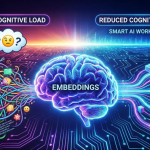
How Embeddings Teach AI the Concept of “Close Enough”


Artificial intelligence faces the challenge of bridging human concepts like similarity with machine-readable data. Embeddings serve as a powerful mechanism to teach AI the concept of “close enough” by transforming complex data into a measurable, semantic space.
1. The Challenge of Discrete Data
Before embeddings, methods like one-hot encoding were used to represent categorical data. This approach assigns a binary vector to each unique item, with a single ‘1’ indicating its presence. It leads to high-dimensional, sparse representations and fails to capture semantic relationships, meaning “apple” and “banana” are as equidistant as “apple” and “truck.”
2. What Are Embeddings?
An embedding is a numerical representation of data such as words, sentences, images, or user IDs-as a continuous vector of real numbers. This transformation projects high-dimensional, discrete data into a lower-dimensional, continuous vector space. The core principle is that semantically similar items will have embedding vectors positioned closer together in this space, while unrelated items will be farther apart.
2.1 One-Hot Encoding vs. Embeddings
| Feature | One-Hot Encoding | Embeddings |
|---|---|---|
| Representation | Sparse binary vectors | Dense continuous vectors of floating-point numbers |
| Dimensionality | High, equal to vocabulary size | Lower, fixed dimension |
| Semantic Meaning | None; all items are equidistant | Captures semantic relationships and similarities |
| Computational Cost | High for large vocabularies | More efficient due to dimensionality reduction |
| Example (“apple”) | [1, 0, 0, …] | [0.2, -1.5, 0.8, …] |
3. How Embeddings Learn “Close Enough”
Embeddings are created by deep learning models, typically neural networks, which learn representations from vast amounts of data. During training, the model adjusts vector values so that items with similar meanings or contexts are mapped to nearby points in the embedding space. For example, “apple” and “banana” become closer than “apple” and “car.”
The concept of “close enough” is quantified by measuring the distance or similarity between vectors using specific metrics.
3.1 Measuring Semantic Similarity
| Metric | Description | Interpretation |
|---|---|---|
| Cosine Similarity | Measures the cosine of the angle between two vectors | Values closer to 1 indicate higher similarity; values closer to -1 indicate dissimilarity. |
| Euclidean Distance | Measures the straight-line distance between two vector points | Smaller distances indicate higher similarity. |
This allows AI systems to determine semantic relatedness even without shared words, moving beyond simple keyword matching
4. The Impact and Applications of Embeddings
Embeddings are fundamental to modern AI, enabling understanding of context and relationships. They allow AI to “reason” about data by gauging conceptual closeness.
Key Applications:
- Semantic Search: Finds conceptually related documents, even with different language (e.g., “large canine pets” returns results about “big dogs”).
- Recommendation Systems: Recommends items “close enough” to a user’s past preferences.
- Clustering: Groups similar items based on semantic proximity.
- Natural Language Processing (NLP): Powers sentiment analysis, machine translation, and chatbots by understanding language nuances.
- Computer Vision: Enables identification of visually similar objects and image recognition.
- Multi-modal AI: Maps different data types (text, images, audio) into a shared vector space to find semantic connections across modalities.
Conclusion
Embeddings give AI a way to move beyond exact matches and rigid rules by introducing a notion that humans use naturally: close enough. By mapping data into a semantic space where distance reflects meaning, embeddings allow AI systems to recognize similarity, infer relationships, and generalize across unfamiliar inputs. This shift from discrete symbols to continuous understanding is what enables modern AI to search, recommend, cluster, and reason effectively. In essence, embeddings teach machines that intelligence is not about perfect matches, but about meaningful proximity. Ready to unlock the true potential of your data with AI solutions built on a foundation of deep understanding? Contact Webmap Network today to discuss how high-quality embeddings can transform your business. We’re here to guide you through further discussions, solution development, and understanding our services regarding this crucial topic.Email us at. connect@webmap.network