Why Embeddings Let AI Reuse Knowledge Instead of Recomputing It

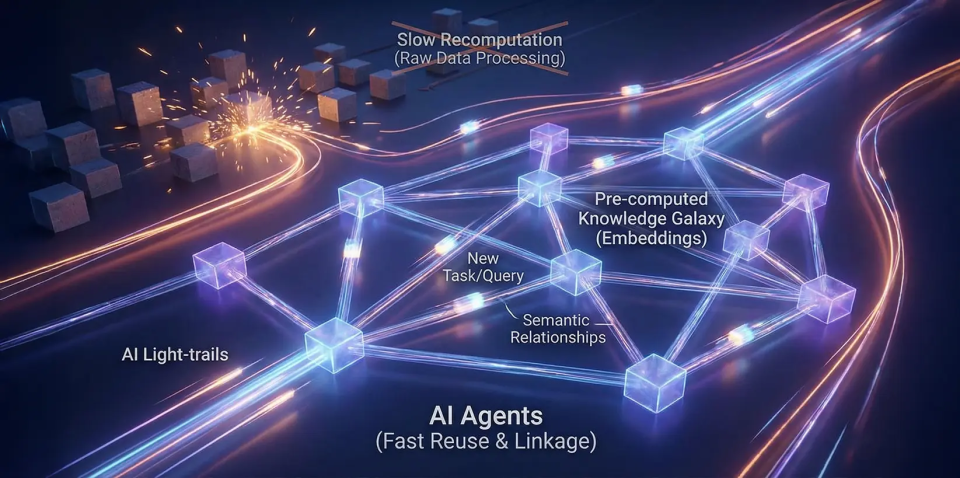
Artificial intelligence models leverage “embeddings” to store and reuse knowledge in a semantically rich format, significantly reducing the need to recompute understanding from scratch for every new task. This fundamental shift enhances AI’s capabilities, making models more efficient, scalable, and versatile.
1. What are Embeddings?
Embeddings are numerical representations of real-world objects or concepts, such as words, sentences, images, audio, or documents, in a continuous vector space. These vectors, crafted by machine learning models like deep neural networks, capture the inherent properties, relationships, and semantic meaning of the original data. For example, in natural language processing, words with similar meanings have embedding vectors that are mathematically “close” to each other, allowing AI models to understand semantic similarity rather than just exact word matches.
2. The Challenge of Recomputation in AI
Before embeddings, AI models faced significant challenges when processing raw, high-dimensional data for every new task.
| Challenge | Description |
|---|---|
| Computational Cost | Directly processing raw data (e.g., millions of pixels or thousands of words) for every operation is computationally expensive and time-consuming. |
| Data Sparsity | Raw data, especially text (e.g., one-hot encoding), can be sparse, making it harder for models to learn meaningful relationships. |
| Lack of Semantic Understanding | Traditional methods treated words or data points as isolated entities, failing to grasp nuanced relationships and contextual meaning. |
Without embeddings, an AI system performing a search would rely on keyword matching and wouldn’t inherently understand that “joyful” is similar to “happy” without explicit programming or re-analysis.
3. How Embeddings Enable Knowledge Reuse
Embeddings transform AI interaction with knowledge by providing a reusable, semantically rich format.
3.1 Semantic Representation and Contextual Understanding
Embeddings convert data into mathematical forms that capture semantic meaning and context. The position and proximity of vectors in multi-dimensional space reflect conceptual relationships, allowing AI to perform mathematical operations to infer knowledge (e.g., vector(“king”) – vector(“man”) + vector(“woman”) ≈ vector(“queen”)).
3.2 Dimensionality Reduction
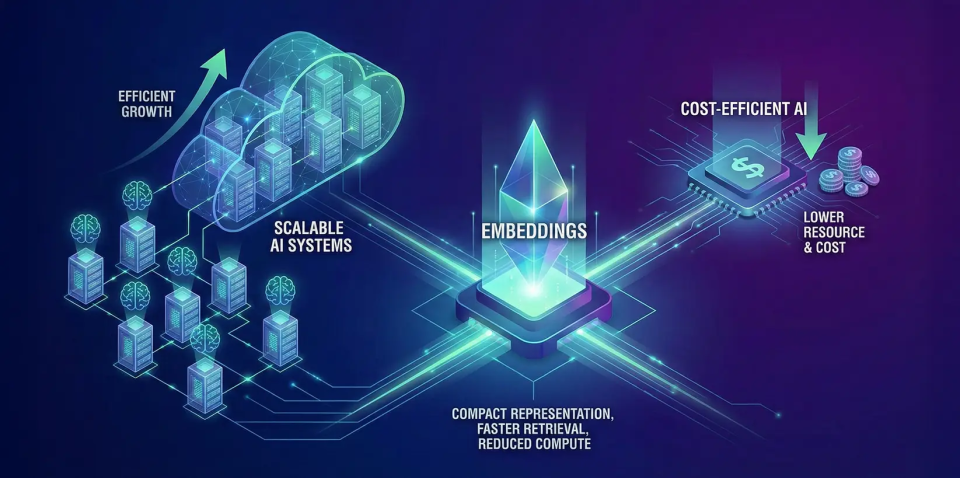
Embeddings reduce the dimensionality of complex data while preserving crucial information and relationships. They distill thousands of dimensions (like image pixels) into a manageable few hundred, identifying commonalities and patterns. This reduction drastically accelerates model training and decreases computational costs.
3.3 Transfer Learning and Reusability
Embeddings are reusable across different tasks and domains via transfer learning. Pre-trained on vast datasets, they capture generalized features that can be leveraged for new tasks without training from scratch.
- Word embeddings (like Word2Vec or GloVe) trained on general text can be reused for sentiment analysis or machine translation.
- Image embeddings (from models like ResNet) trained for object recognition can be fine-tuned for facial recognition.
This reuse saves immense time and computational resources
3.4 Computational Efficiency
By allowing knowledge reuse, embeddings dramatically improve AI efficiency. Instead of re-processing raw data for every query, models can look up or compare pre-computed embedding vectors. This is key in semantic search, where queries are converted to embeddings and matched against a database of pre-embedded documents.
3.5 Multimodal Embeddings
Modern multimodal embeddings encode different data typessuch as images, audio, and text into the same vector space. This enables AI to reason across modalities, connecting, for example, the word “cat” with an image of a cat, expanding the scope of knowledge reuse.
4. Embeddings in Practice
Embeddings are foundational to many modern AI applications.
| Application | How Embeddings are Used | Benefit |
|---|---|---|
| Semantic Search | Queries and documents are converted into embeddings. The engine finds documents with the closest embeddings to the query, ensuring semantically relevant results. | More accurate and context-aware information retrieval. |
| Recommendation Systems | User preferences and item features are embedded. The system suggests content by finding similar user or item embeddings. | Personalized and relevant suggestions. |
| Large Language Models (LLMs) | LLMs rely on embeddings to understand and represent words, sentences, and documents as vectors that encode meaning, serving as the “entry point to reasoning.” | Deep understanding of language and context. |
| Retrieval-Augmented Generation (RAG) | User queries are embedded to search for relevant documents in a vector database. Retrieved document chunks provide context for an LLM to generate informed responses. | Fresh, up-to-date information for LLMs without costly retraining. |
| Clustering and Classification | By embedding data, AI systems can group similar entities or categorize data points based on vector relationships. | Efficient organization and categorization of data. |
5. Embeddings vs. Recomputation: A Comparison
The distinction between leveraging pre-computed embeddings and recomputing knowledge highlights significant efficiency gains.
| Feature | Recomputing Knowledge (Traditional/Brute Force) | Reusing Knowledge via Embeddings |
|---|---|---|
| Process | Full processing and feature extraction for each new input/task. | One-time computation of embeddings, then reuse for various tasks. |
| Computational Cost | High, especially for complex or high-dimensional data. | Significantly lower for downstream tasks; cost is primarily during initial embedding generation. |
| Time | Slower due to repeated processing. | Faster for inference and new tasks due to pre-processed knowledge. |
| Knowledge Transfer | Limited; knowledge often task-specific. | High: pre-trained embeddings capture generalizable features, enabling transfer learning. |
| Scalability | Challenging to scale efficiently with increasing data and tasks. | Highly scalable, as embedding lookups and comparisons are efficient. |
| Flexibility | Less adaptable to new, unseen data or variations without retraining. | More flexible; can be fine-tuned with minimal data for domain-specific applications. |
| Semantic Understanding | Often limited to superficial patterns or explicit rules. | Captures deep semantic relationships and contextual meaning. |
6. Conclusion
Embeddings represent a paradigm shift in how AI systems acquire, represent, and utilize knowledge. By transforming complex raw data into dense, semantically meaningful vectors, embeddings enable AI to store knowledge in a reusable format. This prevents costly recomputation for every new task. Through dimensionality reduction, transfer learning, and efficient semantic search, embeddings empower AI models to be more efficient, adaptable, and intelligent.Contact WebmapNetwork today to discuss how high-quality embeddings can transform your business. We’re here to guide you through further discussions, solution development, and understanding our services regarding this crucial topic.Email us at connect@webmap.network.