Vector Space Alignment: Making Different Embedding Models Speak the Same Language

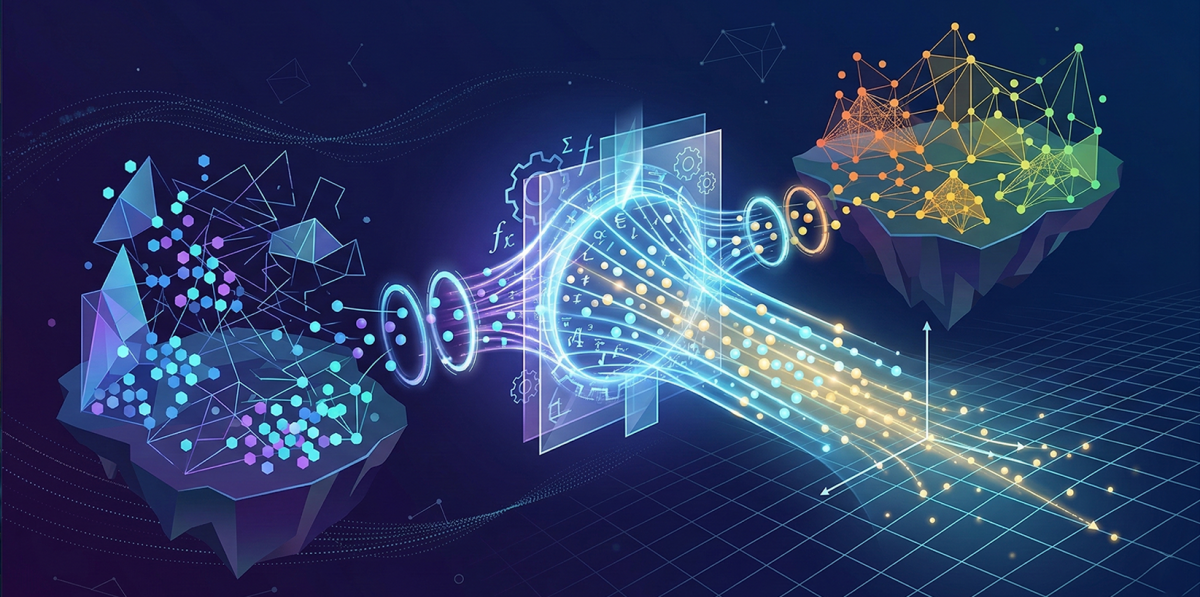
Today, every AI model builds its own embedding space.
OpenAI builds one geometry.
Cohere builds another.
Llama builds its own.
Even if they embed the same word
the coordinates are completely different.
Same meaning.
Different mathematical universe.
So the question becomes:
Instead of retraining everything,
can we mathematically align these spaces?
Welcome to:
Embedding Alignment Across Modalities (Cross-Space Mapping).
The Core Problem: Same Word, Different Coordinates
Imagine three translators.
Each translates the word “Freedom” into numbers.
But:
- Translator A uses 1536 numbers
- Translator B uses 1024 numbers
- Translator C uses 768 numbers
Even if they understand the word correctly,
their coordinate systems are different.
You cannot directly compare them.
It’s like:
- One map uses latitude/longitude
- Another uses grid blocks
- Another uses landmarks
Without conversion, maps are incompatible.
Everyday Analogy: Different City Maps
Imagine Mumbai drawn by three different artists:
- One rotates the map 30 degrees.
- One stretches it horizontally.
- One compresses it vertically.
The city is the same.
But the coordinates don’t match.
Embedding alignment tries to rotate and stretch one map
so it matches another perfectly.
What Is Vector Space Alignment?
Vector space alignment is the process of:
Mapping vectors from Space A
into Space B
Without losing semantic relationships.
We don’t retrain the model.
We learn a transformation function.
A mathematical bridge.
The Procrustes Transformation
One popular technique is called:
Procrustes Transformation
It sounds complex, but the idea is simple.
Imagine you have:
Two sets of dots.
They represent the same concepts,
but one set is rotated and scaled.
Procrustes finds:
- The best rotation
- The best scaling
- The best alignment
So the two sets overlap as closely as possible.
It’s like solving a puzzle by rotating one piece
until it fits.
Table: Retraining vs Alignment
| Approach | What It Does | Cost | Flexibility |
|---|---|---|---|
| Retraining Model | Build a new embedding system | Very High | Low |
| Fine-Tuning | Adjust existing model | Medium | Moderate |
| Space Alignment | Map spaces mathematically | Low | High |
Alignment is efficient.
It preserves existing infrastructure.
Shared Latent Manifold Construction
Now let’s go deeper.
Instead of only mapping A → B,
Researchers are building:
A shared latent manifold.
Think of it like:
Instead of translating Hindi to English directly,
We translate both into a universal language.
Then everything becomes compatible.
This shared manifold acts as:
A neutral meeting ground
for multiple embedding systems.
Why This Matters in 2026
AI ecosystems are becoming multi-model.
Enterprises use:
- Different providers
- Different embedding APIs
- Different architectures
But vector databases need consistency.
Without alignment:
- You cannot merge datasets
- You cannot switch providers easily
- You face vendor lock-in
- You duplicate infrastructure
Alignment enables interoperability.
Cross-Modal Alignment
Even beyond text models:
Different embedding types (text, image, audio)
can be aligned mathematically.
Not for multimodal apps
But for geometric compatibility.
The goal is:
Preserve structure
while transforming coordinates.
Everyday Analogy: Currency Conversion
Think of embeddings as currencies.
- Dollar
- Rupee
- Euro
Each has value.
But you need exchange rates.
Alignment is the exchange rate for vector space.
It allows:
Value comparison without rebuilding economies.
Technical Insight
Alignment methods often involve:
- Linear transformations (matrix multiplication)
- Orthogonal rotations
- Dimensional reduction or expansion
- Contrastive mapping
The key constraint:
Preserve neighborhood relationships.
If “Dog” is close to “Cat” before alignment,
it must stay close after mapping.
Meaning must survive transformation.
The Hard Challenges
Alignment becomes difficult when:
- Dimensions differ significantly
- Training data distributions vary
- Models capture meaning differently
- Non-linear distortions exist
Sometimes simple rotation is not enough.
Advanced methods use:
- Neural mapping layers
- Non-linear manifold matching
- Distribution normalization
But the goal remains the same:
Geometry compatibility without retraining.
The Strategic Insight
Embedding alignment is infrastructure research.
It’s not flashy. But it’s foundational.
Instead of building bigger models,
We connect existing ones.
Instead of retraining,
We rotate.
Instead of replacing,
We align.
This reduces:
- Cost
- Compute
- Data duplication
- Vendor dependency
Alignment makes AI modular.
Final Thoughts
Every embedding model builds its own universe.
Its own geometry.
Its own structure.
Its own mathematical personality.
Today, these universes exist separately.
But the future of AI depends on bridges.
Vector space alignment is not just a technical trick.
It is interoperability at the geometric level.
It allows different models
to speak the same mathematical language.
Because intelligence at scale
is not about isolated systems.
It is about connected ones. And in 2026, The most powerful AI systems may not be the biggest They may be the best aligned.
To explore advanced embedding architectures and interoperable AI infrastructure systems, connect with WebmapNetwork.