Hyperbolic Embeddings: Modeling Hierarchies Beyond Euclidean Space

Most embeddings today live in flat space.
Flat like a table.
Flat like a sheet of paper.
But hierarchies are not flat.
Family trees, knowledge graphs, taxonomies they grow like branches.
And flat geometry struggles to fit branches efficiently.
This is where hyperbolic embeddings come in.
Why Euclidean Space Struggles With Hierarchy
In normal (Euclidean) space: Distance grows linearly.
If you move 1 step, distance increases by 1.
Move 2 steps, distance increases by 2.
Simple.
But hierarchies grow differently.
Everyday Analogy: Family Tree Explosion
Imagine:
- 1 grandparent
- 2 parents
- 4 children
- 8 grandchildren
- 16 great-grandchildren
The number doubles at every level.
That’s exponential growth.
Flat space is not designed for exponential structures.
It starts to:
- Crowd points together
- Distort distances
- Lose clarity in deep branches
Enter Hyperbolic Space (Curved Geometry)
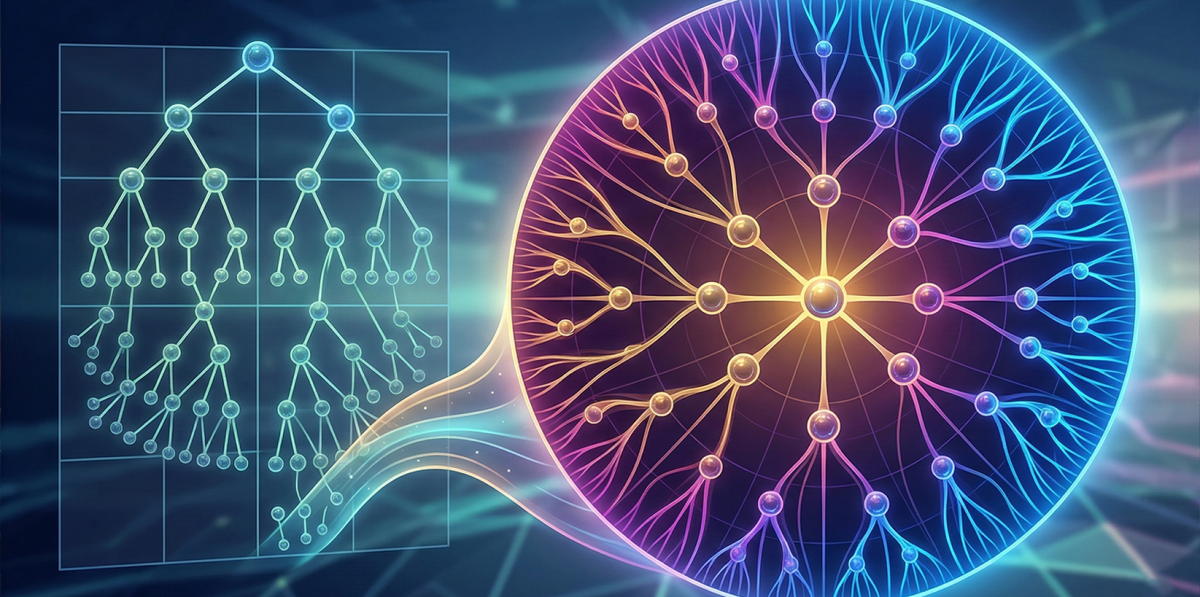
Hyperbolic space is curved outward.
One popular model is called the Poincare disk.
Imagine a circle.
Everything lives inside it.
Near the center:
Space is small.
Near the edges:
Space expands dramatically.
Distances grow faster and faster as you move outward.
Everyday Analogy: Expanding Mall
Imagine a shopping mall.
At the entrance, space is limited.
But as you go deeper, corridors keep branching and expanding.
The deeper you go, the more space becomes available.
That’s hyperbolic geometry.
It naturally supports branching growth.
Why Hierarchies Fit Hyperbolic Space
Let’s take a knowledge graph:
Animal
→ Mammal
→ Dog
→ Labrador
Each level is more specific.
In hyperbolic space:
- General concepts stay near the center.
- Specific concepts move toward the edge.
Because space expands near the edge,
We can place many specialized nodes without crowding.
It mirrors tree structure perfectly.
What Are Poincare Embeddings?
Poincare embeddings are vectors placed inside a hyperbolic disk.
Instead of measuring straight-line distance (like flat space),
They measure distance in curved space.
This allows:
- Compact representation of deep hierarchies
- Better separation of branches
- Efficient storage of tree structures
Curvature-Controlled Vector Geometry
Curvature is the key idea.
Flat space → zero curvature
Sphere → positive curvature
Hyperbolic space → negative curvature
Negative curvature means: Space expands exponentially.
Researchers in 2026 are exploring:
- Controlling curvature strength
- Mixing flat and curved layers
- Learning curvature automatically
Instead of increasing dimensions,
we change geometry.
Euclidean vs Hyperbolic Embeddings
| Feature | Euclidean Space | Hyperbolic Space |
|---|---|---|
| Structure Fit | Best for clusters | Best for trees |
| Distance Growth | Linear | Exponential |
| Hierarchy Depth | Hard to scale | Natural scaling |
| Space Efficiency | Limited for trees | Highly efficient |
Flat space is good for grouping.
Curved space is good for branching.
Why This Matters in 2026
Modern AI systems depend on:
- Knowledge graphs
- Taxonomies
- Ontologies
- Organizational structures
- Semantic hierarchies
These are all tree-like.
Using flat embeddings for tree data is like: Trying to plant a forest on a dinner plate.
Hyperbolic geometry gives the forest room to grow.
Gravity Wells in Hyperbolic Space
In hyperbolic space:
- Central nodes act like anchors
- Branches spread outward
- Subcategories form natural layers
General ideas like:
“Entity”
“Object”
“Concept”
Stay near the center.
Specific ideas move outward.
The geometry itself encodes importance and abstraction level.
Efficiency Advantage
One powerful benefit:
Hyperbolic embeddings can represent deep hierarchies
with fewer dimensions.
Instead of increasing vector size,
we bend space.
That means:
- Lower compute
- Better structure
- Cleaner hierarchy separation
Geometry becomes the optimization tool.
Strategic Insight
Embedding research is shifting from: “Bigger vectors” to “Better geometry”
Hyperbolic embeddings show that: Sometimes the solution is not scaling models.
It’s redesigning space.
This opens doors for:
- Better knowledge graph AI
- Ontology-aware retrieval
- Structured reasoning systems
- Sovereign knowledge infrastructure
Final Thoughts
Hierarchy is not flat.
Knowledge is not linear.
Meaning branches.
So embeddings should too.
Hyperbolic geometry reminds us that
space defines structure.
When we move from flat vectors
to curved manifolds,
We stop forcing trees onto tables.
We let them grow naturally.
In 2026 and beyond, the future of semantic intelligence may not be about increasing dimension It may be about bending space intelligently. Because sometimes, the smartest way to scale AI is not to go bigger but to go curved.
To explore next-generation embedding architectures and geometric AI infrastructure systems, connect with WebmapNetwork.