Vector Entropy and “Semantic Decay”: When Meaning Slowly Fades

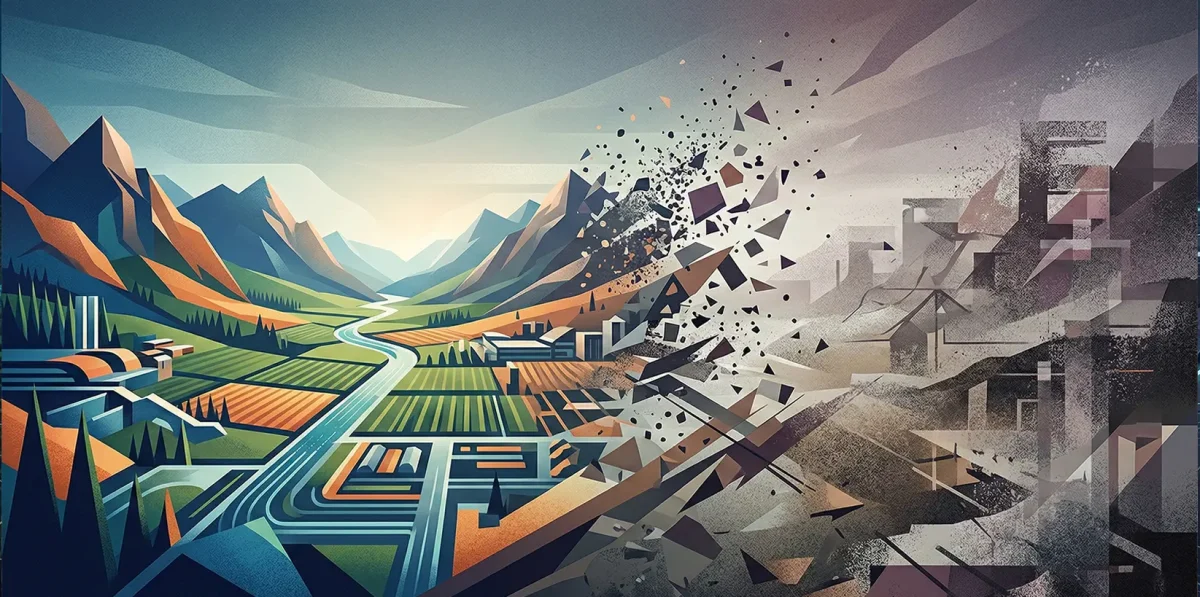
Embeddings are supposed to capture meaning clearly.
But what happens when a vector is:
- Compressed
- Translated across models
- Quantized
- Distilled
- Passed through multiple layers
Does it stay the same?
Or does it slowly lose its sharpness?
Welcome to the idea of:
Vector Entropy and Semantic Decay.
What Is Semantic Decay?
Imagine the word:
Blue
In an embedding space, “Blue” is a precise point.
It carries:
- Color meaning
- Emotional tone
- Cultural associations
- Context from training data
Now imagine we repeatedly:
- Compress the vector
- Translate it into another model
- Reduce its dimensions
- Pass it through summarization layers
After enough steps…
“Blue” might not feel so blue anymore.
It may drift toward:
- Grey
- Cool
- Calm
- Neutral
That slow loss of purity is called semantic decay.
Everyday Analogy: Photocopy of a Photocopy
Take a sharp printed image.
Now photocopy it.
Then photocopy the copy.
Then repeat 10 times.
What happens?
- Edges blur.
- Details fade.
- Contrast reduces.
The image still exists.
But clarity is gone.
Vectors behave the same way.
What Is Vector Entropy?
Entropy means disorder.
In embeddings, vector entropy means:
The uncertainty or spread of meaning inside a vector.
A sharp vector:
- Has clear neighbors.
- Has strong direction.
- Has high semantic contrast.
A high-entropy vector:
- Is more spread out.
- Is less distinguishable.
- Has a weaker identity.
It becomes semantically “noisy.”
The Half-Life of a Vector
In physics, radioactive material has a half-life.
After some time, half its strength is gone.
We can imagine something similar for embeddings:
After how many transformations does a vector lose 50% of its semantic precision?
This is the idea of a vector half-life.
Information Bottleneck Theory
Information bottleneck theory says:
When information passes through a narrow channel,
some of it is lost.
Everyday Analogy: Water Through a Pipe
If you push a large volume of water through a thin pipe:
- Pressure increases.
- Flow reduces.
- Some detail in the stream is lost.
When we compress a vector:
- Reduce dimensions
- Quantize precision
- Distill knowledge
We create a bottleneck.
Some semantic information is removed.
Where Semantic Decay Happens
Semantic decay appears in:
1️] Model Compression
Reducing vector size from 1536 → 512 dimensions.
Less space = less detail.
2️] Cross-Model Translation
Mapping vectors between embedding systems.
Small distortions accumulate.
3️] Quantization
Reducing precision from 32-bit to 8-bit numbers.
Small rounding errors change position slightly.
4️] Iterative Summarization
Embedding → generate → re-embed → repeat.
Each loop introduces drift.
The “Blue to Grey” Effect
Let’s imagine:
Original vector = Pure Blue
After compression → Slightly muted blue
After translation → Blue with grey tone
After quantization → Neutral cool shade
After repeated processing → Grey
Not completely wrong.
But not pure either.
Meaning doesn’t disappear suddenly.
It fades gradually.
Why This Matters for AI Systems
If vectors decay:
- Retrieval accuracy drops
- Similarity ranking shifts
- Semantic clustering weakens
- Hallucination risk increases
Systems relying on repeated embedding transformations may slowly degrade without anyone noticing.
Decay is silent.
Measuring Semantic Sharpness
We can estimate vector purity by analyzing:
- Cosine similarity stability over transformations
- Neighborhood consistency
- Distance drift from original vector
- Variance increase after compression
If a vector’s nearest neighbors change significantly after processing, decay has occurred.
The Balance Between Efficiency and Purity
Modern AI systems aim to:
- Reduce compute cost
- Compress models
- Enable edge deployment
- Improve speed
But every optimization introduces potential entropy.
The key question becomes:
How much meaning can we afford to lose?
Not all compression is harmful.
But uncontrolled decay is dangerous.
The Strategic Insight
Vectors are not permanent objects.
They are dynamic representations.
Every transformation:
- Rotates them
- Shrinks them
- Rounds them
- Distorts them
Over time, identity weakens.
The future of embedding research may include:
- Vector stability metrics
- Decay detection systems
- Entropy-aware embedding pipelines
- Regeneration layers to restore sharpness
Because in large AI infrastructures, vectors travel long journeys.
And long journeys change things.
Final Thoughts
Embeddings feel precise.
But they are fragile.
Pass them through enough layers,
compress them enough times,
translate them across enough systems
and meaning begins to soften.
Not suddenly.
Not dramatically.
But gradually.
Like a photograph fading under sunlight.
Vector entropy reminds us:
Efficiency has a cost.
Compression has a price.
Optimization reshapes identity.
The future of intelligent systems will not only depend on creating powerful embeddings but on preserving their purity over time.
Because when “Blue” becomes “Grey,”
It is not just color that changes. It is meaning itself.
To explore how advanced embedding architectures maintain semantic stability across complex AI pipelines, To explore more visit WebmapNetwork or connect with us at connect@webmap.network.