Cross-Model “Shadow” Projections: Building a Rosetta Stone for Vector Spaces

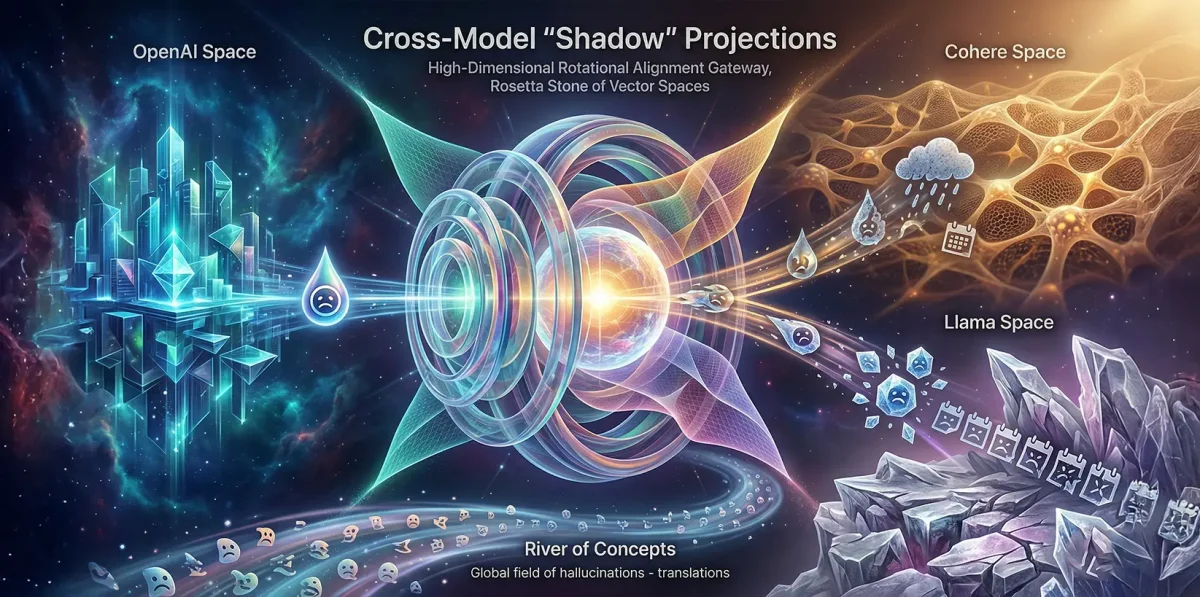
Today, every AI model has its own embedding space.
Think of embedding space as a mathematical universe.
- OpenAI has one universe.
- Cohere has another.
- Llama has its own version.
Each model arranges meaning differently.
Same words.
Different geometry.
This creates a big question:
If we take a concept from one model and “teleport” it into another…
Will it mean the same thing?
Welcome to the world of Cross-Model Shadow Projections.
Every Model Has a Different Personality
Even if two models understand the word “Melancholy,”
they may store it differently.
Why?
Because:
- They are trained on different data.
- They use different architectures.
- They optimize different objectives.
- They shape space differently.
Everyday Analogy: Different City Maps
Imagine three different maps of the same city:
- One map shows metro routes.
- One shows tourist attractions.
- One shows traffic roads.
The city is the same.
But the layout looks different.
Embedding spaces work the same way.
What Happens When You Teleport a Vector?
Let’s say:
In Model A, the vector for “Melancholy” lives near:
- Sadness
- Poetry
- Winter
Now we directly insert those same numbers into Model B.
What might happen?
It could land near:
- Rain
- Tuesday
- Grey sky
Or something even stranger.
Because Model B’s space is structured differently.
Same coordinates.
Different universe.
The Rosetta Stone Problem
In history, the Rosetta Stone helped translate between languages.
Now we need something similar for embeddings.
A system that can:
- Translate vectors from Model A
- Into Model B
- Without losing meaning
This is called:
Manifold Alignment
What Is Manifold Alignment?
Imagine two transparent sheets.
On both sheets, dots represent concepts.
But the sheets are rotated differently.
If you stack them randomly, dots don’t match.
But if you rotate one sheet carefully…
Suddenly:
- “Cat” aligns with “Cat”
- “Love” aligns with “Love”
- “Melancholy” aligns with “Melancholy”
Manifold alignment is the process of rotating and stretching one embedding space so it matches another.
High-Dimensional Rotation
In 3D, we rotate objects easily.
In 1000 dimensions?
Rotation is mathematical, not physical.
But the idea is the same:
We try to find a transformation matrix that maps:
Vector_A → Vector_B
Without breaking semantic relationships.
It’s like solving a giant geometric puzzle.
Why Distortions Happen
If alignment is imperfect:
- Concepts shift slightly.
- Neighbors change.
- Meanings drift.
This creates “shadow projections.”
A concept does not land exactly where it should.
It lands in the shadow of something similar.
Everyday Analogy: Google Translate Errors
You translate a sentence from Hindi to English and back.
It’s close.
But not perfect.
Small distortions appear.
Cross-model projections create similar distortions.
Why This Matters
Today, many companies use multiple embedding providers.
But their vector spaces are incompatible.
That means:
- You cannot mix embeddings easily.
- You cannot switch providers smoothly.
- You cannot share vector databases across systems.
Without alignment, every model lives in its own isolated universe.
Practical Challenges
To build a “vector Rosetta Stone,” we must solve:
1️] Dimensional mismatch (768 vs 1024 vs 1536 dimensions)
2] Different training data distributions
3] Different optimization goals
4] Non-linear distortions
Simple rotation may not be enough.
Sometimes we need:
- Non-linear mapping
- Neural alignment layers
- Contrastive cross-model training
The Risk of Teleportation
If alignment is weak:
- Retrieval accuracy drops.
- Meaning shifts subtly.
- Hallucination risk increases.
- Trust decreases.
Imagine migrating your entire vector database
from one provider to another
and your search results feel “slightly off.”
That is cross-model shadow distortion.
The Big Opportunity
If we solve cross-model alignment:
- Vector portability becomes possible.
- Vendor lock-in reduces.
- National AI infrastructure becomes flexible.
- Public and private systems interoperate.
Embedding universes become connected.
Instead of isolated planets,
we get a multiverse bridge.
Final Thoughts
Every embedding model builds its own mathematical world.
Its own geometry.
Its own structure.
Its own personality.
Today, these worlds exist separately.
But the future of AI infrastructure depends on interoperability.
If we can build a Rosetta Stone for vector spaces,
we unlock:
- Cross-model compatibility
- Seamless migration
- Multi-model orchestration
- True AI ecosystem flexibility
Because in the end, intelligence is not just about creating meaning. It is about translating meaning across systems. And the next frontier of embeddings may not be about building bigger spaces but about connecting them. To explore how advanced embedding systems enable cross-model interoperability and intelligent orchestration, To explore more visit WebmapNetwork or connect with us at connect@webmap.network.