The “Topography of Silence”: Mapping Embedding Voids in High-Dimensional Space

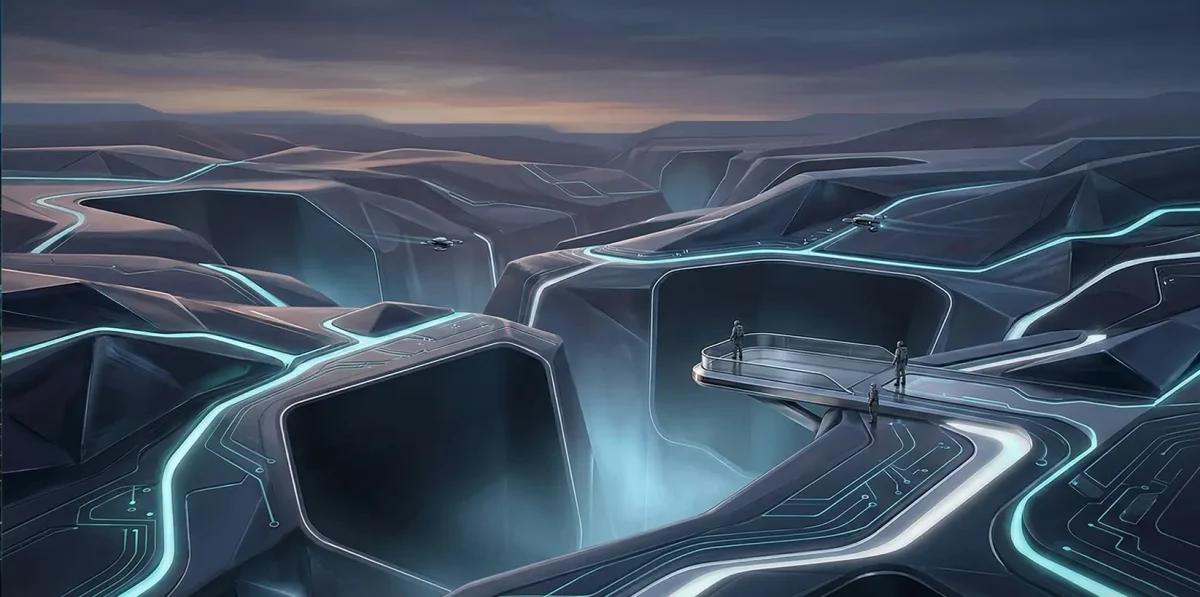
When we talk about embeddings, we focus on points.
Words.
Concepts.
Vectors.
But sometimes, what matters most is not the points.
It’s the empty space between them.
Welcome to the Topography of Silence the vast, uninhabited regions of embedding space where no data exists.
The Hidden Landscape of Embeddings
An embedding model maps language into high-dimensional geometry.
Every concept becomes a coordinate.
“Doctor” lives somewhere.
“Mountain” lives somewhere else.
“Quantum mechanics” occupies its own region.
Clusters form.
Neighborhoods emerge.
But between those neighborhoods?
There are voids.
Large, silent regions of vector space where no training data has ever lived.
Everyday Analogy: Cities and Deserts
Imagine Earth at night from space.
You see bright clusters cities.
But most of the planet is dark.
Oceans.
Deserts.
Uninhabited land.
Embedding spaces are similar.
Clusters are cities of meaning.
Voids are semantic deserts.
What Is a Vector Void?
A vector void is a region in high-dimensional space where:
- No real training examples exist
- No semantic cluster forms
- No meaningful data density appears
These are not random errors.
They are natural consequences of how language occupies space.
Models do not fill the entire geometric universe.
They populate only the regions defined by human knowledge.
Everything else remains empty.
Why Distance Matters More Than Points
In high-dimensional spaces:
- Most of the volume lies far from clusters
- Density drops sharply at boundaries
- Isolation dominates
Often, the structure of knowledge is better understood by studying:
- The gaps
- The boundaries
- The density transitions
Not just the clusters themselves.
This is the geometry of absence.
The Conceptual Cliff
Between two dense semantic clusters, there may be:
- A gradual slope
- Or a sudden drop
When density shifts abruptly, we get what we can call:
A conceptual cliff.
Everyday Analogy: Mountain Edges
Imagine walking in a city (dense cluster).
Then suddenly, you reach the edge of a canyon.
One more step and you’re in empty space.
Embedding spaces contain similar cliffs.
These cliffs separate:
- Disciplines
- Cultural concepts
- Languages
- Knowledge domains
They define where meaning stops.
Force-Rendering the Middle of Nowhere
Now here’s the creative experiment:
What happens if we take a vector from deep inside a void and force the model to render it?
Generate an image.
Generate text.
Generate sound.
What does semantic emptiness look like?
Likely outcomes:
- Abstract noise
- Blended, incoherent features
- Hybrid artifacts
- Unstable outputs
Because the model has no learned gravity in that region.
It tries to interpolate from distant clusters.
It guesses.
Void vectors expose the edges of understanding.
Negative Space as Knowledge Boundary
Artists understand negative space.
In a painting, the empty area defines the subject.
Similarly, embedding voids define:
- What the model has not seen
- What it cannot interpolate confidently
- Where knowledge is sparse
Studying voids reveals:
- Underrepresented languages
- Missing cultural narratives
- Biased data coverage
- Blind spots in training corpora
The absence becomes diagnostic.
Boundary Density Analysis
One way to detect conceptual cliffs is by analyzing:
- Local vector density
- Distance distribution
- Neighborhood variance
- Gradient shifts in similarity
Dense clusters have:
- High local neighbor concentration
- Smooth similarity gradients
Void boundaries show:
- Rapid density drop
- Sharp changes in nearest-neighbor structure
Mapping these density transitions gives us:
A topographic map of meaning.
The Curse and Power of Silence
High-dimensional space naturally contains enormous empty volume.
This is linked to the geometry of dimensionality:
As dimensions grow:
- Most volume lies far from populated clusters
- The interior of clusters becomes statistically tiny
That means:
Human knowledge occupies a very small fraction of possible semantic space.
Everything else is silence.
Why This Matters for AI Design
Understanding embedding voids helps in:
- Detecting hallucination risk
- Identifying dataset bias
- Improving retrieval robustness
- Designing better anomaly detection
- Mapping knowledge gaps
When a query lands near a void:
Generation becomes unstable.
Retrieval becomes weak.
Confidence should drop.
Voids are warning signals.
Strategic Insight
Most AI optimization focuses on:
- Improving clusters
- Tightening neighborhoods
- Increasing alignment
But equally important is:
Mapping emptiness.
Because:
Where models are silent, they are vulnerable.
Where density collapses, hallucination begins.
Where no data exists, imagination fills the gap.
Understanding the topography of silence allows us to:
- Quantify uncertainty
- Improve trust calibration
- Design safer systems
Final Thoughts
Embeddings are not just maps of meaning.
They are maps of absence.
Between every cluster lies a vast semantic wilderness.
In high-dimensional space:
Most of the universe is empty.
Most directions lead nowhere.
Most coordinates have never been inhabited by data.
And that is not a weakness. It is a truth about knowledge itself. Human understanding occupies only small islands in a much larger mathematical ocean. AI models reflect that reality. The future of embedding research may not only be about building denser cities of meaning. It may be about charting the deserts between them. Because before we expand intelligence, we must first understand the silence that surrounds it.
To explore how advanced embedding architectures map both meaning and absence, visit WebmapNetwork or connect with us at connect@webmap.network.