
Find Out More :
Explore the Knowledge of "#AIResearch" !
From Search to Understanding: Why AI Is Replacing Traditional Research Methods
Introduction For years, research has followed a simple process: Search → Read → Compare → Understand Students type a query into a search engine, open multiple links, read through articles, and try to combine information into something meaningful. But today, this process is changing. Artificial intelligence is shifting research from finding information to understanding information … Continue reading “From Search to Understanding: Why AI Is Replacing Traditional Research Methods”
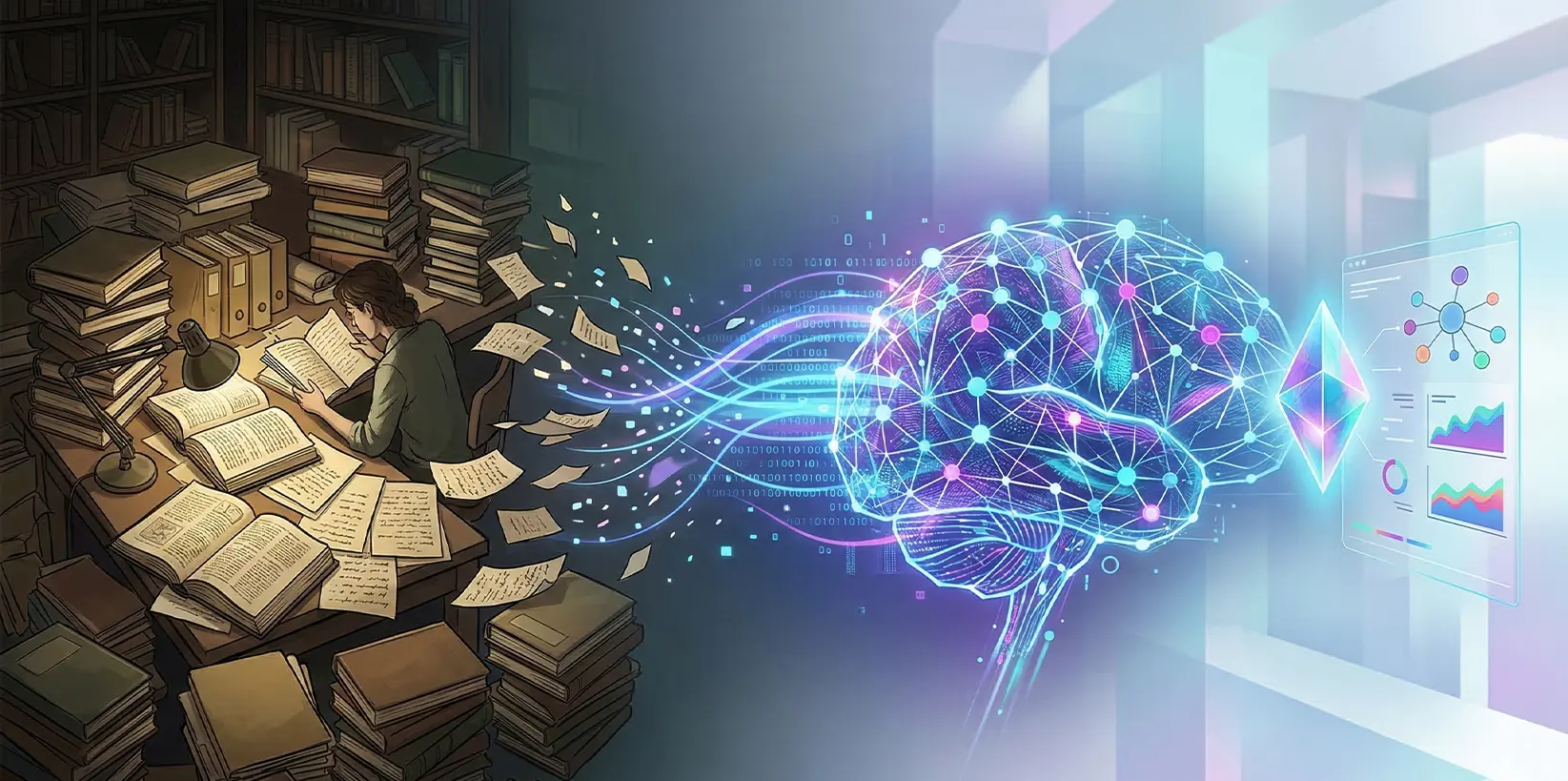

From Dusty Archives to Digital Brains: Reinventing University Knowledge with AI
The Hidden Treasure Inside Universities Universities have always been centers of knowledge creation. Every year they produce research papers, lecture notes, policy documents, dissertations, administrative reports, and countless academic resources. Over decades, this content grows into an enormous archive of institutional knowledge. However, despite its value, much of this information quietly sits inside servers, digital … Continue reading “From Dusty Archives to Digital Brains: Reinventing University Knowledge with AI”

The Next Generation Research Assistant: AI That Thinks Across Models
Introduction Research has always been one of the most important skills in education. Students constantly search for information, read articles, compare ideas, and organize insights into assignments or research papers. However, modern research comes with a new challenge: too much information and too many tools. Students often switch between search engines, research databases, and multiple … Continue reading “The Next Generation Research Assistant: AI That Thinks Across Models”

Non-Euclidean Emotional Manifolds: When Meaning Lives in Curved Space
Most embedding systems use flat geometry. Like a flat sheet of paper. But what if meaning doesn’t actually live on a flat surface? What if emotions, hierarchies, and relationships naturally exist in curved space? Welcome to: Non-Euclidean Emotional Manifolds. What Is Flat (Euclidean) Space? Euclidean space is normal geometry. The type we learn in school: … Continue reading “Non-Euclidean Emotional Manifolds: When Meaning Lives in Curved Space”

Adversarial Latent Camouflage: Hiding Meaning in Plain Sight
In embedding space, every word or concept becomes a vector. A list of numbers. Those numbers define: But what if we slightly modify a vector… So that in 999 dimensions it looks completely normal, But in the 1000th dimension, it secretly represents something else? Welcome to: Adversarial Latent Camouflage. This is steganographybut for vector space. … Continue reading “Adversarial Latent Camouflage: Hiding Meaning in Plain Sight”

The “Topography of Silence”: Mapping Embedding Voids in High-Dimensional Space
When we talk about embeddings, we focus on points. Words.Concepts.Vectors. But sometimes, what matters most is not the points. It’s the empty space between them. Welcome to the Topography of Silence the vast, uninhabited regions of embedding space where no data exists. The Hidden Landscape of Embeddings An embedding model maps language into high-dimensional geometry. … Continue reading “The “Topography of Silence”: Mapping Embedding Voids in High-Dimensional Space”
High-Dimensional “Mirages”: The Geometry of Isolation in Embedding Spaces
In 3D space, most lines are not perpendicular. In 1000-dimensional space? Almost every random pair of vectors is nearly at 90°. This is one of the strangest truths of embedding geometry. And it leads to a powerful idea: In high-dimensional spaces, every concept is almost an island. Welcome to the Geometry of Isolation. The Orthogonality … Continue reading “High-Dimensional “Mirages”: The Geometry of Isolation in Embedding Spaces”