The Intelligence Spectrum: Why One AI Model Is Never Enough

We are living in a time where AI can answer almost everything, from debugging code to proposing a strategy for running a campaign.
But here is a question we don’t ask often enough: do all AI models think the same way?
Not really.
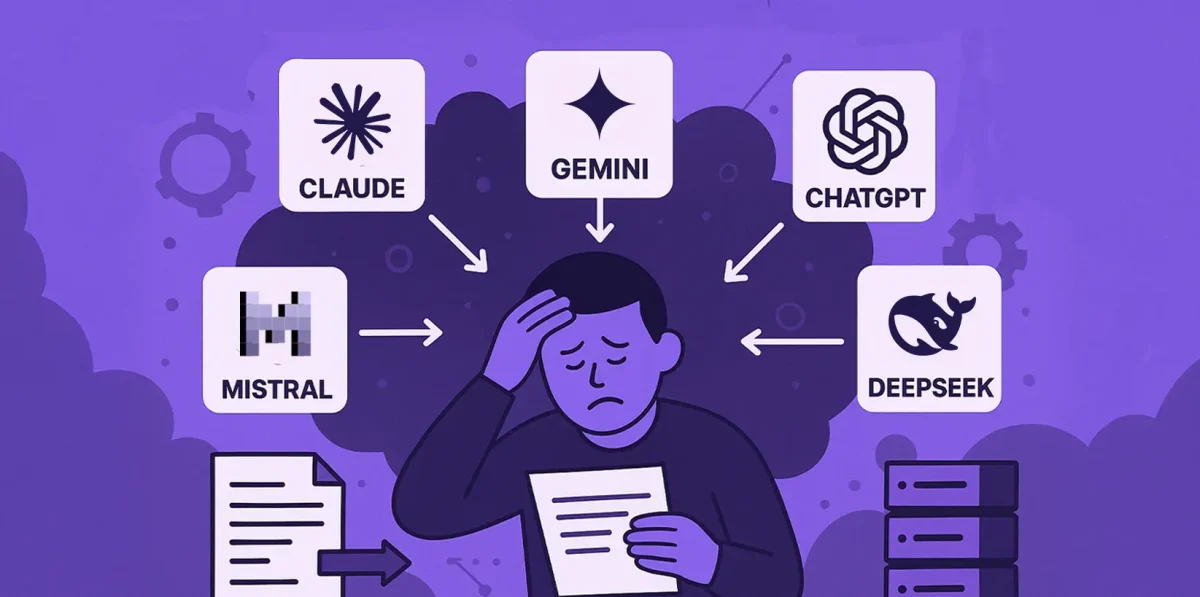
Every model is slightly different; ChatGPT, Gemini, Claude, Deepseek, or Grok all have their unique way of thinking.
Some are analytical and structured, while others are creative, conversational, or intuitive.
Each brings a different strength to the table.
That diversity is what we call “The Intelligence Spectrum” and it’s exactly what Webmap’s ‘Modality’ is built to unlock.
The Problem: One Model Cannot Fulfill All Requirements
Think of it this way: you are in a room with five brilliant experts.
You ask each the same question.
They all give good answers, but from completely different angles.
That’s what happens in AI, too.
- ChatGPT provides structure, context, and clarity.
- Gemini digs deeper into data and factual relationships.
- Claude shines with emotional intelligence and long-form reasoning.
- Deepseek explores unconventional, creative directions.
- Grok cuts to the chase: fast, sharp summaries with humor and brevity.
So, what happens when you rely on just one?
You are cut off from the rest of the spectrum the broader intelligence that only comes into view when these perspectives come together.
Enter Webmap: The Engine That Makes It Possible
Before Modality came into play, Webmap was already doing something quietly revolutionary: making data “smarter.”
Here’s how:
1. Sourcing: Webmap scans and collects information from your website, sitemap, or files with the use of tools such as sitemap scan, spider scan, and path scan.
Every detail counts and Webmap ensures it’s captured directly from reliable sources.
2. Structuring: Then it organizes and analyzes your data through meta and performance analysis, converting raw information into clean, AI-ready formats.
3. Extract: Webmap transforms structured data into pages and documentation that large language models can actually comprehend.
4. RAG: This is where your data transforms into knowledge.
Webmap builds a knowledge base so you can create AI agents that respond, reference, and reason using your own verified data.
And all that power flows seamlessly into Modality now.
Modality: The Bridge Between Minds
Modality is the place where a number of AI models finally sit under one roof in one workspace.
Ask once for something.
See how each model interprets it differently.
Compare their reasoning, tone, and logic side by side.
It’s like hosting a roundtable with five unique experts and watching the conversation unfold in real time.
You no longer have to change tabs, tools, or platforms.
With Modality, you work in one view through the full range of AI intelligence from creativity to computation.
The result?
Smarter insights.
Balanced reasoning.
Smarter decisions.
Smarter Research Starts Here: Coming Soon
First and foremost, Webmap Modality is not just another chat tool.
It’s your multi-intelligence research assistant, powered by multiple AI models and backed by your own structured data.
Soon you’ll be able to:
- Ask questions across ChatGPT, Gemini, Claude, Deepseek, and Grok.
- Check and compare answers instantly.
- Query your own information through the RAG system in Webmap.
- Build knowledge agents that learn directly from your data.
Because the future of AI isn’t ‘one brain doing everything; it’s many minds working together.
That’s the Intelligence Spectrum.
And that’s what Webmap Modality is designed to bridge.
Modality Webmap – Coming Soon
Where multi-model intelligence meets your data.
Follow @Webmap for updates about Modality and future AI innovations.