Personal Knowledge Graphs: AI That Maps Human Thinking

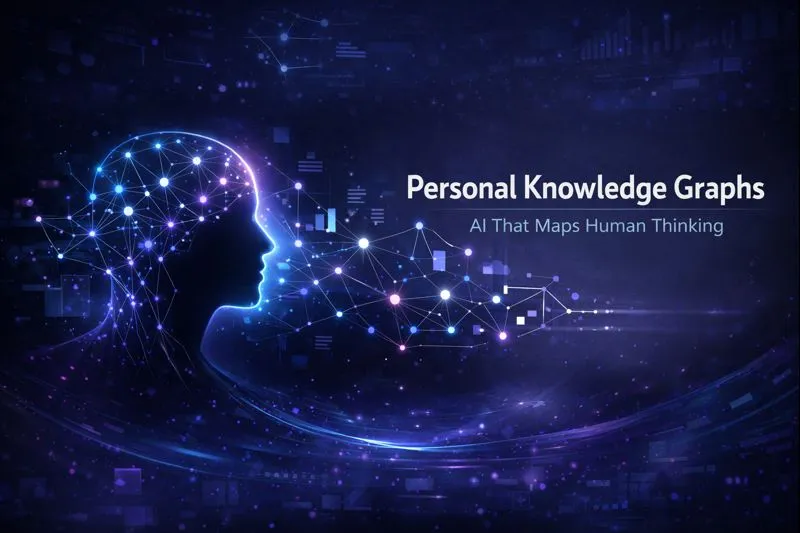
In an increasingly data-rich world, the ability to manage, connect, and derive insights from personal information is paramount. Personal Knowledge Graphs (PKGs) are emerging as transformative technology, providing an AI-powered approach to organize individual knowledge akin to human thought processes. These systems create a dynamic, interconnected web of ideas that enhances understanding, boosts creativity, and empowers individuals with greater control over their digital lives.
1. What is a Personal Knowledge Graph?
A personal knowledge graph is a specialized database that represents an individual’s information as a network of interconnected entities and their relationships. This structure allows for fluid and intuitive exploration of knowledge. The concept emphasizes the individual’s data, ensuring they retain control over their information. A defining characteristic is the use of “triples “combinations of subjects, predicates (relationships), and objects that create complex patterns and deeper meanings.
Table 1: Core Components of a Personal Knowledge Graph
| Component | Description | Example in a PKG |
|---|---|---|
| Nodes | Individual pieces of information, concepts, entities, or ideas. | “Python 3.12”, “React 18”, “Object-Oriented Programming”, “Meeting Notes” |
| Edges | Define the relationships between nodes, indicating their semantic links. | “Is-a-language”, “uses-framework”, “related to”, “attended by” |
| Attributes | Provide contextual details and metadata for nodes and edges, enriching the information. | Creation date, source URL, importance, description, version |
2. How Personal Knowledge Graphs Map Human Thinking
PKGs mirror the associative nature of human memory and cognition. Unlike rigid, isolated databases, human brains form intricate webs of interconnected memories. PKGs aim to replicate this non-linear structure, allowing users to engage in higher-level thinking and problem-solving analogous to human thought.
The term “Second Brain” describes PKGs as external memory systems that store key concepts and their relations, freeing individuals to concentrate on creativity and ideation. AI enhances mapping through natural language processing (NLP) and machine learning, reducing efforts and making research data more meaningful.
3. Benefits of Embracing Personal Knowledge Graphs
Adopting personal knowledge graphs offers numerous advantages for managing information, learning, and decision-making processes.
Table 2: Key Benefits of Personal Knowledge Graphs
| Benefit | Description |
|---|---|
| Improved Information Retrieval | Enables searching based on relationships and context rather than keywords, significantly reducing the time spent finding information. |
| Enhanced Learning & Creativity | Fosters discovery of hidden connections and patterns, enhancing understanding and sparking new ideas. |
| Better Decision Making | Provides a holistic view of interconnected data for more informed choices. |
| Data Sovereignty | Empowers individuals to own and control their personal data, managing access and usage. |
| Efficient Knowledge Management | Organizes information in a navigable structure, boosting productivity and fostering innovation. |
| Accelerated Data Discovery | Allows real-time traversal of relationships, cutting data discovery time significantly. |
| Improved Data Quality | Helps identify and correct inconsistencies by connecting related data points. |
| Streamlined Data Governance | Offers built-in lineage tracking, simplifying compliance requirements for regulated industries. |
4. Applications of Personal Knowledge Graphs
PKGs are versatile tools applicable in various personal and professional contexts.
Table 3: Common Applications of Personal Knowledge Graphs
| Application Area | Examples of Use Cases |
|---|---|
| Personal Productivity & Learning | Organizing notes, managing projects, tracking learning progress, and building a “second brain.” |
| Research & Content Creation | Connecting research papers, managing citations, and outlining articles or complex topics. |
| AI-Powered Assistants | Enabling personalized digital assistants for accurate recommendations and insights based on personal data. |
| Specialized Domains | Healthcare: Integrating clinical data and patient records. Finance: Personalized financial planning. Education: Customized learning paths. |
| Business & Enterprise (Individual Use) | Managing contacts, tracking market intelligence, and personal CRM. |
5. The Role of AI in PKGs
AI is fundamental to the efficiency and effectiveness of personal knowledge graphs, automating tasks such as extracting information and identifying entities. Integrated AI tools can organize content, perform semantic analysis, and even generate new topics. Technologies like Large Language Models (LLMs) are crucial for creating, summarizing, and enhancing the knowledge graph, making PKGs invaluable for ideation.
6. Challenges and Future Outlook
Despite their potential, PKGs face challenges in widespread adoption, including the need for more user-friendly tools and a consistent definition across the community. Ongoing advancements in AI-driven automation, visualization, and integration with data sources will pave the way for PKGs to play a more significant role in information management, transforming how we interact with knowledge.
Conclusion
Personal Knowledge Graphs represent a significant advancement in personal information management, transitioning from static data storage to dynamic, interconnected systems. By employing AI to enhance human thinking, PKGs empower individuals to gain unprecedented insight, creativity, and control over their digital lives. Connect with Webmap Network to explore how intelligent knowledge systems can transform the way information is structured, accessed, and used. We guide organizations and individuals through strategy, system design, and AI-powered knowledge solutions.Email us at: connect@webmap.network