From Static Vectors to Living Knowledge: The Evolution of Embeddings

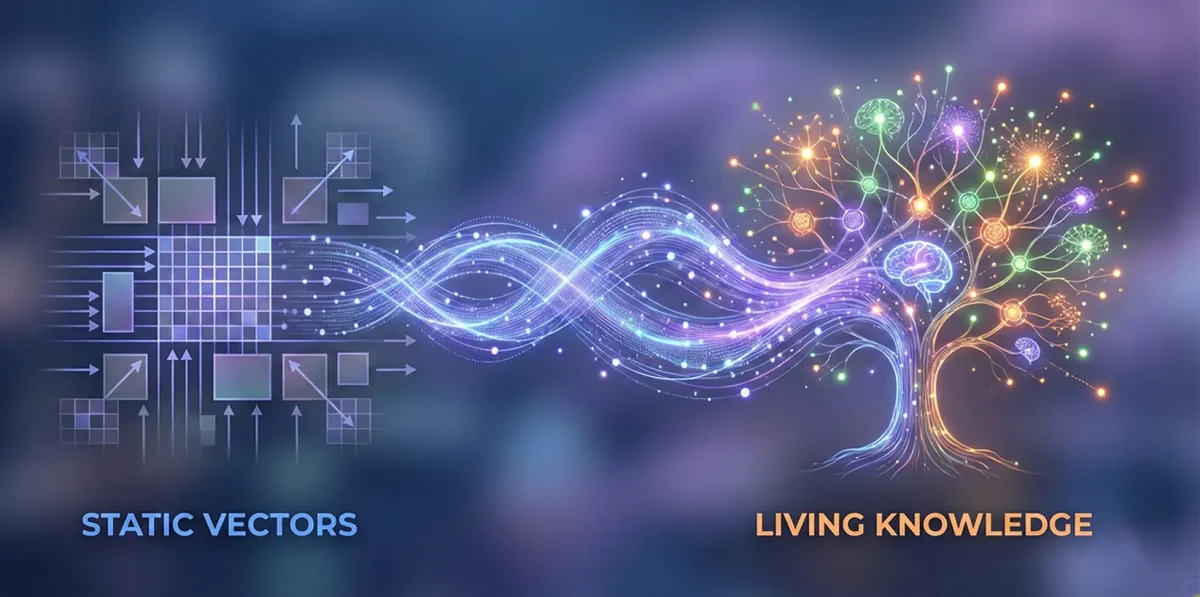
Embeddings are fundamental to modern artificial intelligence (AI), acting as the bridge between human-understandable data and machine-processable numerical representations. These numerical snapshots capture not just the presence of data, but its intrinsic meaning, relationships, and context. Their evolution has transformed AI systems, enabling them to move from rudimentary text processing to understanding complex language, images, and more.
1. The Dawn of Embeddings: Static Representations
The journey of embeddings began with static representations, where each word or token was assigned a single, fixed vector regardless of its context. These early methods primarily relied on statistical measures of word frequency and co-occurrence within a corpus.
1.1 Early Approaches: Frequency-Based Methods
Before the advent of neural networks for embeddings, methods like Count Vectorization and TF-IDF (Term Frequency-Inverse Document Frequency) were used to represent text.
- Count Vectorization: This is one of the simplest techniques, representing text based on the raw count of words.
- One-Hot Encoding: Another early approach where each word is represented by a unique binary vector, with a ‘1’ at the position corresponding to the word and ‘0’s elsewhere.
- TF-IDF: This method improves upon raw counts by weighing words based on their frequency in a document and their inverse frequency across the entire corpus, indicating a word’s importance.
While simple and efficient, these frequency-based methods largely ignored word order and deeper semantic meanings.
1.2 The Rise of Word Embeddings: Word2Vec, GloVe, and FastText
A significant transition came with models that could generate dense vector representations for words. These “prediction-based” embeddings learned to predict words from their neighbors, positioning words with similar contexts closer in the embedding space.
- Word2Vec (2013): Developed by Google, Word2Vec revolutionized NLP by representing words as dense vectors, capturing semantic relationships based on their co-occurrence patterns. It has two main architectures: Continuous Bag of Words (CBOW) and Skip-gram.
- GloVe (Global Vectors for Word Representation) (2014): Created by Stanford, GloVe combines global word co-occurrence statistics with local context information to generate word vectors.
- FastText: An extension of Word2Vec, FastText incorporates subword information, which allows it to generate better embeddings for rare and out-of-vocabulary words by representing words as bags of character n-grams.
These static embeddings were a breakthrough, allowing machines to perform mathematical operations on words and understand semantic relationships. However, a key limitation was their context-independence: the word “bank” would have the same vector whether it referred to a financial institution or a river’s edge.
2. The Contextual Revolution: Dynamic Embeddings
The inability of static embeddings to capture polysemy (words with multiple meanings) led to the development of contextual embeddings. These dynamic representations generate word vectors that adapt based on the surrounding text, providing a nuanced understanding of word meanings.
2.1 ELMo (Embeddings from Language Models) (2018)
ELMo marked a significant advancement by providing deep contextualized word representations. Unlike earlier models, ELMo uses bidirectional LSTMs to produce dynamic embeddings that change based on a sentence’s context, capturing both syntactic and semantic nuances.
2.2 BERT and the Transformer Era (2018 onwards)
The introduction of transformer-based architectures like BERT (Bidirectional Encoder Representations from Transformers) further revolutionized embeddings. BERT generates deep contextualized word embeddings by considering the relationships between words in an entire sentence bidirectionally. This allows for a much richer understanding of context.
| Feature | Static Embeddings (e.g., Word2Vec, GloVe) | Contextual Embeddings (e.g., ELMo, BERT, GPT) |
|---|---|---|
| Vector Assignment | Single, fixed vector per word | Multiple, dynamic vectors per word |
| Context Handling | Context-independent | Context-dependent |
| Polysemy | Cannot differentiate multiple meanings | Can differentiate multiple meanings |
| Computation | Less computationally intensive | More computationally intensive |
| Performance | Good for basic tasks | Better for complex NLP tasks |
3. Beyond Words: The Expansion of Embeddings
As AI models advanced, the concept of embeddings extended beyond individual words to encompass larger units of text, graphs, and even multiple data modalities.
3.1 Document and Sentence Embeddings
- Doc2Vec: An extension of Word2Vec, Doc2Vec generates fixed-length vectors representing entire documents or paragraphs, considering the semantic information of words within them.
- Sentence Embeddings: These embeddings represent each sentence as a numerical vector, capturing its overall meaning and context. This is particularly useful for longer sequences of text.
3.2 Knowledge Graph Embeddings (KGE)
Knowledge graphs represent entities and their relationships as a structured network. Knowledge graph embeddings transform these entities and relationships into continuous vector spaces while preserving their structural and semantic properties. This allows machines to understand and reason about relationships in a deeper way, facilitating tasks like link prediction, entity classification, and relationship inference. Examples include TransE, DistMult, and ComplEx.
3.3 Multimodal Embeddings
The latest frontier in embeddings involves integrating information from multiple data modalities, such as text, images, and audio, into a unified vector space. Multimodal embeddings translate diverse data types into a common representational format, enabling more effective cross-modal retrieval, analysis, and interaction. For instance, an image and its descriptive text can be represented as vectors that are close to each other in the embedding space, reflecting their semantic similarity.
| Embedding Type | Data Represented | Key Benefit | Example Models/Techniques |
|---|---|---|---|
| Word Embeddings | Individual words | Capture semantic relationships | Word2Vec, GloVe, FastText, ELMo, BERT |
| Document/Sentence | Sentences, paragraphs, documents | Summarize overall meaning and context | Doc2Vec, Universal Sentence Encoder |
| Knowledge Graph | Entities and relationships in graphs | Model structured knowledge and infer relationships | TransE, DistMult, ComplEx |
| Multimodal | Text, images, audio, video | Unify diverse data types in a shared space | CLIP (Contrastive Language-Image Pre-training) |
4. The Future of Embeddings: Living Knowledge
The future of embeddings is intrinsically linked to the ongoing evolution of AI. We can expect several key developments:
- Larger and Richer Embeddings: Embeddings are becoming larger to capture more intricate information, with models like GPT-4 using high-dimensional vectors to represent complex relationships.
- Unified Modalities: Embeddings are likely to become even more unified across different modalities, enabling seamless understanding and generation of content combining text, audio, and video.
- Real-time Adaptability: Future embeddings will be more adaptive to real-time data, enabling dynamic personalization in applications and more accurate semantic search systems.
- Enhanced Interpretability: While AI models are often considered “black boxes,” embeddings can offer insights into how models perceive data and their relationships, contributing to greater transparency and explainability in AI.
- Advanced Vector Databases: The increasing reliance on embeddings will drive advancements in vector databases, leading to more intuitive, intelligent, and integrated systems for efficient data representation, storage, and retrieval.
- Deepened Symbiotic Relationship with Generative AI: Embeddings are crucial for the growth of Generative AI (GenAI), particularly in applications like Retrieval Augmented Generation (RAG), by enabling efficient retrieval of relevant information from vast databases.
From their static origins to their current dynamic and multimodal forms, embeddings have transformed how machines interact with and understand the world. As AI continues its rapid advancement, embeddings will remain a cornerstone, bridging the gap between raw data and truly intelligent systems, pushing towards a future where AI can reason and interact with human-like understanding, creating “living knowledge” from mere vectors
Conclusion: From Numbers to Understanding
The evolution of embeddings mirrors the broader journey of artificial intelligence itself from rigid, rule-based systems to adaptive, context-aware intelligence. What began as simple frequency counts and static vectors has matured into rich, dynamic representations capable of capturing meaning, intent, relationships, and even cross-modal understanding. Each leap from TF-IDF to Word2Vec, from static word vectors to contextual transformers, and from text-only embeddings to multimodal and knowledge-graph representations has brought machines closer to understanding information the way humans do.
Today, embeddings are no longer just mathematical conveniences; they are the semantic backbone of modern AI systems. They power search engines that understand intent, recommendation systems that grasp preferences, and generative models that can reason, retrieve, and create with remarkable fluency. As embeddings grow more adaptive, interpretable, and interconnected across modalities, they are transforming static data into continuously evolving representations of knowledge.
Looking ahead, the concept of “living knowledge” is no longer abstract. With real-time learning, unified embeddings, and tight integration with generative AI and vector databases, embeddings will enable systems that not only store information but actively understand, reason over, and evolve with it. In this sense, embeddings are not just representing the world they are becoming the foundation through which AI learns to perceive, connect, and interact with it in increasingly human-like ways