How Embeddings Capture Meaning, Not Words

AI forgets. Embeddings remember That changes everything
Most people think AI “reads” text the way humans do word by word, sentence by sentence.
But that’s not how it works at all.
AI doesn’t understand words, it understands meaning.
And the key to that?
Embeddings.
The Problem With Literal Words
Words can be misleading.
Take these sentences:
- He opened the bank account.
- She sat by the river bank.
Same word. Completely different meaning.
A system that looks at surface-level text would confuse them instantly.
But AI rarely makes that mistake. Why?
Because it doesn’t rely on spelling it relies on relationships.
Enter Embeddings: Meaning in Numbers
Embeddings are the trick that lets AI move beyond literal text.
An embedding is basically a numerical map of meaning:
- Every word, sentence, or document gets converted into a vector.
- Similar meanings → vectors close together.
- Different meanings → vectors far apart.
This isn’t memorizing text.
This is mapping concepts.
In embedding space:
- “King” is close to “Queen.”
- “Apple” (fruit) is far from “Apple” (company).
- “Happy” sits near “joy,” “delight,” and “positive.”
AI isn’t storing definitions.
It’s storing relationships.
How Embeddings Actually Capture Meaning
Here’s what makes embeddings so powerful:
1. Context Shapes the Meaning
Words shift meaning depending on how they’re used.
Embeddings analyze the surrounding structure, not the word itself.
2. Similar Concepts Cluster Naturally
Everything that means something similar ends up grouped together.
Not because the model was told to
but because patterns in billions of sentences naturally create these clusters.
3. They Understand Synonyms Without Learning Lists
AI never memorizes “big = large.”
It simply notices:
- They appear in similar places.
- They’re used in similar ways.
- They appear in similar contexts.
The result?
Their embeddings land close together.
4. They Can Represent More Than Words
Embeddings don’t stop at text.
They can represent:
- Sentences
- Whole documents
- Images
- Audio
- Concepts
Anything that carries meaning can be turned into a vector.
Why Embeddings Matter for Real Work
This isn’t just technical magic.
Embeddings make real things possible:
✔ Better Search
AI can find results based on meaning, not exact keywords.
✔ Smarter Recommendations
I understand that someone who likes “space documentaries” might also like “cosmos podcasts.”
✔ More Accurate Answers
Because it grasps relationships, not surface-level matches.
✔ Cross-language Understanding
Meaning exists before language embeddings make that possible.
Embeddings allow AI to operate on the level of concept transformation, not word recognition.
A Simple Way to Think About Embeddings
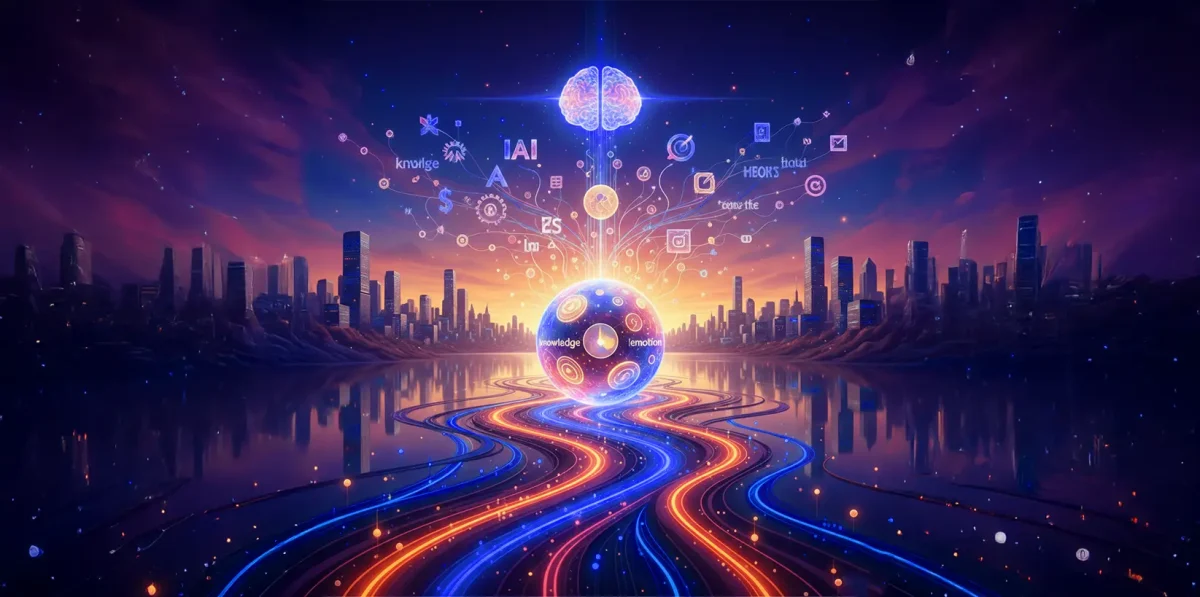
Imagine every idea you’ve ever had, placed on a huge 3D map.
- Similar thoughts are near each other.
- Opposite ideas sit far apart.
- Ambiguous ideas sit somewhere between two regions.
Now imagine that map has hundreds of dimensions, not three.
That’s an embedding space.
AI isn’t reading our words. It’s navigating that map.
Summary
Embeddings are how AI understands the true meaning behind text:
- They map concepts, not words.
- They cluster meanings by similarity.
- They separate different contexts.
- They work across languages, formats, and content types.
If language is the surface…
embeddings are the structure underneath it.
They’re the reason AI can understand us, not just read us.