Non-Euclidean Emotional Manifolds: When Meaning Lives in Curved Space

Most embedding systems use flat geometry.
Like a flat sheet of paper.
But what if meaning doesn’t actually live on a flat surface?
What if emotions, hierarchies, and relationships naturally exist in curved space?
Welcome to:
Non-Euclidean Emotional Manifolds.
What Is Flat (Euclidean) Space?
Euclidean space is normal geometry.
The type we learn in school:
- Straight lines
- Flat surfaces
- Standard distance formulas
Most embeddings assume meaning lives in this flat world.
If two words are similar, they are close.
If they are different, they are far.
Simple.
But reality is not always flat.
Everyday Analogy: City Map vs Family Tree
Imagine mapping a city.
Flat geometry works well.
Road A to Road B.
Distance measured directly.
Now imagine mapping a family tree.
You start with:
- One ancestor
- Two children
- Four grandchildren
- Eight great-grandchildren
The number of nodes grows fast.
Flat space struggles to represent this growth efficiently.
But curved space handles it beautifully.
Enter Hyperbolic Space (Curved Geometry)
Hyperbolic space is curved outward.
One popular example is the Poincare disk.
Inside this disk:
- The center is small.
- The edges stretch infinitely.
- Distances grow exponentially near the boundary.
This means: You can represent huge hierarchies efficiently.
Everyday Analogy: Expanding Universe
Imagine standing at the center of a balloon.
As you move outward:
Space stretches more and more.
Near the edges, space expands rapidly.
That’s how hyperbolic geometry behaves.
Why Hierarchies Love Curved Space
Hierarchies grow exponentially:
- Animal
- Mammal
- Dog
- Cat
- Dog
- Bird
- Eagle
- Sparrow
- Eagle
- Mammal
Each level branches more.
In flat space: You need more and more room to separate branches.
In hyperbolic space: The space naturally expands as you move outward.
It fits trees perfectly.
Emotional Hierarchies Are Also Structured
Now think about emotions.
At the center, you might have:
- Basic emotions (Joy, Fear, Anger)
From Joy branch:
- Excitement
- Contentment
- Pride
From Fear branch:
- Anxiety
- Panic
- Worry
Emotions form hierarchies.
Flat embeddings may struggle to represent these layered relationships clearly.
Curved spaces model them more naturally.
Gravity Wells in Latent Space
Now here’s the unique angle.
In curved space, some regions behave like gravity wells.
Certain vectors – like “Love,” “Power,” or “Fear” – can become central attractors.
Other related emotions orbit around them.
Everyday Analogy: Planets and the Sun
The Sun pulls planets into orbit.
In emotional embedding space: Core concepts pull related ones toward them.
These gravity wells form semantic centers.
Why Flat Space Is Sometimes Limiting
In flat embeddings:
Distance increases linearly.
But hierarchies grow exponentially.
This mismatch causes:
- Crowding
- Distortion
- Loss of structure
Flat space tries to fit a tree onto a table.
Curved space grows with the tree.
The Poincare Disk in Simple Terms
Imagine drawing a circle.
Everything lives inside it.
Near the center: Space is small and compact.
Near the edges: Space stretches infinitely.
This allows:
- Deep hierarchies
- Clear branching
- Better separation
Without needing huge dimensions.
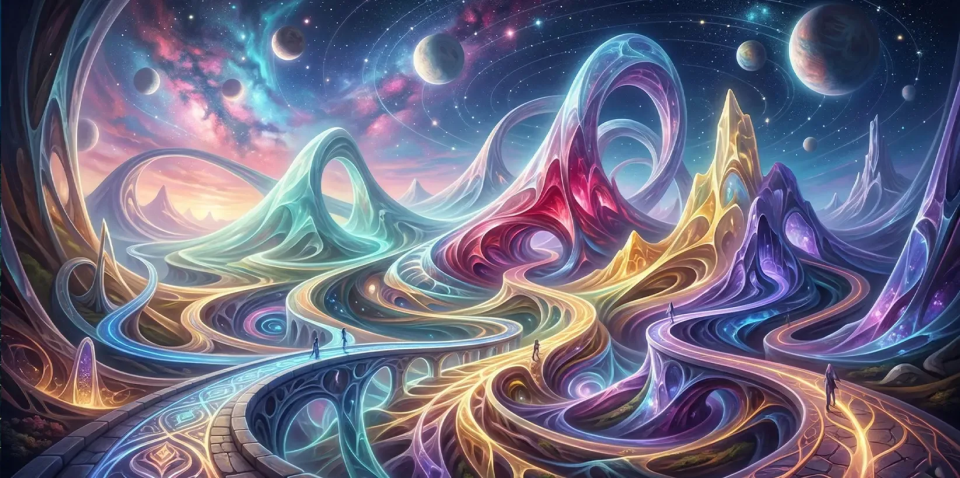
Emotional Manifolds as Warped Landscapes
Instead of thinking of embeddings as flat maps,
Think of them as curved terrains.
Some areas:
- Dip downward (gravity wells)
- Pull related concepts inward
- Create stable emotional clusters
Other areas:
- Stretch outward
- Allow rapid expansion of subcategories
- Represent nuance layers
Meaning becomes geography.
Why This Matters for AI
Using non-Euclidean manifolds helps:
- Better represent taxonomies
- Model hierarchical knowledge
- Improve recommendation systems
- Structure emotional AI systems
- Enhance ontology learning
Instead of increasing vector size,
We change the geometry.
Sometimes the solution is not “more dimensions.”
It is “better shape.”
The Strategic Insight
Most embedding research focuses on:
- Bigger models
- Higher dimensions
- More data
But geometry choice matters deeply.
Curved spaces can:
- Represent complexity more efficiently
- Preserve hierarchy naturally
- Reduce distortion
- Improve interpretability
This opens doors for:
- Structured knowledge AI
- Emotional reasoning systems
- Sovereign knowledge graphs
- Semantic governance layers
Final Thoughts
Meaning is not flat.
Emotion is not linear.
Hierarchy does not grow in straight lines.
So why should embeddings?
Non-Euclidean manifolds remind us:
The structure of space defines the structure of meaning.
By moving from flat geometry to curved geometry,
We don’t just improve representation.
We reshape intelligence itself.
In curved latent space,
Core ideas become gravity wells.
Hierarchies expand naturally.
Emotion gains structure.
Because sometimes,The future of AI is not about building larger models It’s about bending space in smarter ways.
To explore next-generation embedding architectures and geometric intelligence systems, visit WebmapNetwork or connect with us at connect@webmap.network.