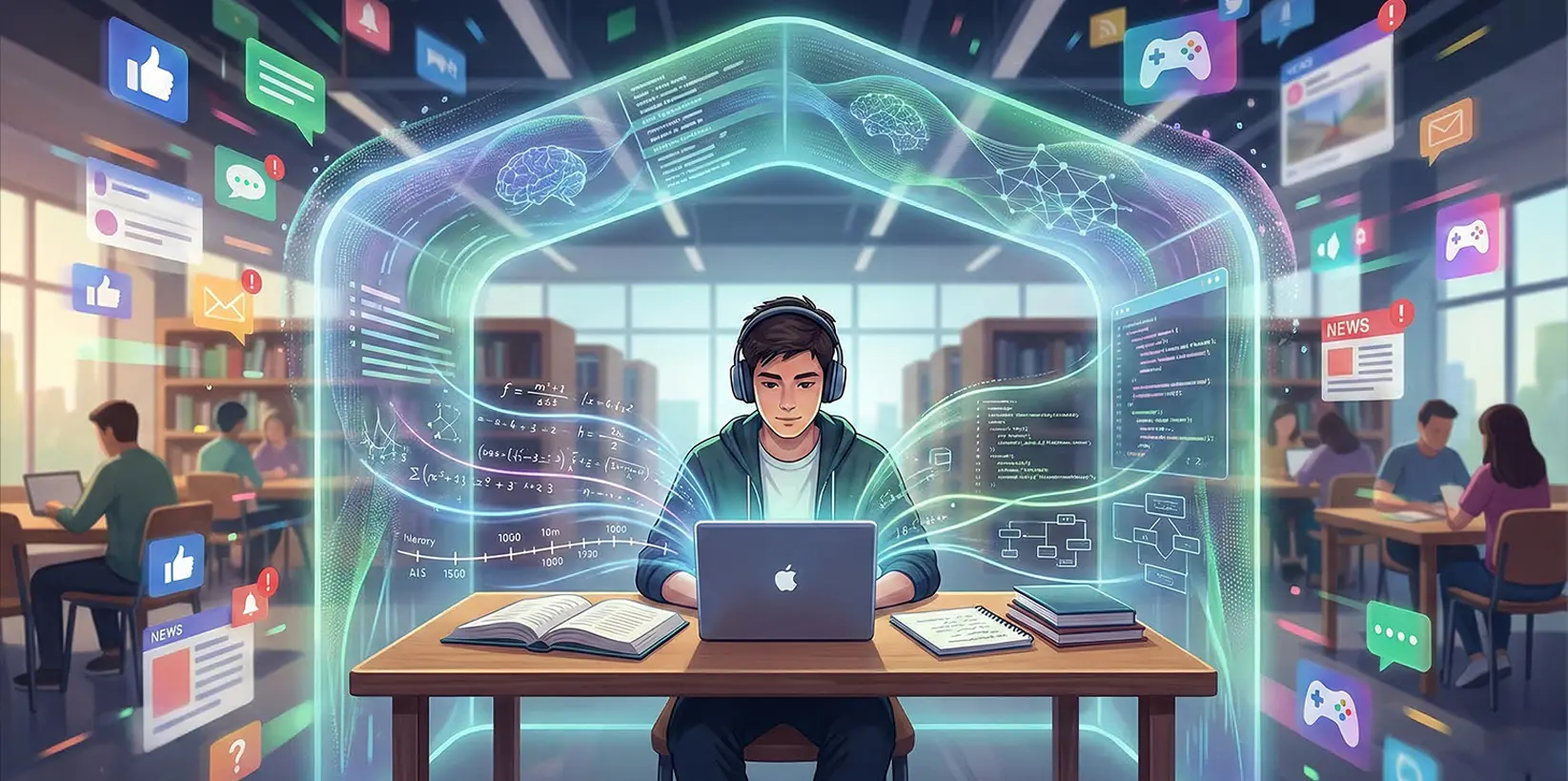
The Future of Studying: AI That Understands Your Learning Context


Introduction
Studying has always required effort, patience, and the ability to connect different ideas together. Students read textbooks, attend lectures, take notes, and revise concepts before exams.
But one major problem still exists in traditional studying methods: learning tools usually do not understand the student’s context.
For example, a student studying economics today might ask a question related to a lecture they attended yesterday. A search engine or a basic learning tool will not remember that previous context. The student must repeat explanations, search again, and manually reconnect information.
Artificial intelligence is beginning to solve this challenge through context-aware learning systems. These systems remember conversations, understand what the student is studying, and provide responses that build on previous discussions.
From the perspective of WebMap Network observations, this shift could redefine how students interact with knowledge, making studying more efficient, personalized, and connected.
The Problem With Traditional Study Methods
Information Without Memory
Most digital study tools work like calculators.
A calculator gives the correct answer, but it does not remember what problem you solved five minutes ago. Each new input is treated as a completely separate task.
Traditional search engines and many learning platforms work in the same way. Students type a question, receive an answer, and then start again with the next question.
Imagine trying to have a conversation with someone who forgets everything you said after every sentence. Learning would quickly become frustrating.
Students often face a similar experience when using disconnected study tools.
Why Context Matters in Learning
Understanding the Bigger Picture
Learning is not just about individual facts. It is about how those facts connect together.
Think about assembling a jigsaw puzzle. If you look at only one piece at a time without seeing the full image, it becomes very difficult to understand where that piece belongs.
Studying works the same way. A concept learned today may depend on something studied last week. Without context, it becomes difficult to build a complete understanding.
Context-aware AI systems solve this problem by remembering previous discussions, notes, and research topics. This allows them to provide answers that build on the student’s existing knowledge instead of starting from zero each time.
AI That Learns With the Student
A Personalized Study Companion
Context-aware AI behaves less like a search engine and more like a study partner.
Imagine studying with a friend who remembers your previous questions, understands the topic you are working on, and continues the discussion from where you left off yesterday.
That is the kind of experience modern AI systems are beginning to create.
AI models such as ChatGPT, Claude, and Gemini can help students generate explanations, analyze topics, and summarize learning materials.
However, the real power emerges when these systems operate within platforms that maintain long-term context and knowledge structure.
From Questions to Structured Knowledge
Organizing Learning Automatically
Students often collect information from many places:
- lecture notes
- research articles
- online resources
- AI explanations
Over time, this information can become messy and difficult to manage.
A useful analogy is a desk covered with scattered papers. Even if the information is valuable, finding the right document quickly becomes difficult.
Context-aware AI systems help organize this information into structured learning frameworks.
Instead of scattered notes, students can maintain organized knowledge that grows as they continue studying.
The Role of Multi-Model Intelligence in Learning
Learning From Multiple AI Perspectives
Different AI systems have different strengths. Some models may provide clearer explanations, while others might excel at logical reasoning or summarizing complex documents.
Access to multiple AI models allows students to explore different interpretations of the same topic.
For example, a student studying machine learning might ask multiple AI systems to explain neural networks. Each model may provide a slightly different explanation, helping the student understand the concept more deeply.
This approach transforms learning from a simple question-and-answer process into a multi-perspective knowledge exploration experience.
How Webmap Enables Context-Aware Studying
Platforms like Webmap are designed to support this new way of learning through a unified interaction layer.
Instead of switching between multiple tools and losing context each time, students can study within a single environment where AI systems remember conversations and organize knowledge.
Through its interaction capabilities, Webmap allows students to:
- interact with multiple AI models in one workspace
- maintain conversation history and learning context
- explore topics through different AI perspectives
- convert discussions into structured knowledge
For example, a student preparing for a biology exam could ask questions about genetics, receive explanations from different AI models, and organize the insights into a structured study guide.
Because the system preserves context, the student can continue the learning session days later without restarting the entire discussion.
Making Studying More Efficient
Context-aware AI can significantly improve how students manage their time.
Instead of repeatedly searching for explanations, students can focus on understanding concepts and exploring deeper questions.
AI systems can assist by:
- summarizing lecture materials
- explaining difficult concepts
- organizing notes automatically
- suggesting related topics for further exploration
This reduces the time spent managing information and increases the time spent actually learning.
Future Outlook
As context-aware AI technology continues to evolve, studying may become far more interactive and personalized.
Future learning systems could automatically:
- track a student’s learning progress
- identify knowledge gaps
- recommend personalized study paths
- connect lecture materials with research sources
Instead of static study tools, students will interact with dynamic learning environments that adapt to their needs.
Teachers will remain central to education by guiding discussions, mentoring students, and encouraging critical thinking. AI will simply enhance the learning process by handling the complexity of information management.
Conclusion
Studying has traditionally required students to manage large amounts of disconnected information. This often makes learning slower and more frustrating than it needs to be.
Context-aware AI offers a new approach by remembering conversations, connecting ideas, and organizing knowledge into structured frameworks.
Platforms like Webmap demonstrate how AI systems can transform studying into a more connected and efficient experience.
As these technologies continue to develop, the future of studying may no longer rely on isolated tools and scattered notes. Instead, students will work alongside intelligent systems that understand their learning context and help guide them through the expanding world of knowledge.