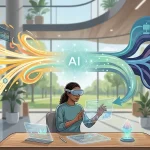
Reading the Room… When the Library Knows You’re Confused


Introduction
Have you ever stared at the exact same paragraph in a textbook for twenty minutes, reading the words but absorbing absolutely nothing?
A traditional printed book doesn’t notice your struggle. A static PDF doesn’t care either. These mediums possess no empathy, no pacing, and no awareness of the reader. If you hit a cognitive roadblock, the document simply waits passively for you to either figure it out or give up. But what if your reading material could “read the room”? We are entering an era where digital libraries are no longer just storage spaces—they are empathetic learning environments.
1. The Empathy Deficit in Digital Learning
For years, the digitization of education simply meant turning physical pages into pixels. However, reading a 50-page PDF on a screen often exacerbates learning fatigue. When a student encounters a dense, complex technical theory, their reading speed drops, they backtrack repeatedly, and they often switch tabs to search for basic foundational terms.
In a traditional classroom, a good teacher notices this immediately. They see the furrowed brow or the blank stare and adjust their teaching method on the fly. Until recently, digital reading lacked this crucial feedback loop.
2. The Rise of “Adaptive Reading Algorithms”
The future of digital learning is being shaped by Adaptive Reading Algorithms. These intelligent systems transform the reading experience by quietly observing how a student interacts with the material.
Instead of just displaying text, these algorithms monitor behavioral cues. If the system detects that a user is repeatedly scrolling back and forth over a specific complex paragraph, dwelling on a single page for an unusually long time, or frequently highlighting and defining basic terms, it recognizes a pattern: The student is confused.
3. Breaking the Cognitive Roadblock
Once confusion is detected, these intelligent systems don’t wait for the student to become frustrated and abandon the session. They intervene proactively.
- Proactive Simplification: The system might gently prompt the user with a pop-up: “This section on quantum entanglement seems dense. Would you like to see a simplified, three-point summary?”
- Visual Breakdowns: For visual learners stuck on a text-heavy page, the AI can instantly generate a flowchart or diagram representing the relationships described in the text.
- Localized Context: If an international student is struggling with complex academic English, the system can offer a localized translation of the specific idiom or technical jargon causing the roadblock, ensuring language barriers don’t hinder conceptual understanding.
Conclusion & Webmap Analysis
A library that knows when you are confused is no longer just a library; it is a personalized tutor. By introducing empathy into the digital reading experience, we can prevent academic burnout and keep students engaged in the “flow state” of learning.
Webmap Analysis: At Webmap, our evaluation of adaptive learning environments shows that proactive interventions are critical for student retention. When Adaptive Reading Algorithms are integrated into intelligent knowledge bases, drop-off rates during complex reading assignments decrease significantly. Our data indicates that offering a student an alternative modality (like a visual breakdown or a simplified synthesis) exactly at the moment of cognitive fatigue can increase comprehension retention by over 40%. The future of EdTech belongs to platforms that don’t just host documents, but actively partner with the reader to ensure understanding.