Embeddings Are the Geometry of Meaning


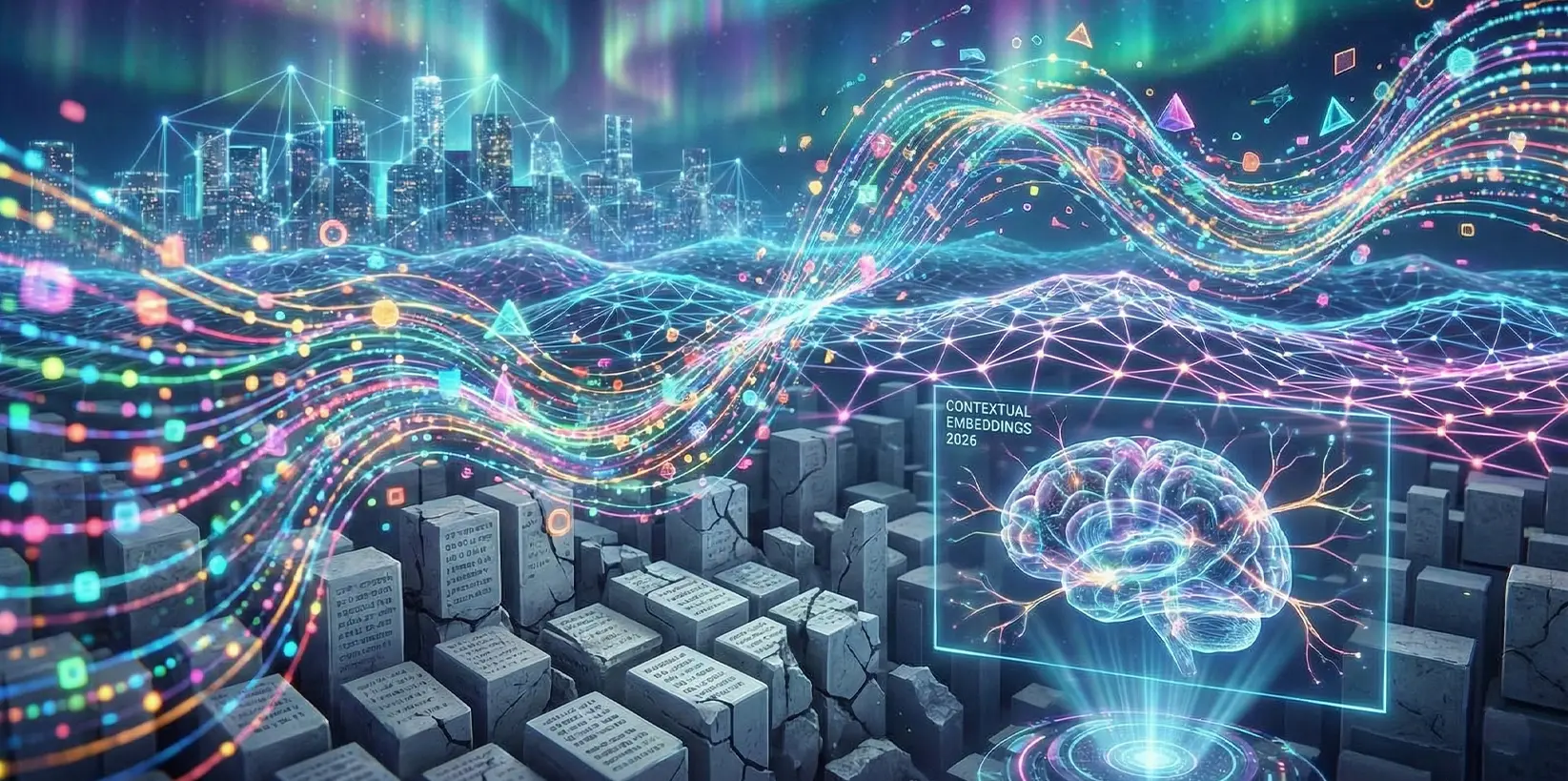
The way machines understand, and process human language has moved from brittle, rule-based systems to sophisticated models that grasp the nuances of meaning. At the heart of this revolution are “embeddings,” a powerful concept that translates complex data, such as words, sentences, images, and documents, into a numerical format that machine learning algorithms can interpret. More than just numerical representations, embeddings create a “geometry of meaning,” where semantic relationships are encoded as spatial relationships in a high-dimensional vector space.
1. What Are Embeddings?
At their core, embeddings are numerical representations of data, converting complex, high-dimensional inputs into lower-dimensional vectors. They represent words, phrases, and documents as vectors of numbers in a continuous, high-dimensional space. This transformation enables machines to process and analyze data efficiently, capturing semantic relationships that would otherwise be difficult to discern.
Unlike traditional sparse representations like one-hot encoding, which can lead to very large and inefficient vectors, embeddings are dense, meaning they contain mostly non-zero values and have fixed dimensions regardless of the vocabulary size. This density allows for more efficient computation and storage.
Table 1: Traditional vs. Embedding Approach for Word Representation
| Feature | Traditional Approach (e.g., One-Hot Encoding) | Embedding Approach (e.g., Word2Vec, BERT) |
|---|---|---|
| Representation | Sparse vector, largely zeros | Dense vector, mostly non-zero real numbers |
| Dimensionality | High, equal to vocabulary size | Fixed, typically 384–4096 dimensions |
| Semantic Meaning | Lacks direct semantic relationships | Captures semantic relationships |
| Computational | Less efficient for similarity | More efficient for similarity |
| Generalization | Limited to seen words | Better generalization to unseen words |
2. The Geometry of Meaning
The true power of embeddings lies in their ability to translate semantic meaning into geometric relationships. In the embedding space:
- Similar concepts cluster together: Words or phrases with similar meanings are positioned close to each other in the vector space. For instance, “king” and “queen” would be closer than “king” and “car.”
- Analogies emerge as geometric relationships: One of the most famous demonstrations is the “King – Man + Woman = Queen” analogy. By performing vector arithmetic, we can navigate the embedding space to discover relationships, demonstrating how dimensions like gender and royalty are encoded.
- Meaning becomes computable: The spatial relationships allow for mathematical operations (like vector addition and subtraction) to reflect semantic operations, making meaning quantifiable and manipulable. This enables efficient similarity calculations using vector operations like cosine distance, where a smaller distance indicates higher similarity.
Each value within an embedding vector represents a different dimension of meaning, carefully assigned to preserve semantic relationships during mathematical operations. While real embeddings can have hundreds or even thousands of dimensions (e.g., 768-4096), dimensionality reduction techniques like t-SNE, PCA, and UMAP are used to project them into 2D or 3D for human visualization, helping to reveal clusters and relationships within the data.
3. How Embeddings Are Created
Embeddings are not manually engineered; instead, they are learned from vast amounts of data using various algorithms, primarily neural networks. Key methods for creating embeddings include:
- Word2Vec: Introduced by Tomas Mikolov et al. in 2013, Word2Vec learns word embeddings by predicting the context of words or a word from its context. This marked a significant milestone in natural language processing.
- GloVe (Global Vectors for Word Representation): GloVe focuses on global co-occurrence statistics of words in a corpus.
- FastText: An extension of Word2Vec, FastText considers sub-word information (character n-grams), allowing it to handle out-of-vocabulary words and morphologically rich languages more effectively.
- Transformer-based Models (e.g., BERT, GPT): Modern large language models (LLMs) utilize transformer architectures to generate contextualized embeddings. This means that the embedding for a word can change based on the surrounding words in a sentence, capturing polysemy (words with multiple meanings) more effectively.
These models learn to represent words, sentences, or even entire documents as vectors that capture semantic nuances and contextual relationships.
4. Applications of Embeddings
The ability of embeddings to represent meaning geometrically has unlocked a wide array of applications across various fields of machine learning.
Table 2: Key Applications of Embeddings
| Application Area | Description | Example |
|---|---|---|
| Semantic Search | Finds results based on the meaning of a query, not just keyword matching. By embedding queries and documents, systems can retrieve semantically similar items. | A user searches for “recipes for healthy eating,” and the system returns articles about “nutritious meals” even if “healthy eating” isn’t explicitly in the document. |
| Clustering & Topic Modeling | Groups similar documents or words together based on their proximity in the embedding space, revealing underlying themes or topics. | Automatically organizing news articles into categories like “Sports,” “Politics,” and “Technology” based on their content similarity, or identifying key themes in customer feedback. |
| Recommendation Systems | Recommends items (products, movies, music) by finding items or users with similar embeddings. | Suggesting movies to a user based on their watch history and the similarity of those movies’ embeddings to other available films, or recommending products based on user and item embeddings. |
| Anomaly Detection | Identifies unusual data points that are distant from the main clusters in the embedding space. | Detecting fraudulent transactions in financial data where unusual patterns stand out from typical spending habits, or identifying unusual network activity. |
| Sentiment Analysis | Understands the emotional tone of text by analyzing the position of word/sentence embeddings relative to positive or negative sentiment vectors. | Determining if a customer review is positive, negative, or neutral about a product or service. |
| Machine Translation | Helps translate languages by mapping words and phrases from one language’s embedding space to another’s, preserving semantic relationships. | Enabling translation between English and Spanish where “cat” in English and “gato” in Spanish occupy similar regions in their respective embedding spaces, due to multilingual embeddings and aligned embedding spaces. |
| Information Retrieval | Efficiently retrieves relevant information from large datasets by comparing the embedding of a query to the embeddings of stored documents. | Finding relevant legal documents by searching for phrases that convey similar legal concepts, even if the exact wording differs. |
5. Challenges and Limitations
Despite their power, embeddings are not without their challenges:
- Bias in Embeddings: Embeddings are learned from data and thus can inherit and amplify biases present in the training corpus. This can lead to problematic associations, such as gender stereotypes or racial biases.
- Polysemy: While contextual embeddings from transformer models have improved this, words with multiple distinct meanings (e.g., “bank” as a financial institution vs. a riverbank) can still pose challenges if the context isn’t fully captured.
- Out-of-Vocabulary (OOV) Words: Traditional word embeddings struggle with words not encountered during training. Sub-word embeddings (like Fast Text) offer a partial solution, but novel words or highly specialized terms can still be problematic.
6. Conclusion
Embeddings have fundamentally reshaped how machines interact with and understand data, particularly language. By transforming words, sentences, and other complex information into a geometric space where meaning is encoded by proximity and direction, they enable a wide range of intelligent applications. The “geometry of meaning” provided by embeddings allows machines to grasp semantic nuances, perform complex reasoning through vector arithmetic, and generalize knowledge more effectively. As research continues into dynamic and multimodal embeddings, their role in bridging the gap between human understanding and machine intelligence will only continue to grow, Contact WebmapNetwork today to discuss how high-quality embeddings can transform your business. We’re here to guide you through further discussions, solution development, and understanding our services regarding this crucial topic.Email us at connect@webmap.network.