How Embeddings Reduce Cognitive Load in AI Workflows

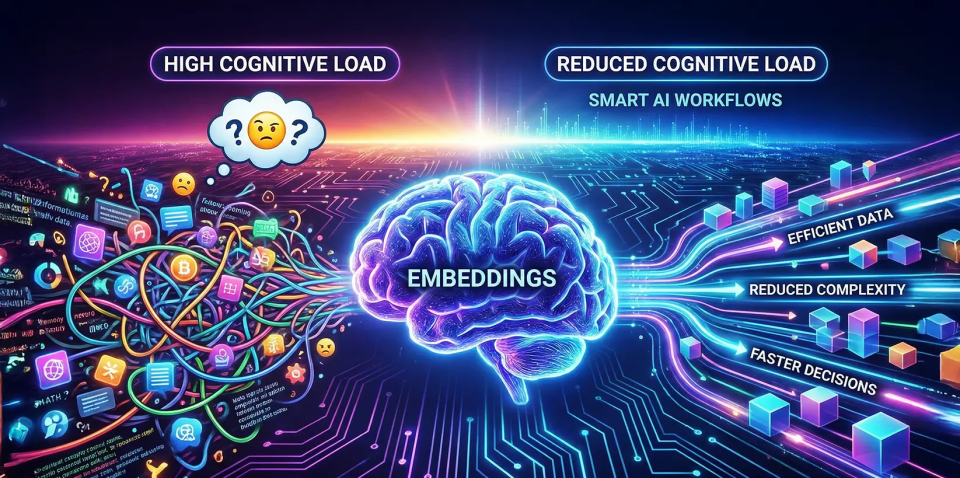
In the rapidly evolving landscape of Artificial Intelligence, managing complex, high-dimensional data presents a significant challenge. This complexity can lead to increased cognitive load for both AI models and human developers. Embeddings, a fundamental concept in modern AI, emerge as a powerful solution by transforming intricate data into a more digestible and semantically rich format, thereby significantly reducing the cognitive burden across various AI workflows.
1. The Challenge of Raw Data for AI
AI models inherently struggle with raw, unstructured data such as text, images, or audio. These data types are often high-dimensional, noisy, and lack a direct numerical representation for machines to process efficiently. Traditionally, preparing such data involved extensive, labor-intensive feature engineering a process that required deep domain expertise, could introduce biases, and contributed heavily to the cognitive load on data scientists and engineers.
2. Embeddings as a Solution
An embedding is a mathematical representation of complex data in a lower-dimensional vector space, meticulously designed to preserve the semantic relationships between data points. This transformation is crucial for alleviating cognitive load in several key ways:
- Dimensionality Reduction: Embeddings compress high-dimensional, often redundant data into a more compact, continuous vector space while retaining essential information. This simplifies input for AI models, making them faster to train and less prone to issues like the curse of dimensionality.
- Semantic Understanding: Embeddings capture the meaning and context of data. For example, in Natural Language Processing (NLP), words with similar meanings have vectors that are closer together in the embedding space. This inherent semantic understanding allows AI models to process and reason about information more effectively without explicit rule-based programming for every relationship.
- Efficiency and Performance: Converting complex data into manageable numerical vectors accelerates model training times and reduces computational costs. This efficiency enables quicker iteration cycles for developers and faster task completion for AI systems.
- Foundation for Advanced AI Applications: Embeddings are the backbone of advanced applications like semantic search, recommendation systems, and Retrieval-Augmented Generation (RAG). They enable efficient similarity comparisons, allowing these systems to retrieve relevant information quickly and generate contextually relevant content.
- Workflow Simplification for Developers: Embeddings abstract the complexities of data representation into a standardized vector format. This allows developers to organize AI workflows around business components rather than technical functions, creating a more modular and maintainable architecture that is easier to reason about.
- Bridging the Human-Machine Cognitive Gap: Embeddings act as an “entropy reduction” mechanism. They transform ambiguous, high-entropy human inputs into clear, low-entropy representations that machines can process, bridging the cognitive gap between messy human intentions and structured machine understanding.
3. Keyways Embeddings Reduce Cognitive Load
The following table summarizes the primary mechanisms through which embeddings alleviate cognitive burden for both developers and AI models.
| Aspect | How Embeddings Help | Cognitive Load Reduction for Developers/Models |
|---|---|---|
| Data Complexity | Transform high-dimensional, unstructured data (text, images) into compact numerical vectors. | Eliminates the need for extensive manual feature engineering. Simplifies data preprocessing pipelines. |
| Semantic Understanding | Capture the meaning and relationships between data points, making implicit connections explicit for models. | Reduces the need for complex rule-based systems to interpret meaning. Enhances model accuracy and generalization. |
| Computational Efficiency | Lower-dimensional representations speed up model training and inference. | Decreases time spent on model optimization and resource management. Faster experimentation cycles. |
| Application Development | Provide a standardized input format for diverse AI tasks (NLP, CV, RAG). | Streamlines integration of different AI components. Simplifies building complex AI applications. |
| Workflow Organization | Allow for modular and business-component-focused AI architecture. | Reduces mental overhead in reasoning about and maintaining large AI systems. |
| Human-Machine Interaction | Convert ambiguous human inputs into clear, machine-understandable representations, reducing “entropy.” | Improves AI’s ability to understand user intent, leading to more natural and effective interactions. |
4. Applications of Embeddings in AI Workflows
The utility of embeddings is vast, underpinning many core AI functionalities:
- Natural Language Processing (NLP): Fundamental for tasks like sentiment analysis, machine translation, text summarization, and semantic search, allowing models to grasp linguistic nuances and context.
- Computer Vision: Image embeddings enable object detection, image recognition, and content-based image retrieval by representing visual features in a comparable vector space.
- Recommendation Systems: By embedding users and items into a shared space, these systems can identify similar users or items to generate personalized recommendations.
- Generative AI (RAG): In Retrieval-Augmented Generation, embeddings facilitate efficient semantic search within vast knowledge bases, allowing models to retrieve relevant context to ground their responses and reduce “hallucinations.”
5. Embeddings in Action: Impact on AI Workflows
The table below contrasts traditional approaches with embedding-based methods, highlighting the resulting reduction in cognitive load.
| AI Workflow | Pre-Embedding Approach | Embedding-Based Approach | Cognitive Load Reduction |
|---|---|---|---|
| Text Analysis | Keyword matching, complex regex, hand-crafted features for each concept. | Semantic similarity search, clustering documents by meaning. | Focus shifts from explicit rule creation to understanding semantic clusters. |
| Image Retrieval | Metadata tagging, pixel-by-pixel comparisons. | Content-based image retrieval, finding visually similar images. | Eliminates manual tagging and reduces the need for pixel-level analysis. |
| Recommendation Engines | Collaborative filtering based on explicit user-item interactions or rule-based systems. | Embeddings for users and items capture latent preferences, enabling more nuanced recommendations. | Reduces the complexity of modeling user preferences and item attributes explicitly. |
| Generative AI (RAG) | Large context windows, prone to “hallucinations” without external knowledge. | Embeddings enable efficient retrieval of precise, relevant information from external knowledge bases. | Reduces the model’s burden of memorizing vast amounts of information and the risk of generating inaccurate content. |
| AI System Design | Tight coupling between data formats, logic, and UI, leading to “cognitive overload.” | Modular design with embeddings as a universal data interface between components. | Simplifies system architecture and makes components more independent and reusable. |
6. The Role of Interpretability in Embeddings
While embeddings reduce cognitive load by abstracting complexity, their inherent numerical nature often makes them opaque, as individual dimensions rarely map directly to human-understandable concepts. This “black-box” property can be a challenge in fields where explainability is crucial.
Techniques exist to indirectly analyze embeddings. Dimensionality reduction methods like PCA and t-SNE can project high-dimensional embeddings into 2D or 3D spaces, allowing for visual identification of clusters and relationships (e.g., showing that “dog,” “cat,” and “horse” cluster together). The emerging field of “interpretable embeddings” aims to address this challenge directly by aligning each dimension with a human-understandable attribute, promising to further reduce cognitive load by enhancing the trustworthiness and diagnostic capabilities of AI systems.
Conclusion
Embeddings are not just a technical detail, they are the cognitive foundation of modern AI. By turning complex, unstructured data into meaningful representations, they reduce both machine complexity and human mental overhead. This allows AI systems to reason through context instead of rules, and enables developers to design cleaner, more scalable workflows.
As AI continues to evolve, embeddings will remain the quiet force that makes intelligence usable, reliable, and human-aligned If you’re interested in delving deeper into how embeddings can benefit your work, I invite you to reach out at connect@webmap.network for further discussions and solutions tailored to your needs.