From Search to Understanding: Why AI Is Replacing Traditional Research Methods

Introduction
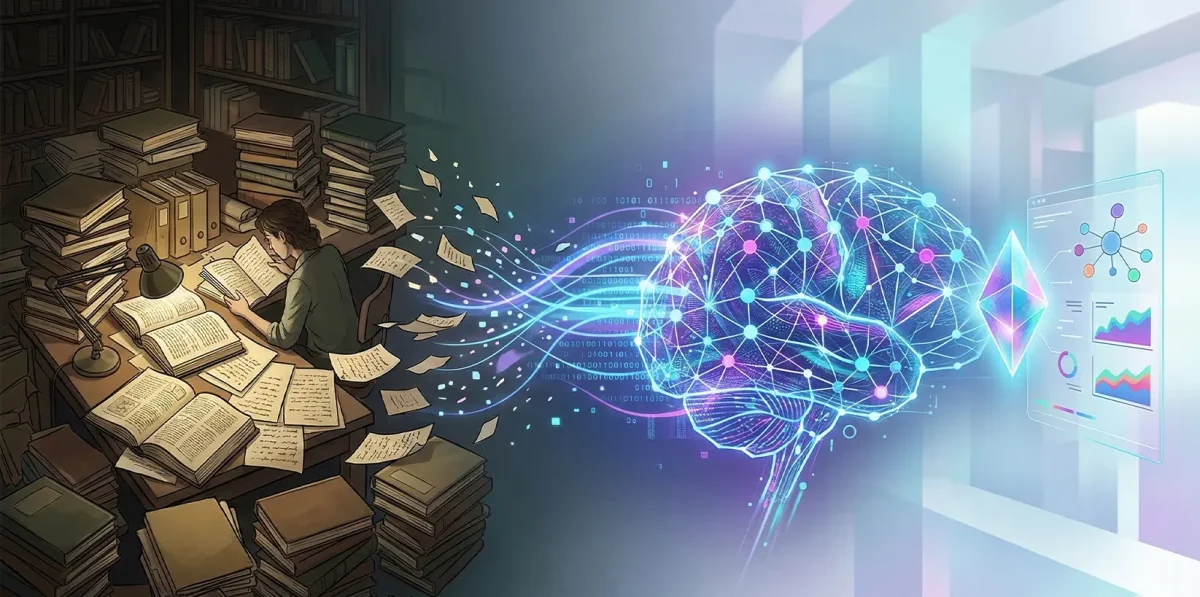
For years, research has followed a simple process:
Search → Read → Compare → Understand
Students type a query into a search engine, open multiple links, read through articles, and try to combine information into something meaningful.
But today, this process is changing.
Artificial intelligence is shifting research from finding information to understanding information instantly.
From the perspective of WebMap Network observations, this shift is not just about speed it’s about transforming research into a structured, context-aware experience where students no longer struggle to connect scattered pieces of knowledge.
The Traditional Research Problem
Searching Without Clarity
Traditional research tools are built for retrieval, not understanding.
When a student searches for a topic, they usually get:
- dozens of links
- long articles
- mixed-quality sources
The responsibility of:
- filtering information
- identifying key points
- connecting ideas
…falls completely on the student.
Everyday Analogy
Think of it like going to a library and being handed 10 different books for one question without being told which pages to read.
The answer exists somewhere inside those books, but finding it takes time, effort, and patience.
This is how most students experience research today.
The Shift: From Information to Understanding
AI Changes the Process
AI tools are transforming research by removing unnecessary steps.
Instead of:
- searching multiple pages
- reading everything manually
Students can now:
- ask direct questions
- get summarized insights
- explore explanations instantly
Tools like ChatGPT, Claude, and Gemini are leading this shift.
They don’t just show links they process information and present it in a usable form.
Why Search Alone Is No Longer Enough
The Limitation of Keywords
Traditional search engines rely heavily on keywords.
But learning is not just about matching words it’s about understanding context.
For example:
- Two students may search the same topic
- But need different levels of explanation
Search engines cannot fully adapt to this.
AI, however, can:
- simplify explanations
- go deeper when needed
- adjust based on follow-up questions
Analogy
Search engines are like a map.
AI is like a guide who walks with you and explains everything along the way.
The Rise of Context-Aware Research
Learning That Builds Over Time
One of the biggest advantages of AI is its ability to maintain context.
Instead of treating each question separately, AI systems can:
- remember previous queries
- build on earlier discussions
- connect related concepts
This creates a continuous learning flow.
Imagine learning a subject with a teacher who remembers every question you asked and builds each answer on top of the previous one.
That is what context-aware AI enables.
Multi-Model Intelligence in Research
One Question, Multiple Perspectives
Different AI models approach problems differently.
- ChatGPT may simplify concepts
- Claude may provide detailed reasoning
- Gemini may connect broader ideas
Traditionally, accessing multiple perspectives would require:
- reading multiple sources
- comparing viewpoints manually
Now, AI makes this process faster and more efficient.
Analogy
It’s like asking the same question to three different experts at once and comparing their answers instantly.
The Missing Piece: Structured Knowledge
Why Answers Alone Are Not Enough
Even with AI, there is still a challenge.
Students often receive:
- multiple answers
- different explanations
- scattered insights
Without structure, this can still lead to confusion.
What students truly need is:
organized knowledge, not just generated answers
How Webmap Transforms Research
Platforms like Webmap are designed to take AI-powered research one step further.
Instead of just generating responses, Webmap focuses on:
structuring and organizing knowledge across multiple AI models
What This Means for Students
1. Unified Research Environment
Students can interact with multiple AI models in one place without switching tools.
2. Continuous Context
Research conversations are preserved, allowing students to build deeper understanding over time.
3. Structured Outputs
Information is transformed into:
- summaries
- step-by-step flows
- connected knowledge maps
4. Multi-Model Insights
Students can compare different AI perspectives within a single workflow.
This approach follows the core idea:
“One context, many models”
A New Way to Learn and Research
From Effort to Efficiency
AI is not removing the need for research.
It is improving how research is done.
Instead of spending hours:
- searching
- filtering
- organizing
Students can focus on:
- understanding concepts
- exploring ideas
- asking better questions
Future Outlook
As AI continues to evolve, traditional research methods may become less common.
Future research systems will likely:
- understand user intent instead of keywords
- organize knowledge automatically
- provide multi-perspective insights
- guide students through structured learning paths
Platforms like Webmap represent this shift toward intelligent research environments.
Conclusion
The era of traditional search-based research is slowly coming to an end. While search engines helped us access information, AI is helping us understand it.
By combining context awareness, multi-model intelligence, and structured knowledge systems, AI is transforming research into a more efficient and meaningful process.
In the future, students won’t just search for answers…They will interact with knowledge, explore perspectives, and build understanding in real time.