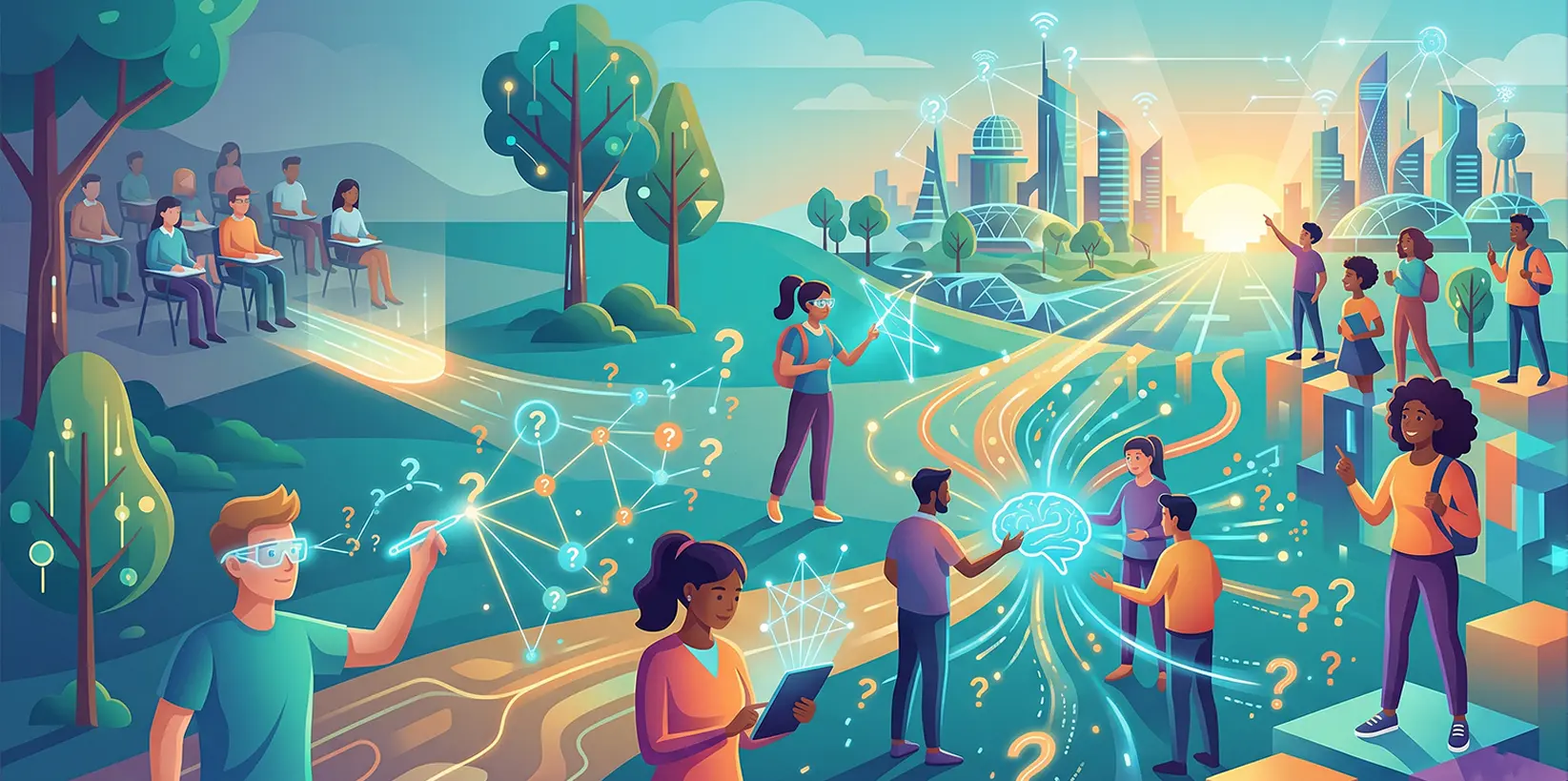
The AI-Powered University: What Education Might Look Like in 2030


Introduction
Universities have evolved many times over the centuries. From chalkboards and printed textbooks to online learning platforms and digital libraries, each generation has adopted new technologies that changed how students learn.
Today, artificial intelligence is becoming the next major transformation in education.
AI is already helping students summarize notes, generate explanations, and assist with research. But the next phase will go much further. Instead of simply answering questions, AI systems will become active learning partners that organize knowledge, guide research, and personalize education.
From the perspective of WebMap Network observations, universities in the coming years may move toward an AI-powered academic environment where knowledge is structured, searchable, and interactive across multiple intelligent systems.
By 2030, the university experience may look very different from what students know today.
From Static Classrooms to Intelligent Learning Environments
Learning That Adapts to Students
Traditional education often follows a fixed structure. Lectures are delivered to large groups of students, assignments follow a set timeline, and exams measure understanding at specific intervals.
However, every student learns differently. Some students understand concepts quickly, while others need additional explanations and examples.
A helpful analogy is a GPS navigation system. When you drive to a destination, the GPS adjusts the route depending on traffic conditions and road closures. It adapts to help you reach your goal efficiently.
AI-powered learning systems could function in a similar way.
Instead of delivering the same explanation to every student, AI systems will adapt explanations, examples, and study material based on how each student learns best.
The Rise of AI Learning Assistants
A Personal Academic Companion
One of the biggest changes by 2030 could be the widespread use of AI learning assistants for students.
These assistants would not replace professors but would support students throughout their academic journey.
Imagine having a personal research partner available at any time to help you:
- explain difficult concepts
- summarize complex research papers
- organize lecture notes
- prepare study guides for exams
Tools like ChatGPT, Claude, and Gemini already demonstrate the potential of AI assistants in education.
By 2030, these capabilities could be integrated directly into the university learning ecosystem.
Students would interact with AI tools that understand their coursework, research topics, and academic progress.
Multi-Model Intelligence in Education
Learning From Multiple AI Perspectives
Another major development in AI-powered universities will be multi-model intelligence.
Different AI models specialize in different areas. Some models may provide deeper analytical reasoning, while others may generate clearer explanations or structured summaries.
A good analogy is consulting multiple experts when solving a difficult problem. Each expert brings a different perspective that improves the final understanding.
Multi-model AI systems allow students to explore questions across different AI perspectives.
Platforms like Webmap enable this by allowing students to interact with multiple AI models in a single environment.
Instead of relying on one AI response, students can compare insights from several models and build a richer understanding of complex topics.
AI That Organizes Academic Knowledge
Turning Information Into Structured Learning
One of the biggest challenges students face today is information overload.
A typical research project might involve reading dozens of articles, reviewing lecture notes, and gathering data from multiple sources.
Managing this information manually can become overwhelming.
Think of it like trying to cook a complex recipe with ingredients scattered across the kitchen. Even if all the ingredients are available, preparing the meal becomes difficult if everything is disorganized.
AI-powered systems can solve this problem by organizing information automatically.
For example, AI can:
- summarize long academic papers
- highlight key concepts from lecture recordings
- connect related topics across different courses
- structure research findings into organized knowledge frameworks
Platforms like Webmap focus on transforming scattered information into structured knowledge that students can easily explore.
This allows students to spend less time managing data and more time understanding ideas.
The Future of Research and Collaboration
AI as a Research Partner
By 2030, AI will likely play an important role in academic research.
Students and researchers may collaborate with AI systems to:
- identify research gaps in existing literature
- analyze large datasets
- generate structured research summaries
- explore multiple interpretations of complex topics
AI will not replace academic thinking but will accelerate the research process.
Just as calculators improved mathematics education without replacing mathematical thinking, AI will enhance research without replacing human curiosity and creativity.
A New Role for Professors
From Information Providers to Learning Guides
As AI becomes integrated into universities, the role of professors may also evolve.
In traditional classrooms, professors spend much of their time delivering information through lectures.
In an AI-powered university, professors may shift toward a more mentorship-focused role.
Instead of simply explaining concepts, professors may guide students in:
- asking better research questions
- evaluating AI-generated insights
- developing critical thinking skills
- applying knowledge to real-world challenges
AI will handle many routine information tasks, allowing educators to focus more on mentorship and intellectual development.
Future Outlook
By 2030, the university learning experience may become far more interactive, personalized, and knowledge-driven.
Students may learn in environments where:
- AI assistants help organize and explain course material
- multiple AI models collaborate to provide deeper insights
- research tools structure large volumes of information
- learning paths adapt to each student’s pace and understanding
Platforms like Webmap show how multi-model AI systems could serve as the foundation for this new educational ecosystem.
Instead of navigating scattered information across many tools, students may work within unified AI environments designed specifically for learning and research.
Conclusion
Artificial intelligence is beginning to reshape the way universities operate and how students interact with knowledge.
The AI-powered university of 2030 may not replace traditional education, but it will enhance it by making knowledge more accessible, organized, and interactive.
Through intelligent assistants, multi-model insights, and structured knowledge systems, students will gain the ability to explore subjects more deeply and efficiently.
Platforms like Webmap represent an early step toward this future, where AI helps transform education into a more dynamic and intelligent learning experience.
As universities continue to evolve, one thing is becoming clear: the future of education will not just be digital – it will be intelligently powered by AI.