Smart Learning: How AI Can Convert Lectures Into Structured Knowledge

Introduction
Lectures remain one of the most widely used teaching methods across schools and universities. Every day, professors deliver hours of explanations, insights, and examples designed to help students understand complex subjects.
Yet despite this effort, a common problem persists.
Students often walk away from lectures with pages of notes that are difficult to interpret later. Important ideas may be scattered across different pages, explanations may lack context, and connections between concepts are often lost.
This issue is not caused by poor teaching or inattentive students. It happens because lectures move quickly while human note-taking is limited by time and attention.
A new wave of AI-driven learning technology is beginning to solve this challenge by transforming lecture content into structured, organized knowledge.
From the perspective of WebMap Network observations, this shift represents a significant evolution in how educational institutions manage and use academic information. Rather than treating lectures as temporary events, universities are beginning to convert them into long-term knowledge assets.
Understanding How AI Structures Lecture Knowledge
What the Development Is
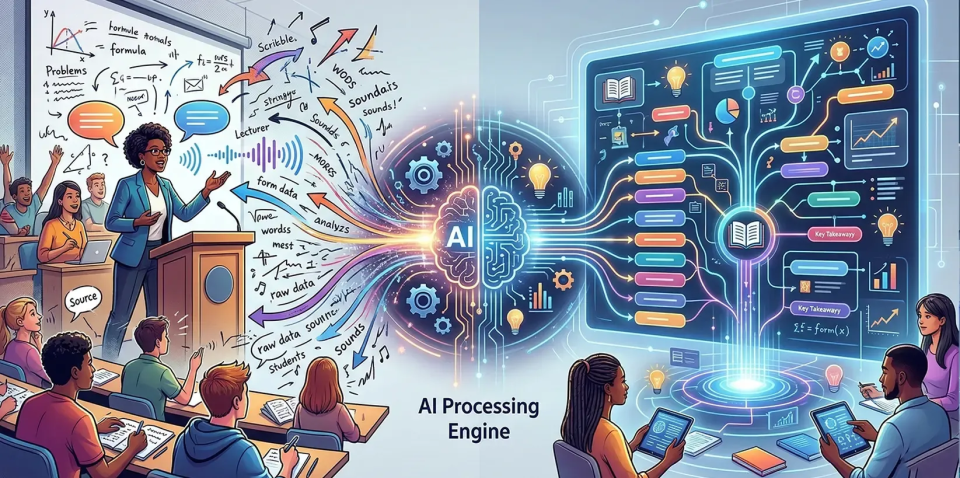
In a traditional classroom, information flows in one direction. A lecturer explains a concept, presents examples, and moves on to the next topic. Students try to capture key points while also listening and thinking about the material.
This process often produces fragmented notes because it is difficult to record every important idea while simultaneously processing new information.
Structured AI systems introduce a different approach. Instead of relying solely on human note-taking, AI can process lecture transcripts, presentation slides, and supplementary materials to identify the underlying structure of the content.
The system then reorganizes the information into logical segments such as main concepts, supporting arguments, definitions, examples, and related references.
The result is a structured knowledge framework that reflects how the subject is actually organized, making it easier for students to understand and revisit the material.
Why It Is Important
Education today generates far more information than students can realistically manage on their own. Recorded lectures, digital readings, and online discussions have expanded the volume of academic content available to learners.
Without a clear structure, this abundance of information can quickly become overwhelming.
Structured AI helps solve this problem by converting lecture content into organized knowledge layers. Instead of searching through long recordings or scattered notes, students can quickly identify the core ideas discussed during a lecture and explore the supporting details in a logical order.
This transformation shifts the learning process from information collection to knowledge comprehension.
Students spend less time organizing notes and more time analyzing the ideas behind them.
Industry or Market Impact
The growing interest in AI-driven knowledge structuring is influencing the evolution of educational technology platforms.
For many years, learning management systems focused mainly on distributing course materials. These platforms stored lecture slides, assignments, and discussion boards but rarely interpreted the content within those materials.
Today, institutions are beginning to look for solutions that do more than host information. Universities increasingly want systems capable of analyzing academic content and transforming it into interactive knowledge resources.
Large language models such as ChatGPT, Claude, and Gemini have demonstrated the power of AI in interpreting and summarizing complex information.
The next phase of innovation lies in applying these capabilities to large educational datasets turning lectures, course materials, and research content into structured knowledge systems.
India and Global Implications
The need for structured academic knowledge is not limited to a single region. Universities around the world are experiencing rapid growth in digital learning resources.
In countries such as India, where higher education institutions serve millions of students across diverse academic disciplines, managing educational content efficiently has become a major challenge.
Large universities may produce thousands of hours of lecture material each semester. Without intelligent organization, much of this valuable content remains difficult to navigate and underutilized.
Structured AI allows institutions to convert these vast collections of lectures into organized knowledge repositories that remain accessible to both students and faculty.
This capability is especially important for large academic environments where managing information at scale is essential.
Future Outlook
As artificial intelligence becomes more integrated into education systems, lectures will likely evolve beyond traditional formats.
Rather than serving only as real-time teaching sessions, lectures may become the starting point of a broader knowledge-building process.
After each class session, AI systems could automatically generate structured summaries, highlight important concepts, and link the lecture content with relevant academic resources.
Students would then interact with these structured insights through intelligent interfaces, enabling them to explore topics more deeply and efficiently.
Over time, universities could develop living knowledge environments where every lecture contributes to a continuously expanding academic knowledge base.
Analysis Section
WebMap Network Insights
At WebMap Network, internal analysis suggests that the most significant innovation in smart learning lies in the ability to extract structured knowledge from unstructured educational content.
Lectures are naturally unstructured; they include explanations, digressions, examples, and spontaneous discussions. AI systems capable of identifying and organizing these elements provide a powerful new way to manage academic information.
Rather than relying on manual note-taking or static transcripts, structured AI enables universities to transform lecture content into searchable, organized knowledge systems that improve both teaching and learning efficiency.
Trends and Long-Term Meaning
The long-term impact of this trend extends beyond lecture processing. It represents a broader transition toward intelligent academic knowledge infrastructure.
Educational institutions are gradually moving away from static information storage and toward systems that actively interpret and organize academic data.
As these technologies mature, students will interact less with isolated lecture files and more with integrated knowledge environments that connect lectures, research materials, and academic discussions.
Institutions that invest in structured AI capabilities today may gain a significant advantage in managing knowledge, supporting research, and improving the overall learning experience.
Conclusion
Lectures will continue to play an important role in education, but the way students interact with lecture content is changing. Artificial intelligence is making it possible to convert lecture material into structured knowledge that is easier to navigate, review, and understand. By transforming spoken explanations into organized learning frameworks, structured AI helps students move beyond scattered notes toward a deeper and more coherent understanding of academic subjects.