Why Asking AI the Same Question Twice Can Give a Better Answer the Second Time (and Why That’s a Good Thing!)


1. Introduction
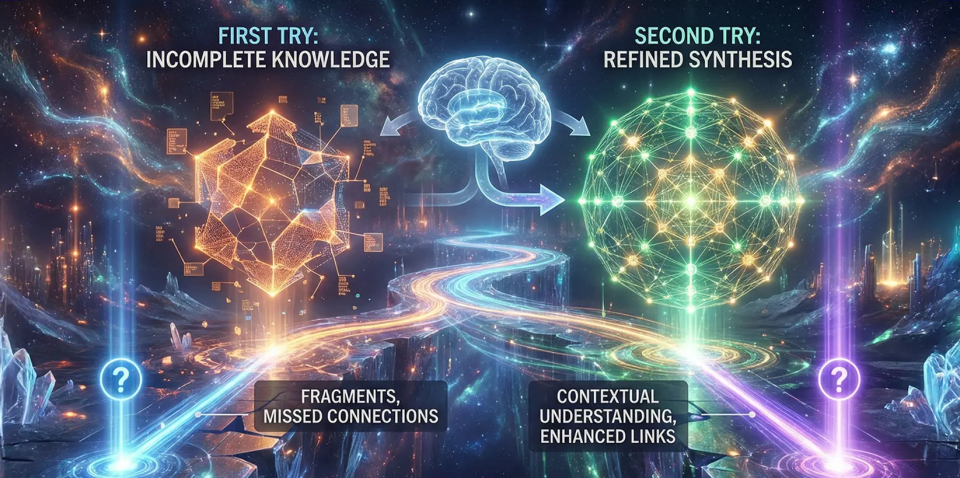
As someone who frequently interacts with AI, I’ve found that asking the same question twice often yields surprising and more refined responses. You might wonder why this is the case. Isn’t the first answer enough? The reality is, in the world of AI, there’s value in repetition and refinement. This blog will explore why rephrasing or repeating questions can uncover better insights and deeper understanding.
Have you ever found yourself interacting with an AI, asking it a question, and then, out of curiosity or dissatisfaction, asking the exact same question again, only to receive a completely different—and often better—response? This isn’t a bug; it’s a fundamental feature of how modern AI works and understanding it can unlock significantly better interactions.
2. Understanding AI Response Mechanisms
AI systems are incredibly sophisticated, processing queries based on patterns and contextual information. Initially, they analyze the words in your question but may miss certain nuances or details. Large Language Models (LLMs) like those powering popular AI tools aren’t deterministic calculators; they are text generators that predict the next most probable word in a sequence based on extensive training data.
This process involves an element called “stochasticity,” which is built-in randomness. When you request a simple fact, such as “Who is the president of France?”, you’ll likely receive the same answer each time. However, when asked something more open-ended, like “What’s a good marketing strategy for a startup?” or “Write a short story about a cat,” the AI infers and creates, allowing for variability in responses.
3. The Value of Repetition
Think of asking AI a question like throwing a ball. The first throw may not land precisely where you hoped. Just as you can adjust your trajectory and practice throws to hone in on your target, asking AI the same question multiple times allows it to refine its answers based on what has already been established.
This iterative approach can prove invaluable, particularly in fields like research or decision-making. Asking the same question in slight variations can draw out different perspectives, leading to a more comprehensive understanding of the topic.
4. Analogies to Everyday Life
Consider a typical conversation. If you feel misunderstood, you might rephrase or elaborate on your point to ensure clarity. Humans naturally seek feedback and clarification, adjusting their inquiries or responses based on the previous dialogue. AI operates similarly, benefiting from this iterative nature of communication.
5. The “Temperature” Dial: Controlling Creativity
One of the parameters that governs randomness in AI responses is often called “temperature.” Think of it as a creativity dial where a lower temperature setting yields more predictable, factual responses, while a higher temperature encourages exploration and creativity.
When you ask questions multiple times, especially those requiring creative input, you’re effectively allowing the AI to roll its “probabilistic dice” again. Each attempt can tap into a slightly different pathway of potential responses, uncovering phrasings or ideas you hadn’t considered.
6. The Power of Iterative Prompting and Context
It’s not just randomness at play; context is king. AI models are sensitive to how you phrase your prompts. Even subtle changes can lead to significantly different outcomes. This leads us to the technique of iterative prompting, which involves refining and adjusting your questions based on the AI’s previous outputs.
Instead of seeking a perfect result from a single prompt, this method allows for a dynamic conversation where each response helps guide the AI towards the depth, accuracy, or creativity you seek. It clarifies your intent and allows the AI to build a more comprehensive understanding, leading to progressively better results.
7. Benefits Beyond Simple Consistency
Embracing this inherent variability offers several advantages:
- Fresh Perspectives: Generating diverse responses can break you out of mental ruts and provide new angles.
- Reduced Bias: Varied responses mitigate potential biases by preventing the model from locking into a single cultural or ideological lens.
- Deeper Exploration: Iterative prompting allows for granular exploration, uncovering nuances that a single query might miss.
8. Practical Applications
This iterative approach can enhance clarity in various domains, particularly in research or decision-making. If you’re gathering insights for a project, rephrasing or slightly altering questions can elicit different perspectives and depth, contributing to a more comprehensive understanding.
9. Conclusion
In a rapidly evolving world, embracing the iterative nature of inquiry especially in AI interactions can open the door to richer, more informative answers. I encourage you to experiment with this approach. If you’ve had any interesting experiences questioning AI, I’d love to hear about them!
Connect with Webmap Network for More AI Insights!
At Webmap Network, we’re passionate about demystifying AI and helping you harness its full potential. For more insights into prompt engineering, AI strategy, and how these technologies can drive your business forward, visit our website or connect with us on social media. You can also contact us via email at contact@webmapnetwork.com.