From Answers to Thinking: Why AI Should Challenge Students, Not Just Help Them

Artificial intelligence has completely changed the way students learn today. With tools like ChatGPT, Claude, and Gemini, students can get instant answers, explanations, and even complete solutions within seconds. This has made learning faster and more convenient. But at the same time, it has created an important shift: students are moving from thinking deeply to simply collecting answers quickly. The real question is not whether AI is useful, but whether it is being used in the right way.
Traditionally, learning required effort. Students had to read, analyze, and struggle with problems before reaching a solution. This process was not just about getting the right answer, it was about building the ability to think, question, and understand. Today, AI removes that struggle. While this saves time, it can also reduce the opportunity to develop strong thinking skills. It’s similar to using a calculator for every problem you get the answer, but you may not understand how the answer was reached. Over time, this creates a gap between knowing something and truly understanding it.
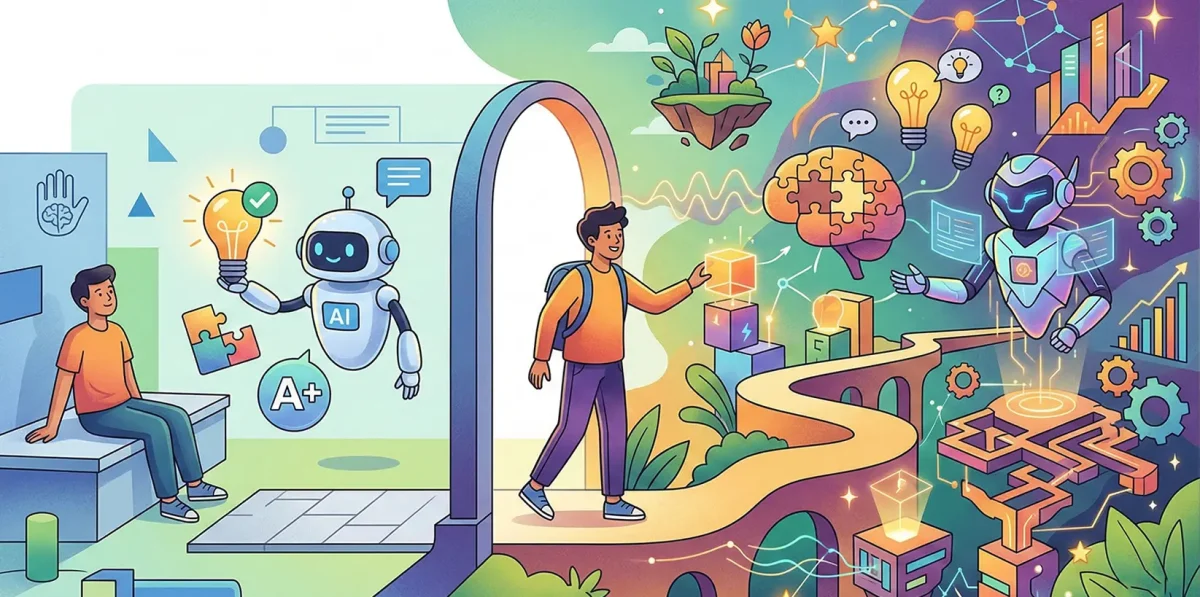
The problem becomes more serious when AI is used only as a shortcut. Many students now depend on AI to complete assignments, generate ideas, and solve problems without fully engaging in the process. This turns learning into a passive activity. Instead of thinking through a problem, students simply accept the output given by AI. Imagine going to the gym but letting a machine do all the work for you. You are present, but you are not building strength. In the same way, when AI does all the thinking, students miss the chance to develop their own intellectual ability.
However, this is not a limitation of AI it is a limitation of how AI is being used. AI should not just act as an answer provider; it should act as a thinking partner. A good teacher does not immediately give the answer. Instead, they ask questions, challenge assumptions, and guide students toward discovering the solution themselves. AI has the capability to do the same. It can push students to think deeper, ask follow-up questions, explore different perspectives, and connect ideas in meaningful ways. When used like this, AI becomes a tool that strengthens thinking instead of replacing it.
Another important aspect is the use of multiple AI models. Different systems like ChatGPT, Claude, and Gemini offer different types of responses; some simplify concepts, some provide deeper reasoning, and others connect broader ideas. When students compare these perspectives, they naturally begin to think more critically. It is similar to discussing a topic with different experts; each viewpoint adds a new layer of understanding. This process encourages students to analyze, question, and refine their thinking.
The challenge, however, is that most students use these tools in a fragmented way. They switch between platforms, lose context, and focus on collecting answers instead of building knowledge. This is where structured AI systems become important. Platforms like Webmap are designed to move beyond simple question-answer interactions and create a continuous learning experience. Instead of restarting conversations and losing context, students can build on previous discussions, explore multiple perspectives in one place, and organize information into structured outputs like summaries, steps, and connected insights.
This approach changes the role of AI completely. Students are no longer just asking isolated questions, they are developing a structured understanding of topics over time. With the concept of “One context, many models,” they can interact with multiple AI systems without breaking their flow of thinking. This allows them to go beyond quick answers and focus on deeper learning. AI becomes a system that supports thinking, not just a tool that delivers results.
In the future, the role of AI in education will not be defined by how quickly it provides answers, but by how effectively it helps students think. The most successful students will not be those who rely entirely on AI, but those who use AI to challenge themselves, explore ideas, and build strong conceptual understanding. Learning will shift from simply completing tasks to developing the ability to think independently and critically.In conclusion, AI has the power to transform education, but its true value lies in how it is used. When used only for answers, it limits growth. When used as a thinking partner, it enhances learning. Systems like Webmap show how this transformation is possible by creating structured, context-aware learning environments that encourage exploration and deeper understanding. Because in the end, education is not about how fast you get answers it is about how well you learn to think.