The AI Education Paradox: More Tools, Less Understanding?


Introduction
Artificial intelligence is everywhere in education today.
Students are using AI tools to write assignments, summarize notes, solve problems, and even prepare for exams. With platforms like ChatGPT, Claude, and Gemini, learning has become faster and more accessible than ever before.
But here’s the paradox:
Even with more AI tools, many students are understanding less.
How is that possible?
From the perspective of WebMap Network observations, the issue is not the availability of AI it is how students are using it and how these tools are structured (or not structured) for learning.
The Problem: Too Many Tools, Not Enough Clarity
When More Becomes Confusing
Today’s students don’t rely on just one AI tool. They often switch between multiple platforms:
- One for explanations
- One for summaries
- Another for research
At first, this seems powerful.
But imagine this:
You are cooking a meal using 5 different kitchens. One has vegetables, another has spices, a third has utensils, and the rest have ingredients. You keep running between them to complete one dish.
Even though you have everything you need, the process becomes slow, confusing, and inefficient.
This is exactly what happens when students use multiple AI tools without a unified system.
The Illusion of Productivity
Fast Answers = Deep Understanding
AI tools are excellent at giving quick answers.
But learning is not just about getting answers – it is about understanding the process behind them.
Think of it like using a calculator.
If you only rely on the calculator without understanding the formula, you may get the correct answer, but you won’t know why it is correct.
Similarly, when students copy AI-generated responses without exploring the reasoning, they miss the opportunity to actually learn.
The result?
- Faster task completion
- But weaker conceptual clarity
Context Loss: The Hidden Problem
Why Switching Tools Breaks Learning
One of the biggest challenges students face is losing context.
Each time a student switches between AI tools, the system forgets:
- previous questions
- earlier explanations
- learning progress
This forces students to:
- repeat prompts
- re-explain their needs
- rebuild context again and again
A simple analogy:
Imagine explaining your problem to a new teacher every 10 minutes. Each time, you have to start from the beginning.
This breaks your flow and slows down understanding.
Learning works best when context is continuous – not constantly reset.
The Missing Layer: Structured Intelligence
Tools vs Systems
Most AI tools today are designed as standalone assistants.
They can answer questions, but they do not:
- connect ideas over time
- structure knowledge
- maintain deep learning context
This creates a gap between information and understanding.
Think of it like having hundreds of notes scattered across your desk. Each note contains useful information, but without organization, it is difficult to see the bigger picture.
What students really need is not more tools.
They need a system that connects, organizes, and builds knowledge over time.
Multi-Model Intelligence: A Better Approach
One Question, Many Perspectives
Different AI models have different strengths.
- ChatGPT may explain concepts clearly
- Claude may provide deeper reasoning
- Gemini may offer broader contextual insights
Using multiple models can improve learning – but only if the experience is unified.
Otherwise, it becomes another source of confusion.
A better approach is to bring all these models into a single structured environment where:
- context is preserved
- responses can be compared
- insights are organized
How Webmap Solves the Paradox
Platforms like Webmap are designed to address this exact problem.
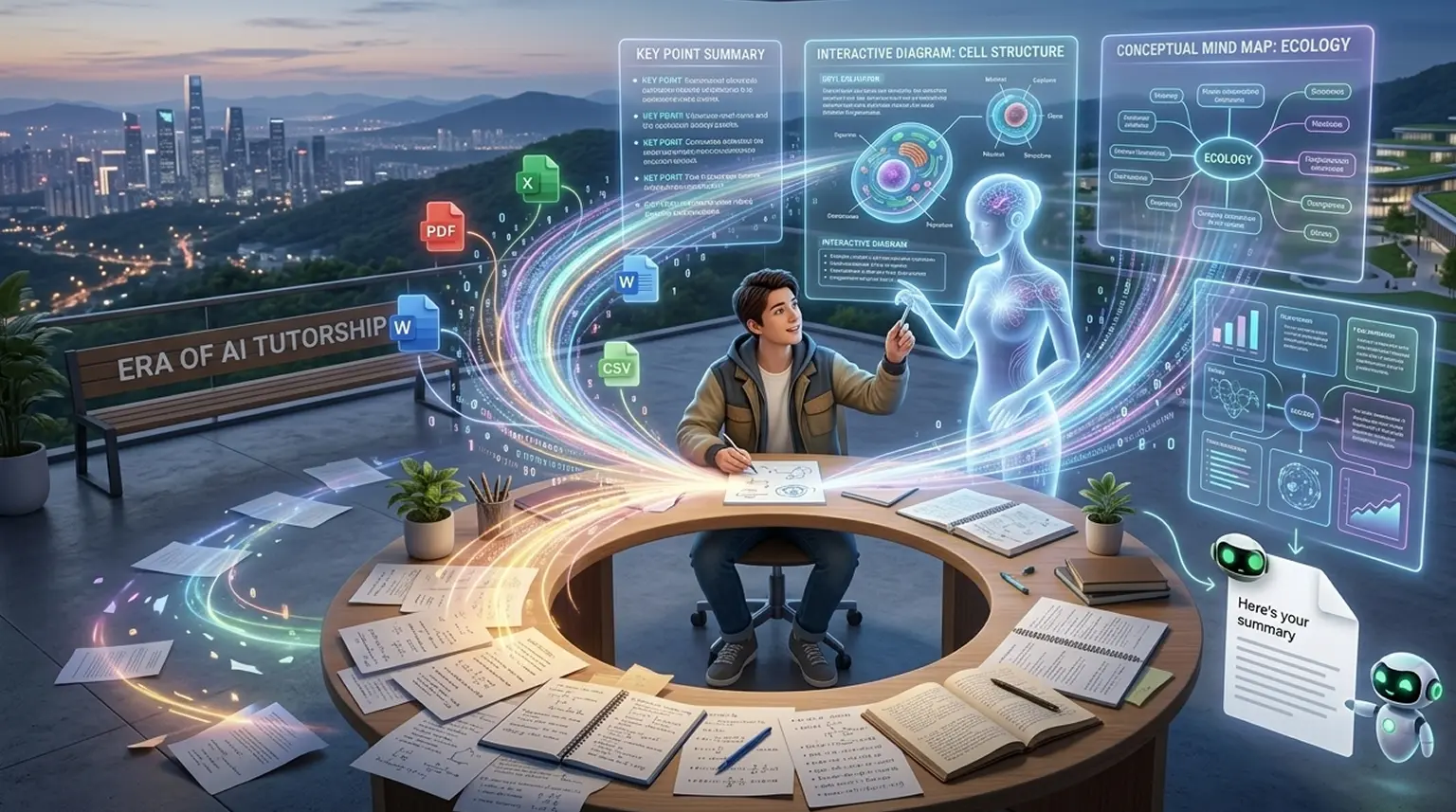
Instead of forcing students to jump between tools, Webmap creates a unified interaction layer where multiple AI models work together.
This approach helps students:
1. Maintain Context
Students can continue conversations without losing previous information, making learning more continuous and natural.
2. Compare Multiple AI Insights
Instead of relying on one answer, students can explore different perspectives from multiple models in one place.
3. Structure Knowledge
Information is not just generated – it is organized into meaningful formats like summaries, steps, and connected ideas.
4. Learn, Not Just Complete Tasks
By seeing how ideas connect, students move from simply finishing assignments to actually understanding concepts.
This is where the idea of “One context, many models” becomes powerful.
From Tool Usage to Intelligent Learning
Changing How Students Use AI
To truly benefit from AI, students need to shift their approach:
Old way:
- Ask for answers
- Copy results
- Move on
Better way:
- Ask follow-up questions
- Compare different explanations
- Build structured understanding
- Connect ideas across topics
AI should not replace thinking.
It should enhance thinking.
Future Outlook
As AI continues to evolve, the focus in education will shift from:
- “Which AI tool should I use?”
[to] - “How do I use AI systems to build knowledge?”
Future learning environments will likely:
- integrate multiple AI models
- maintain long-term learning context
- organize information automatically
- guide students through structured learning paths
Platforms like Webmap represent an early version of this future.
Conclusion
The rise of AI in education has created a powerful opportunity but also a paradox.
While students have access to more tools than ever before, true understanding can suffer when these tools are used without structure or context.
The solution is not to reduce AI usage, but to use it more intelligently.
By moving from scattered tools to unified, context-aware systems, students can transform AI from a shortcut into a true learning partner.
Because in the end, education is not about how many tools you use…
It’s about how well you understand what you learn.