Recursive Self-Embedding: The Hall of Mirrors Inside AI

We know what embeddings are.
They take something a word, sentence, image
and turn it into numbers.
But what if we do something strange?
What if a model embeds…
its own embedding process?
What if we create a vector
not just for a word
but for the algorithm that created the word’s vector?
Welcome to:
Recursive Self-Embedding – The Hall of Mirrors.
Step 1: Normal Embedding (The First Mirror)
Let’s start simple.
You give a model the word:
“Ocean”
It converts it into a vector
a list of numbers.
That vector represents:
- Water
- Vastness
- Blue
- Depth
- Waves
Now we have a point in space.
That’s normal embedding.
Step 2: Embedding the Embedding Process
Now imagine something unusual.
Instead of embedding “Ocean,”
we embed:
- The transformation function
- The model’s mapping rule
- The algorithm that created the vector
In simple words:
We try to create a vector
that represents the behavior of the model itself.
Everyday Analogy: Taking a Photo of a Mirror
Imagine standing in front of a mirror.
You take a photo.
Now place that photo inside another mirror.
Then take another photo.
Now repeat.
You get:
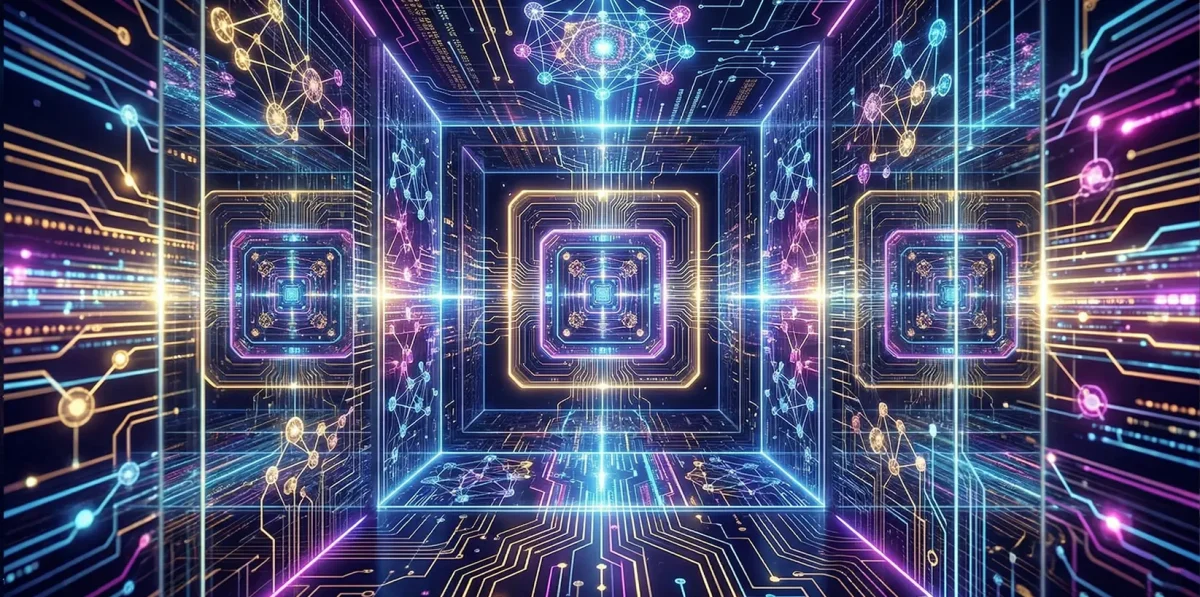
A mirror reflecting a mirror reflecting a mirror.
That infinite visual loop
is recursive self-embedding.
What Does the “Shape” of an Algorithm Look Like?
Normally, embeddings represent meaning.
But here we ask:
What does a transformation look like in vector form?
If an embedding model is a machine that bends space,
Then embedding the model means:
Representing the bending itself as a point.
We move from:
Meaning → to → Meta-meaning.
The Hall of Mirrors Effect
When a model embeds its own embedding process, we create layers:
1️] Word
2️] Word’s vector
3️] Vector of the embedding function
4️] Vector of the transformation that shaped the function
5️] And so on…
Each level becomes more abstract.
Like:
- Book
- Summary of book
- Summary of summary
- Analysis of summary
- Meta-analysis
Each step moves further away from the original object.
Fractal-Like Hierarchy
Fractals are patterns that repeat at different scales.
Recursive self-embedding creates a similar structure.
Each level contains:
- Information about the previous level
- But in compressed form
It becomes a hierarchy of metadata.
Everyday Analogy: Russian Dolls
Open one doll.
Inside is another.
Inside that, another.
Each smaller doll represents the previous one
but in reduced form.
Recursive embeddings are mathematical Russian dolls.
The Birth of Latent Inception
This idea creates something powerful:
Latent space inception.
A space inside a space.
An embedding of an embedding.
Instead of representing only objects,
we begin representing transformations.
That means AI systems could:
- Understand their own reasoning style
- Measure their own biases
- Compare architectures
- Align models more deeply
It’s like AI gaining geometric self-awareness.
Why This Matters
Today, embeddings represent data.
But tomorrow, they could represent:
- Model behavior
- Training dynamics
- Optimization patterns
- Alignment signatures
We could compare two models by embedding:
Their embedding process.
Instead of comparing outputs,
We compare geometric fingerprints.
The Risk of Infinite Reflection
Recursive systems can become unstable.
Just like:
Two mirrors facing each other create endless reflections.
If we repeatedly embed embeddings:
- Information may compress too much
- Noise may amplify
- Structure may collapse
We return to earlier concepts like semantic decay.
Not all recursion preserves clarity.
The Deeper Question
When we embed an algorithm,
We ask something philosophical:
Can a system represent its own structure?
Can geometry describe the rules that shape geometry?
It’s like asking:
Can a brain fully model itself?
Recursive self-embedding touches the limits of abstraction.
Strategic Insight
If developed carefully, recursive embedding could help:
- Model introspection
- Cross-model comparison
- Alignment verification
- Architecture fingerprinting
- AI governance tracking
It transforms embeddings from passive representation tools
into self-referential analysis instruments.
From representing the world
to representing the mind that represents the world.
Final Thoughts (Webmap Style)
Embeddings began as a way to map meaning.
Then they became infrastructure.
Now they may become mirrors.
Recursive self-embedding is not just a technical trick.
It is a shift in perspective.
Instead of asking:
“How does the model represent the world?”
We begin asking:
“How does the model represent itself?”
A mirror reflecting a mirror.
A space inside a space.
A vector describing the force that creates vectors.
This is the inception of latent spaces. And as AI systems grow more complex, Understanding not just their outputs,
but the shape of their internal transformations, may become the next frontier of intelligent design. Because the future of AI will not only depend on what models know. But on whether they can understand the geometry of their own knowledge.
To explore more advanced embedding architectures and next-generation latent intelligence systems, visit WebmapNetwork or connect with us at connect@webmap.network.