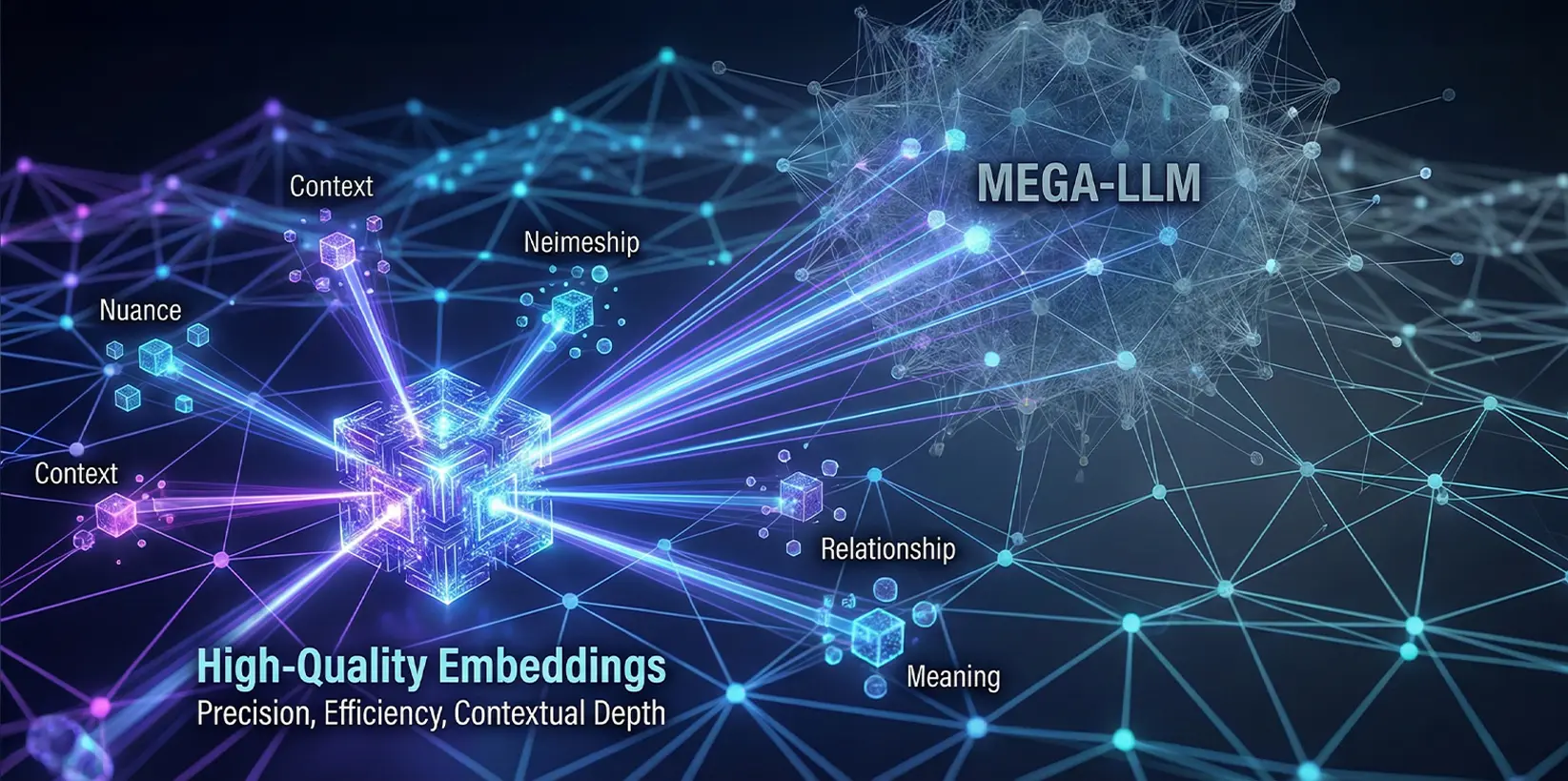
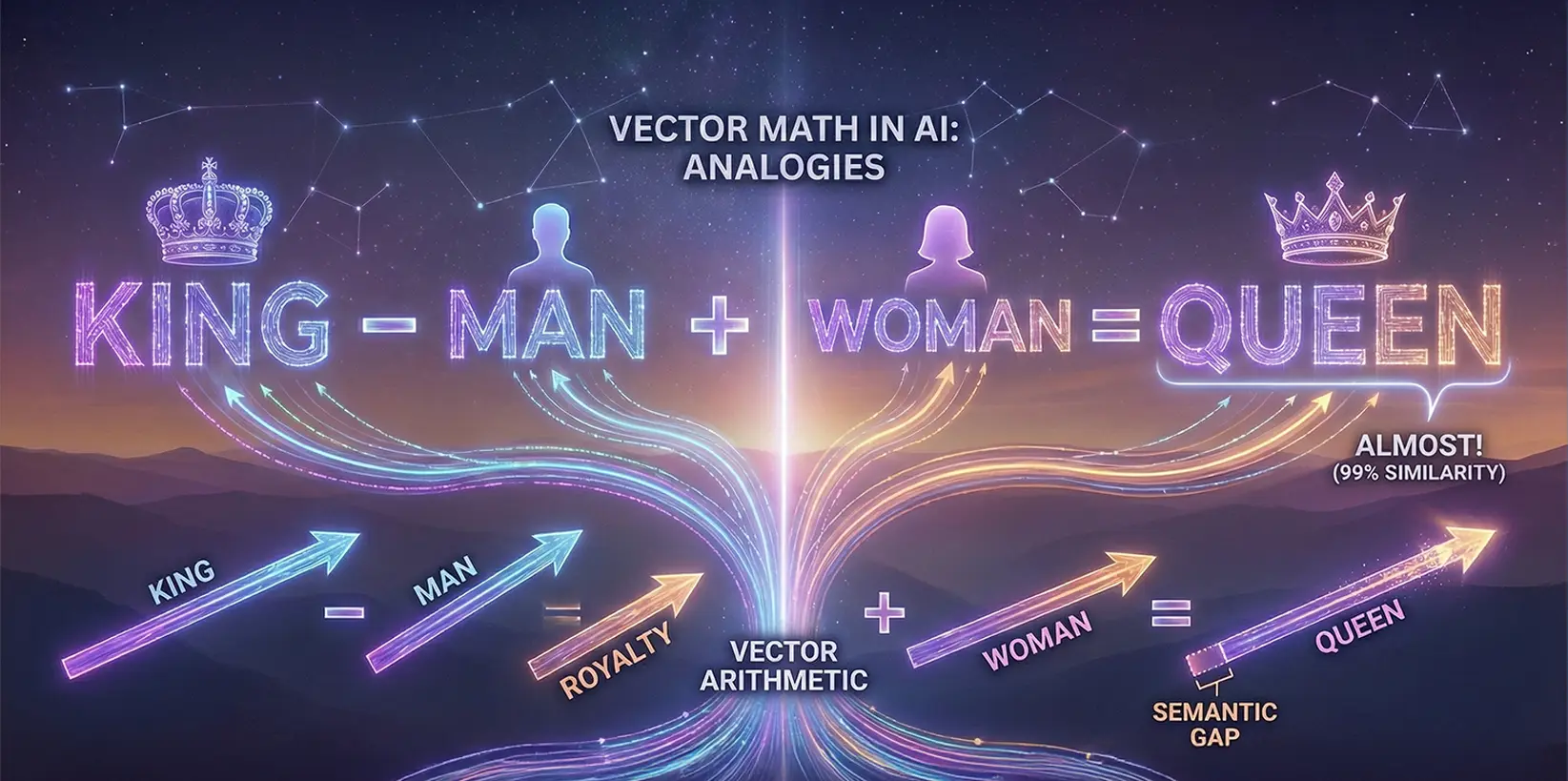
Edge-Ready Embeddings: Redesigning Vector Models for Bharat


In 2026, one question dominates India’s AI conversation:
How do we make AI work everywhere, not just in metro data centers?
At the national level, the focus has shifted toward:
- Democratizing AI beyond Tier-1 cities
- Reducing dependency on massive GPU clusters
- Enabling startups, MSMEs, and public institutions
- Making AI affordable and deployable at scale
India cannot rely only on billion-parameter models running in hyperscale cloud environments.
The next breakthrough may not be bigger models.
It may be smarter, lighter embeddings.
Why Embeddings Matter at the Edge
Large language models consume heavy compute.
But embeddings are the foundation of:
- Semantic search
- Recommendation systems
- Grievance classification
- Document similarity
- Local AI assistants
If embeddings become efficient, AI becomes accessible.
If embeddings remain heavy, AI stays centralized.
Everyday Analogy: Trucks vs Motorbikes
Large AI models are like freight trucks.
They move massive loads but require highways and fuel.
Edge-ready embeddings are like motorbikes.
They:
- Navigate narrow roads
- Consume less fuel
- Reach remote locations
- Operate independently
For Bharat smaller towns, rural networks, edge institutions motorbikes scale better than trucks.
Compact Embedding Architectures
Traditional embeddings often use large vector dimensions (768, 1024, 1536).
But do we always need that much?
Compact architectures reduce:
- Vector dimension size
- Memory footprint
- Compute cost
- Latency
Through architectural redesign, embeddings can preserve semantic richness while shrinking in size.
Think of It Like File Compression
A raw image might be 20MB.
A compressed version might be 2MB.
If designed well, quality remains visually similar.
Efficient embeddings work the same way.
Quantized Vector Representations
Quantization reduces the precision of numbers stored in vectors.
Instead of 32-bit floating point values, models can use:
- 16-bit
- 8-bit
- Even lower precision formats
This dramatically reduces:
- Storage cost
- Memory bandwidth
- Power consumption
Everyday Analogy: Rounding Currency
If you calculate ₹100.002134, you don’t need that precision.
₹100 is enough.
Quantization keeps the meaning while reducing unnecessary precision.
For edge systems, this is critical.
Sparse vs Dense Trade-offs for Edge Systems
Dense embeddings capture semantic richness.
Sparse embeddings use keyword-weight signals and require less compute.
At the edge, hybrid strategies may emerge:
- Use sparse retrieval for fast filtering
- Apply lightweight dense embeddings for refinement
This reduces heavy computation while maintaining accuracy.
Efficiency is not about removing intelligence.
It is about distributing it wisely.
Edge-Device Vector Search
Running vector search locally means:
- No constant cloud dependency
- Reduced latency
- Improved privacy
- Lower bandwidth usage
Imagine:
- A district hospital running semantic medical search offline
- A local agricultural advisory system clustering crop queries
- A rural grievance system categorizing complaints locally
Edge-ready embeddings enable AI without permanent internet reliance.
Embedding Distillation Techniques
Distillation allows a smaller model to learn from a larger one.
Instead of deploying a massive embedding system:
- Train a large, powerful model centrally
- Transfer its semantic intelligence to a smaller embedding model
- Deploy the compact version locally
Everyday Analogy: Master & Apprentice
A master craftsman trains an apprentice.
The apprentice cannot replicate every detail but can perform essential tasks efficiently.
Distilled embeddings carry core intelligence in lighter form.
Why This Matters for India
India’s AI growth depends on:
- Startups with limited compute budgets
- MSMEs without cloud-scale infrastructure
- Public institutions in remote regions
- Multilingual systems across bandwidth constraints
Scaling AI in India is not just about scale-up.
It is about scale-out.
Efficient embeddings allow AI to run:
- On affordable hardware
- On mobile-first environments
- Within constrained energy systems
- Across diverse connectivity conditions
The Strategic Shift
Globally, AI competition often focuses on:
“Who has the biggest model?”
India’s opportunity may be different:
“Who has the most efficient AI layer?”
Edge-ready embeddings represent:
- Infrastructure innovation
- Cost optimization
- Compute democratization
- Inclusion-first AI design
They reduce dependency on centralized GPU clusters.
They lower the barrier to entry.
They enable sovereign AI expansion beyond metros.
Final Thoughts
India’s AI future will not be built only in data centers.
It will be built in classrooms, district hospitals, startups, government offices, and rural enterprises.For that to happen, embeddings must evolve.
They must become:
- Lighter
- Quantized
- Distilled
- Edge-compatible
- Compute-efficient
Because true AI democratization does not come from scaling models upward.
It comes from designing intelligence that runs anywhere.
Edge-ready embeddings may not be the loudest innovation of 2026.But they may become the most important one. To explore how efficient embedding architectures can power scalable, decentralized AI systems, visit WebmapNetwork or connect with us at connect@webmap.network.