RAG 2.0: The New Embedding Architectures Powering Intelligent Retrieval


Retrieval-Augmented Generation (RAG) changed how AI systems answer questions.
Instead of relying only on what a model “remembers” from training, RAG allows it to:
- Retrieve relevant documents
- Use them as context
- Generate more accurate responses
But the first version of RAG had limitations.
It could retrieve information – but not always the right information.
That’s where RAG 2.0 begins.
Why RAG Is Evolving
Early RAG systems worked like this:
- Convert documents into embeddings
- Store them in a vector database
- Retrieve top similar chunks
- Pass them into an LLM
This worked well – but not perfectly.
Problems began to appear:
- Irrelevant chunks in top results
- Missing important context
- Poor ranking of highly relevant documents
- Static embeddings that didn’t improve over time
As AI moved into enterprise environments, accuracy became critical.
RAG needed to mature.
That evolution is now called RAG 2.0.
What Is RAG 2.0?
RAG 2.0 is not just retrieval + generation.
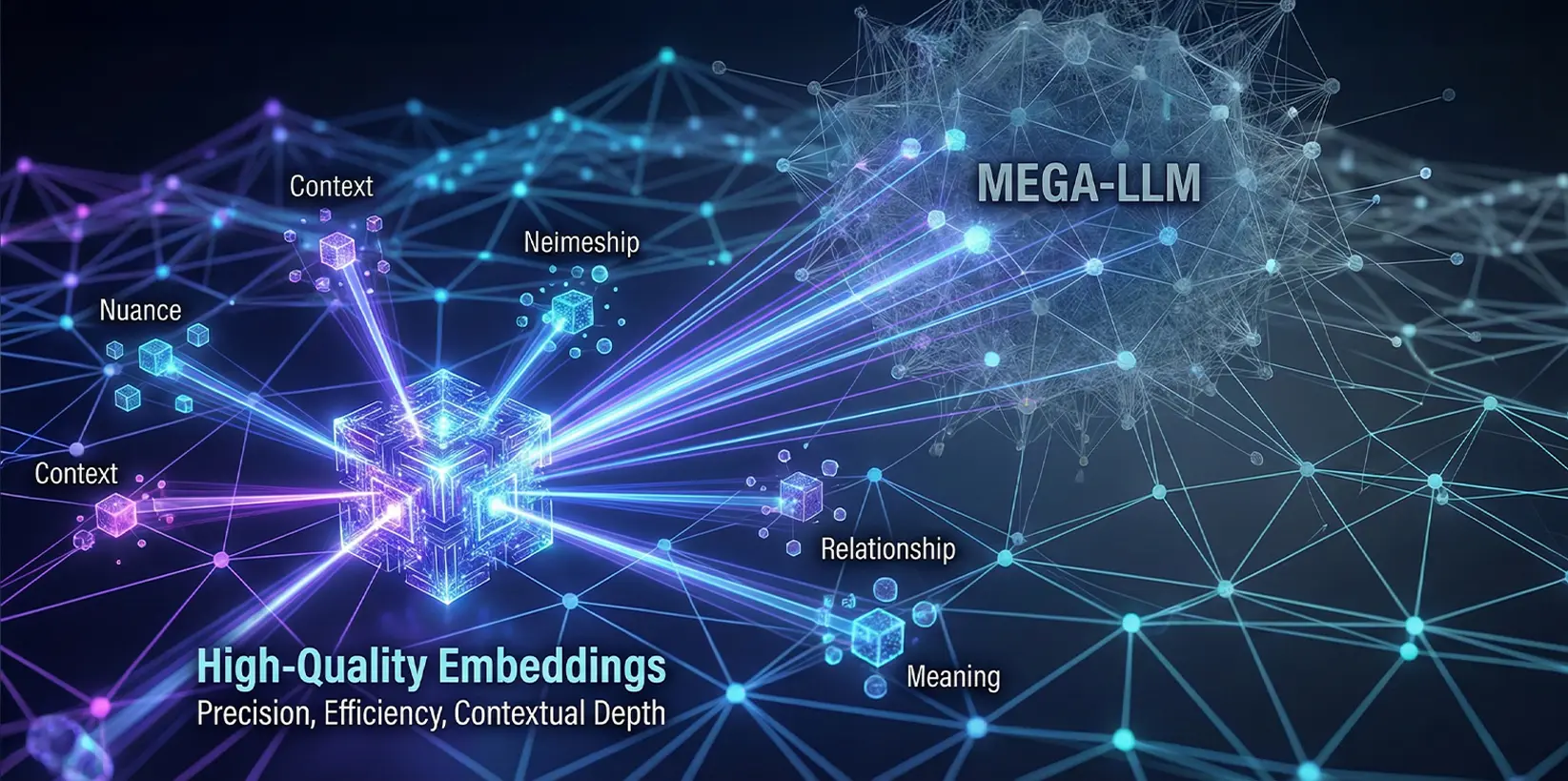
It introduces an Embedding Optimization Layer between search and generation.
Think of it as adding an intelligence filter before the AI answers.
Instead of:
Query → Retrieve → Generate
Now it becomes:
Query → Retrieve → Optimize → Generate
That “optimize” step changes everything.
Everyday Analogy: The Research Assistant
Imagine you ask a research assistant a complex question.
In RAG 1.0:
They grab the first five books that seem relevant and hand them to you.
In RAG 2.0:
They:
- Scan multiple books
- Highlight key sections
- Re-rank by relevance
- Remove noise
- Cross-check overlapping facts
Then they give you the most relevant material.
That extra intelligence layer is the embedding optimization layer.
The Core Innovations in RAG 2.0
1️) Embedding Re-Ranking Layers
In early RAG systems, similarity search alone determined results.
But semantic similarity isn’t always enough.
RAG 2.0 adds re-ranking layers.
After initial retrieval:
- A secondary model evaluates deeper contextual relevance
- Results are reordered
- Weak matches are removed
This improves answer quality dramatically.
Think of it like a second reviewer double-checking research quality.
2️) Hybrid Sparse + Dense Retrieval
Traditional search uses keyword matching (sparse retrieval).
Vector search uses embeddings (dense retrieval).
Each has strengths.
Sparse retrieval:
- Good for exact terms
- Strong for compliance/legal wording
Dense retrieval:
- Good for meaning
- Strong for conceptual similarity
RAG 2.0 combines both.
Everyday Analogy: Searching for a Recipe
If you search:
“Chocolate cake with almond flour”
Keyword search ensures:
“Chocolate” and “almond flour” appear.
Embedding search ensures:
It understands you want a dessert recipe, not a nutrition article.
Hybrid retrieval merges both strengths.
This reduces missed context.
3️) Embedding Feedback Loops
In early systems, embeddings were static.
They didn’t learn from user behavior.
RAG 2.0 introduces feedback loops:
- Which documents led to correct answers?
- Which retrieval patterns failed?
- What users clicked or ignored?
The system updates ranking strategies and embedding weights over time.
Everyday Analogy: A Smart Librarian
If readers consistently ignore certain books, the librarian stops recommending them.
If certain books are always useful, they move closer to the front shelf.
The system improves itself.
Why This Is Trending Now
Three major shifts are driving RAG 2.0:
1. Enterprise Adoption
Businesses require:
- High accuracy
- Low hallucination risk
- Reliable document grounding
Basic RAG is not enough for compliance-heavy industries.
2. Knowledge Explosion
Organizations now manage:
- Internal documents
- APIs
- PDFs
- Policies
- Data lakes
- Multi-modal sources
Simple embedding search struggles at scale.
Optimization layers are required.
3. Model Costs and Efficiency
Poor retrieval increases:
- Token usage
- Latency
- Compute costs
Optimized retrieval reduces noise before generation.
Better retrieval = better efficiency.
The Architecture Shift
RAG 1.0 focused on connecting LLMs to data.
RAG 2.0 focuses on structuring how that data is selected.
The real intelligence is no longer only in the language model.
It’s in the embedding orchestration layer.
This layer:
- Filters
- Ranks
- Validates
- Optimizes
- Learns
Before the model ever generates text.
The Bigger Picture
RAG 2.0 marks a shift from: “Can the AI retrieve something relevant?”
To: “Can the AI retrieve the most contextually accurate, optimized knowledge at scale?”
This transforms RAG from a helpful add-on into a core architectural component of intelligent systems.
Final Thoughts
Retrieval-Augmented Generation began as a way to ground AI in real data.
RAG 2.0 transforms it into an optimized intelligence pipeline powered by advanced embedding architectures. With re-ranking layers, hybrid sparse+dense retrieval, and embedding feedback loops, retrieval becomes adaptive, precise, and scalable.
If RAG 1.0 was about connecting models to documents, RAG 2.0 is about engineering how those documents are understood, prioritized, and optimized before generation begins. As AI systems scale across enterprise knowledge environments, the embedding optimization layer will become the backbone of intelligent retrieval infrastructure. To explore how advanced embedding architectures power structured, optimized retrieval systems, visit WebmapNetwork or continue the discussion with us at connect@webmap.network.