“Robots That Understand Space: Embeddings Powering AI-Native Automation”

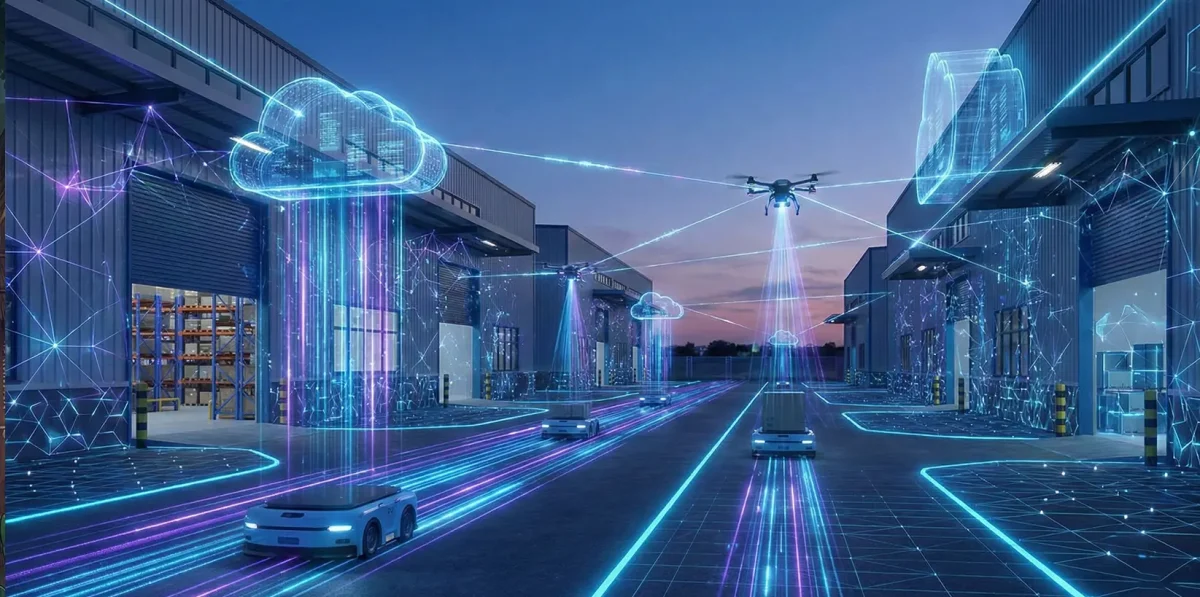
Robots are no longer isolated machines working inside cages on factory floors.
They are moving into:
- Smart factories
- Large-scale warehouses
- Hospitals
- Airports
- Retail environments
- Even humanoid pilot programs
As robotics scales, coordination becomes the real challenge.
When one robot operates alone, rules are enough.
When hundreds of robots move together carrying objects, navigating shared spaces, collaborating with humans something deeper is required.
They need contextual understanding.
That’s where embeddings become foundational.
Why This Is Emerging Now
Three major shifts are happening simultaneously:
1️) Industrial Robotics Is Scaling
Manufacturing plants now deploy fleets of robotic arms that must synchronize assembly, welding, packaging, and quality inspection.
2️) Warehouse Automation Is Expanding
Autonomous mobile robots move inventory across massive fulfillment centers, coordinating paths in real time.
3️) Humanoid Robots Are Entering Pilot Programs
Humanoids designed for real-world tasks must interpret dynamic environments and collaborate with humans safely.
The complexity has increased.
And coordination at scale requires more than programmed rules.
It requires machines that understand relationships between:
- Space
- Objects
- Intent
- Motion
- Other agents
Embeddings make this possible.
What Are Embeddings in Robotics?
Embeddings convert complex sensory and contextual information into structured numerical representations.
In robotics, that means encoding:
- Spatial awareness
- Task intent
- Collaborative motion prediction
Think of embeddings as the internal “map of meaning” that robots use to understand their environment and each other.
Spatial Awareness: Understanding the Room
A robot does not “see” the world like humans do.
It receives:
- Lidar readings
- Camera frames
- Depth maps
- GPS coordinates
- Sensor signals
Without embeddings, these remain isolated data streams.
With embeddings, they become a structured representation of space.
Everyday Analogy: Walking Through a Crowded Room
When you walk through a crowded room, you instinctively understand:
- Where people are
- Which spaces are blocked
- Which paths are opening
- Who is likely to move
You don’t calculate coordinates manually.
You perceive spatial relationships.
Embeddings allow robots to form a similar understanding not just measuring distances, but encoding relationships between objects and obstacles.
This enables:
- Collision avoidance
- Path optimization
- Dynamic rerouting
- Real-time adaptation
Task Intent: Understanding the Goal
Robots don’t just move. They perform tasks.
In a warehouse, one robot might:
- Pick items
- Another transports them
- Another sorts them
- Another loads them
Coordination depends on shared task understanding.
Everyday Analogy: A Kitchen Team
In a restaurant kitchen:
- One chef prepares ingredients
- Another cooks
- Another plates
- Another serves
They don’t collide because they understand shared intent.
Embeddings encode task intent so robots understand:
- What stage a task is in
- What dependencies exist
- Which robot should act next
Instead of fixed rule sequences, robots can adapt based on context.
Collaborative Motion Prediction: Anticipating Movement
When multiple robots operate together, prediction becomes critical.
Imagine 200 warehouse robots navigating aisles simultaneously.
Without predictive coordination:
Traffic jams happen.
With embedding-driven coordination:
Robots anticipate each other’s movement.
Everyday Analogy: Driving in Traffic
You don’t just react to the car in front of you.
You anticipate:
- When it might brake
- When it might change lanes
- How traffic is flowing
Embeddings allow robots to encode movement patterns and anticipate trajectories.
This enables:
- Smooth fleet coordination
- Reduced idle time
- Lower energy consumption
- Fewer operational conflicts
AI-Native Robotics vs Rule-Based Robotics
Traditional robotics relies on:
- Predefined paths
- Static maps
- Fixed instruction chains
But real-world environments are dynamic.
AI-native robotics uses embeddings to:
- Continuously update environmental understanding
- Adjust task priorities
- Learn from historical motion patterns
- Adapt to human presence
It shifts robotics from rigid automation to contextual intelligence.
Industrial Impact
Embedding-driven robotics coordination enables:
- Scalable warehouse fleets
- Human-robot collaboration
- Adaptive manufacturing lines
- Multi-agent robotic ecosystems
- Safe humanoid pilot deployments
Instead of managing robots individually, systems manage collective intelligence.
Why Embeddings Matter at Scale
As robotics fleets grow from tens to thousands of units, coordination complexity grows exponentially.
Embeddings allow systems to:
- Compress high-dimensional sensor data
- Compare environmental states quickly
- Detect anomalies in movement patterns
- Learn optimal coordination strategies
They become the shared language between machines.
The Bigger Picture
The future of robotics isn’t just automation.
It’s orchestration.
Factories, warehouses, and service environments are becoming multi-agent ecosystems.
Embeddings provide the intelligence layer that connects:
- Space
- Objects
- Intent
- Movement
- Collaboration
Without embeddings, robots follow instructions.
With embeddings, robots understand context.
Final Thoughts
Robotics is entering an AI-native era.
As industrial fleets expand, warehouses automate, and humanoid robots enter real-world environments, coordination becomes the defining challenge.
Embeddings transform raw sensor signals, spatial data, and task workflows into structured intelligence that machines can share and reason over.
They enable robotic systems to:
- Understand spatial relationships
- Encode task intent
- Predict collaborative motion
- Coordinate at scale
- Adapt in real time
If traditional automation is like machines following a script, embedding-driven robotics is like machines understanding the choreography. As multi-agent robotic ecosystems grow in complexity, embedding architectures will form the foundational layer enabling scalable, safe, and intelligent coordination. To explore how embedding architectures power structured intelligence across complex, real-world systems, visit WebmapNetwork or continue the discussion with us at connect@webmap.network.