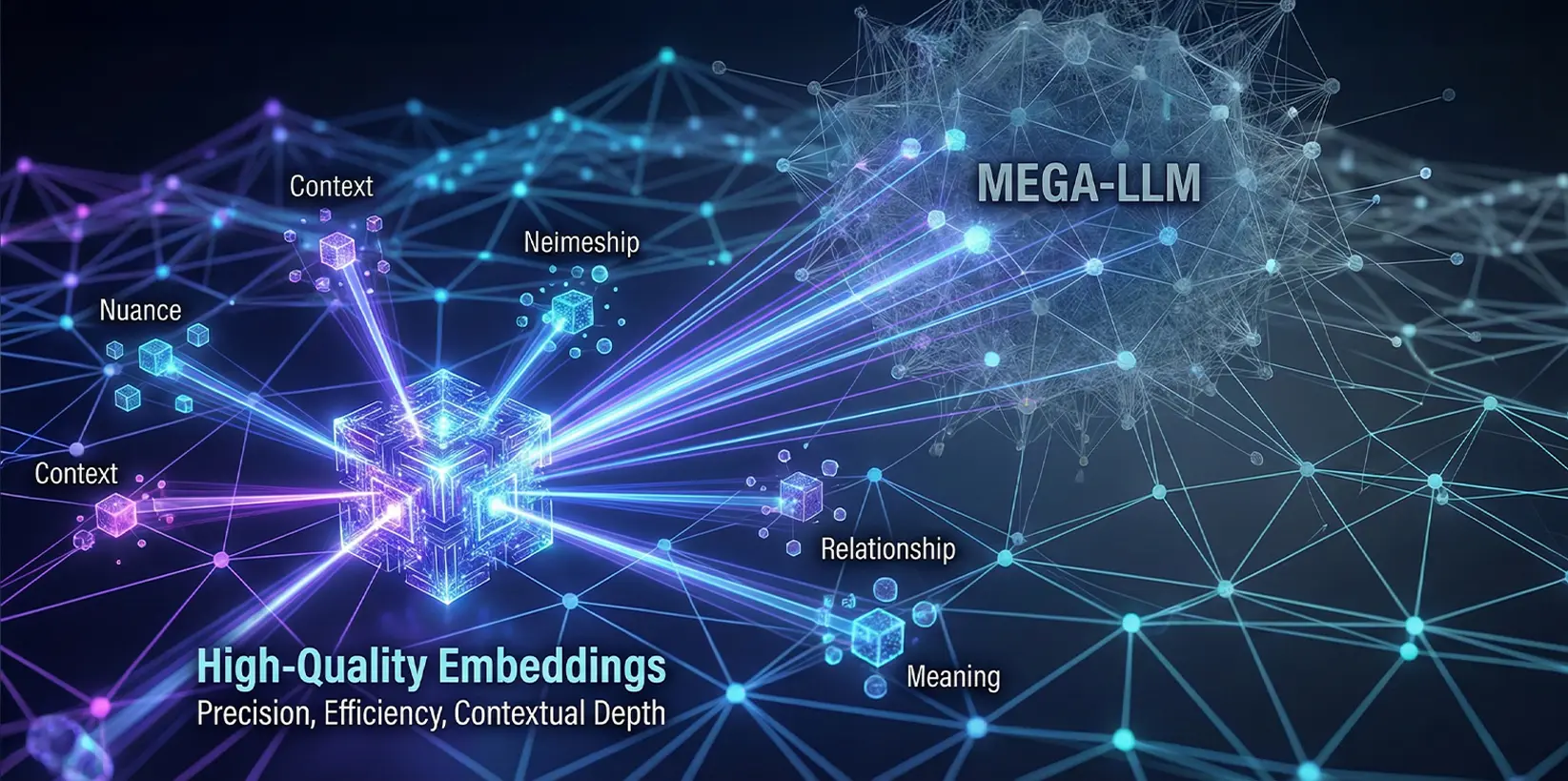
The Future of AI: Beyond Context Windows, Towards Intelligent Memory Embeddings


In the rapidly evolving landscape of Artificial Intelligence, there is a significant debate about the future path of truly intelligent systems. While the focus has traditionally been on increasing the size of context windows in Large Language Models (LLMs) to enable processing of more information in a single interaction, there is a growing consensus that the key to advancing AI lies in developing sophisticated memory embeddings for efficient knowledge retrieval and reasoning.
1. The Limits of Ever-Expanding Context Windows
Context windows define the maximum amount of information LLMs can process, but their expansion presents notable drawbacks:
- Computational Cost and Latency: Doubling context length quadruples computation and memory costs, leading to higher expenses and increased latency.
- Diminishing Returns and “Attention Dilution”: More context doesn’t necessarily improve outcomes; performance degrades in the middle of large contexts, causing models to overlook significant details.
- The “Needle in a Haystack” Problem: With extensive tokens, models may still miss critical information needed for complex reasoning.
- Inconsistent Understanding: Important information outside the context window can lead to misunderstandings and inconsistent responses.
Table 1: Pros and Cons of Large Context Windows
| Aspect | Pros | Cons |
|---|---|---|
| Information | Can process longer documents and conversations. | Prone to “needle in a haystack” problem; important details can be missed. |
| Performance | Allows more comprehensive analysis in a single pass. | Uneven attention distribution: performance often degrades in the middle of the context. |
| Cost & Speed | Simpler for tasks that previously needed chunking. | Significantly higher computational cost and increased latency with growing size. |
| Complexity | Reduces multi-step orchestration for some tasks. | Requires careful prompt design and context management to be effective. |
2. The Power of Better Memory Embeddings
Rather than focusing solely on expanding context windows, a more promising approach is the use of advanced memory systems powered by embeddings:
- Persistent and Personalized Knowledge: Embeddings facilitate the creation of AI systems that remember user preferences and long-term knowledge, thus overcoming LLM forgetfulness.
- Efficient and Scalable Retrieval: These embeddings allow for the conversion of high-dimensional data into compact vectors, enabling semantic searches that retrieve relevant information based on meaning.
- Enhanced Contextual Understanding and Reasoning: By focusing on the most pertinent information, embeddings provide robust context, forming the basis for techniques like Retrieval-Augmented Generation (RAG).
- Cost-Effectiveness: Generating embeddings is often inexpensive, making it feasible to map extensive knowledge bases efficiently.
Table 2: Types of Memory Embeddings and their Applications
| Type of Memory Embedding | Description | Key Applications |
|---|---|---|
| Semantic Embeddings | Capture meanings and relationships between texts. | Semantic search, question answering, document summarization, content recommendation. |
| Episodic Embeddings | Represent specific events or interactions. | Personalized chatbots, agent state management, user journey tracking. |
| User Profile Embeddings | Encapsulate user preferences and behaviors. | Personalization, adaptive learning, tailored content suggestions. |
| Knowledge Graph Embeddings | Represent entities within knowledge graphs. | Complex reasoning, fact verification, inferring relationships, enhanced querying. |
3. Memory Embeddings vs. Context Windows: A Paradigm Shift
The transition from larger context windows to sophisticated memory embeddings signifies a fundamental shift in information processing in AI:
Table 3: Context Windows vs. Memory Embeddings
| Feature | Large Context Windows | Memory Embeddings (via Vector Databases) |
|---|---|---|
| Nature | Ephemeral, immediate “working memory.” | Persistent, long-term semantic memory. |
| Capacity | Fixed; limited by quadratic complexity. | Virtually unlimited; scalable and external to the model. |
| Information Use | Processes all tokens indiscriminately. | Selectively retrieves only the most relevant information. |
| Cost | High and scales quadratically with length. | Cost-effective storage and retrieval per token. |
| Reasoning | Prone to “needle in a haystack” issues and attention dilution. | Provides focused, quality context for robust reasoning. |
| Adaptability | Static within a session. | Dynamic; can be updated with new interactions. |
4. Challenges and Future Directions
Despite their advantages, developing effective memory systems with embeddings poses challenges, including memory management, data privacy, and optimization of stored information. Hybrid models like Retrieval-Augmented Generation (RAG) demonstrate improved performance by integrating LLMs with external knowledge bases, leading to enhanced accuracy and factual grounding. Memory-Augmented RAG further enhances this by dynamically storing and reusing past interactions for more personalized AI experiences.
Conclusion
The trend toward larger context windows faces inherent limitations in scalability and cost, detracting from true intelligence in AI. The future lies in moving towards sophisticated, persistent memory systems powered by embeddings. This evolution promises to enable AI to learn, adapt, and reason with an unprecedented depth and breadth, paving the way for genuinely intelligent and personalized experiences. Connect with WebmapNetwork to discover how embedding-driven memory architectures can redefine intelligent AI systems for the next decade. We help organizations move beyond context limits by designing scalable, memory-centric AI solutions built for real-world complexity. Email us at: connect@webmap.network