The Embedding Ecosystem: A Look at Tools and Libraries for Developers

Here at Webmap Network, we often talk about the power of embeddings the numerical “fingerprints” that allow AI to understand language, images, and complex data. But turning that theory into practice requires the right set of tools. Think of it like building a piece of furniture: you can have the perfect blueprint (your AI concept), but you need the right saws, drills, and sanders (the libraries) to bring it to life. This blog is your guide to the developer’s workshop for the embedding ecosystem.
Far from being a niche concept, embeddings are becoming the bedrock of intelligent applications, much like a well-organized library makes it easy to find any book you need.
What Are Embeddings? The Digital Fingerprint of Data
Imagine you have a vast collection of items books, songs, images, or even customer reviews. If you wanted a computer to understand the meaning or essence of each item, how would you represent it? This is where embeddings come in.
Embeddings are high-dimensional numerical representations (vectors) that capture the semantic meaning and relationships of data points like words, sentences, images, or even entire documents. Think of them as unique “digital fingerprints” for every piece of information. Just as a fingerprint uniquely identifies an individual, an embedding uniquely represents the meaning of data, placing similar items closer together in a multi-dimensional space. If two words like “car” and “automobile” have similar meanings, their embeddings will be numerically very close, while “banana” would be much further away.
Why Embeddings Matter: Bridging the Human-Machine Gap
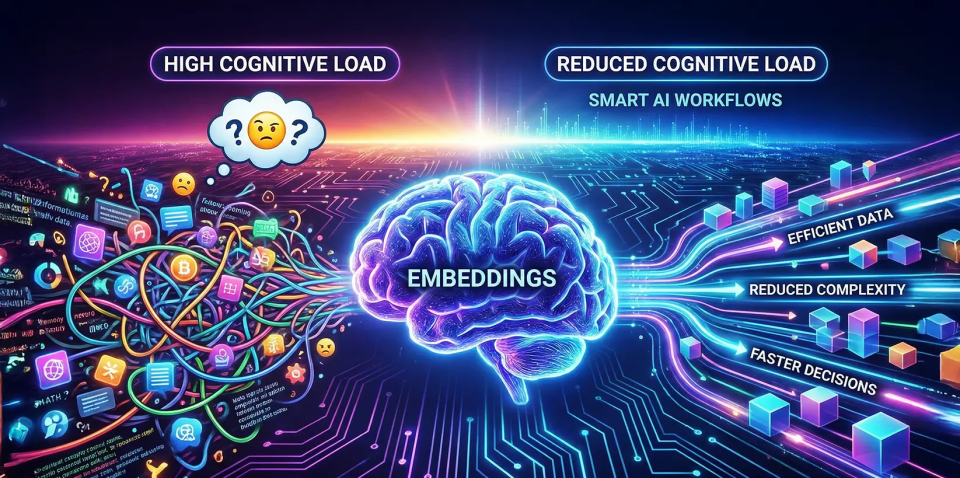
For traditional machine learning algorithms, raw text or images are often challenging to process directly. Embeddings provide a crucial solution by converting complex, unstructured data into a structured numerical format that machines can easily understand and process. This preservation of semantic similarity is key.
At Webmap Network, we’ve seen firsthand how this capability allows machines to interpret context, nuance, and relationships in ways that were previously impossible. This directly translates into more intelligent, more human-like AI applications. Choosing the wrong library for your embedding task can lead to inefficiency, poor performance, and frustration. The ecosystem has matured, offering specialized tools for every stage: from generating embeddings and storing them efficiently to performing lightning-fast searches. Selecting the appropriate one streamlines development, optimizes resource use, and is crucial for building scalable, production-ready AI applications.
How Embeddings Are Created: From Raw Data to Meaningful Vectors
So, how do we create these magical digital fingerprints? The process typically involves feeding raw data into sophisticated neural networks, often large language models (LLMs) or other deep learning architectures. These networks are trained to transform complex inputs into compact, dense vectors that encapsulate their essential meaning.
It’s like having a brilliant linguistic expert who can read an entire paragraph and, instead of just repeating the words, distills its core idea into a precise numerical code that captures its essence. Whether we’re leveraging pre-trained models or fine-tuning our own, this conversion process is fundamental to making complex data digestible for our applications. While these tools are powerful, developers face several hurdles. Training a custom embedding model from scratch, for instance, is a significant undertaking. The challenges mirror building a complex engine: you need massive amounts of high-quality training data (the raw materials), immense computational power (the factory), and careful tuning of the model’s architecture to ensure it learns stable and meaningful representations. Evaluating whether your embeddings truly capture semantic meaning adds another layer of complexity.
Key Applications: Where Embeddings Shine
The practical applications of embeddings are vast and continue to grow. We at Webmap Network frequently leverage them for:
- Natural Language Understanding (NLU): For tasks like sentiment analysis, spam detection, and topic classification, embeddings provide machine learning models with rich input that reflects the actual meaning of a document.
- Intelligent Search & Recommendations: Instead of keyword matching, embeddings enable semantic search, allowing users to find relevant content by describing what they want, even if their exact words aren’t present. Similarly, users and items can be embedded to enable highly personalized recommendations.
- Chatbots & Virtual Assistants: Embeddings help chatbots parse user intent more flexibly, understanding that phrases like “Will it rain tomorrow?” and “What’s the weather forecast for tomorrow?” carry the same meaning.
- Code Search: Developers can find relevant code snippets by describing their needs, rather than guessing exact variable names.
Navigating the Embedding Ecosystem: Essential Tools & Libraries
The embedding workflow typically involves three key phases: creation, storage, and retrieval. The embedding ecosystem is thriving, offering a range of tools for generation, storage, and application.
Generating Embeddings: APIs vs. Local Models
| Approach | Description & Examples | Best For |
|---|---|---|
| Cloud Provider APIs | For ease of use and scalability, these APIs abstract away complex model inference via HTTP calls. | Quick integration of state-of-the-art models and rapid prototyping. |
| Google’s Vertex AI: Provides a text-embeddings API powered by Generative AI, producing embeddings with an output dimension of 768. | ||
| OpenAI: Offers widely used embedding models accessible via API. | ||
| Cohere: Another prominent provider with powerful embedding models and APIs. | ||
| Local Inference & Libraries | For more control or self-contained solutions, these libraries facilitate local embedding generation. | Custom model training, research, and full control in production. |
| Sentence Transformers, TensorFlow Hub, PyTorch: Core Python libraries for implementing embedding services and custom models. | ||
| @xenova/transformers (JavaScript): Supports running transformer models locally using ONNX for lightweight tasks. | ||
| Ollama: Can be called via its HTTP interface from backend applications for local model interaction. |
Storing & Querying Embeddings: Vector Databases and Beyond
Once generated, embeddings need to be stored and efficiently queried to power applications. The table below compares tools for storage, management, and retrieval.
| Phase / Tool | Primary Purpose / Description | Best For / Analogy |
|---|---|---|
| Vector Storage & Management | Storing, indexing, and managing large collections of vectors for efficient search. | Production applications requiring scalable, low-latency similarity search. |
| Pinecone, Weaviate, Qdrant, Milvus, Chroma | Specialized databases designed for high-performance similarity search at scale. | Like a library that groups books by genre, theme, and narrative style for fast similarity searches. |
| pgvector (PostgreSQL Extension) | Allows storage and search of embeddings directly within PostgreSQL. | Like adding a highly efficient index to an existing library catalog to find books by content similarity alongside traditional searches. |
| Similarity Search & Retrieval | Finding the most similar vectors to a given query vector. | In-memory search within applications, research prototypes, and high-performance nearest neighbor lookup. |
| FAISS (Facebook AI Similarity Search), Annoy | Libraries for approximate nearest neighbor search. | High-performance nearest neighbor lookup within applications. |
Choosing Your Path: Practical Guidance and Partnership
So, how do you choose? Start by defining your project’s “recipe.” Are you building a semantic search engine for documents? A pre-trained model from Sentence Transformers paired with a vector database like Weaviate might be perfect. Need to search through millions of product images? FAISS could be your go-to for efficient in-application search. For rapid prototyping, start with an API-based solution like OpenAI; for full control and scalability in production, lean towards dedicated vector databases. The key is to match the tool’s strengths to your specific requirements for data type, scale, latency, and operational complexity.
At Webmap Network, we understand that navigating this evolving ecosystem can be complex. From choosing the right embedding model to implementing efficient storage and retrieval mechanisms, our team of experts is here to guide you. We specialize in building custom solutions that harness the power of embeddings to create smarter search, more personalized recommendations, and truly intelligent applications tailored to your specific needs.
Our Perspective and Conclusion
At Webmap Network, we see embeddings not just as a technical component, but as the foundational language for building intelligent spatial and data solutions. We leverage this ecosystem to help our clients create systems that understand context, find nuanced relationships, and deliver insightful results. Whether it’s enhancing search capabilities or powering recommendation engines, the right tooling makes all the difference.
The embedding ecosystem is not just a technological trend; it’s a fundamental shift in how we enable machines to understand and interact with the richness of human data. By transforming abstract concepts into quantifiable vectors, embeddings unlock unprecedented capabilities across various domains.
If you’re looking to navigate this ecosystem for your project whether you’re figuring out the best library to start with or designing a full-scale vector search infrastructure we’re here to help. Let’s discuss how to translate these tools into tangible solutions for your business.
We invite you to reach out to us at connect@webmap.network for further discussions and solutions development. Think of us as your skilled navigators through this exciting new landscape – if you have a puzzle to solve or a complex system to build, we’re ready to help you find the right pieces and put them together seamlessly.