The Learning Stack: How Students Are Building Their Own AI-Powered Education Systems


Introduction
A new trend is quietly emerging in education.
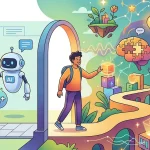
Students are no longer relying only on textbooks, lectures, or a single platform. Instead, they are building their own “learning stack” , a combination of different AI tools, resources, and workflows to study smarter.
From summarizing notes to solving problems and conducting research, students are designing personal AI-powered education systems.
From the perspective of WebMap Network observations, this shift is powerful but also incomplete.
Because while students are building stacks…
they are still missing structure, connection, and continuity.
What Is a Learning Stack?
A DIY Approach to Learning
A learning stack is simply a combination of tools a student uses to study.
For example, a student might:
- use ChatGPT for explanations
- use Claude for deeper reasoning
- use Gemini for research insights
- use notes apps for saving information
Each tool plays a role in the learning process.
Everyday Analogy
Think of a learning stack like a gym routine.
- one machine for cardio
- another for strength
- another for flexibility
Each tool helps but they are still separate pieces of the workout.
Why Students Are Building Their Own Stacks
The Limitations of Traditional Education
Traditional systems often:
- follow fixed structures
- move at a uniform pace
- don’t adapt to individual needs
Students want:
- faster answers
- personalized explanations
- flexibility in learning
AI tools provide exactly that.
So instead of waiting for systems to evolve, students are creating their own.
The Benefits of a Learning Stack
1. Speed and Efficiency
Students can quickly:
- get answers
- summarize content
- explore topics
2. Multiple Perspectives
Using different tools allows students to:
- compare explanations
- understand concepts better
3. Personalized Learning
Each student builds a stack based on:
- their needs
- their subjects
- their learning style
The Hidden Problem: Fragmentation
While learning stacks are powerful, they come with a major issue:
Everything is disconnected.
Students constantly:
- switch between tools
- copy information from one place to another
- lose track of context
Analogy
Imagine building a house using tools that are all placed in different locations.
- hammer in one room
- nails in another
- wood somewhere else
You can still build the house
but the process becomes slow and confusing.
The Cost of a Fragmented Stack
1. Lost Context
Each tool works independently.
No tool remembers what the other did.
2. Repetition
Students repeat the same prompts across platforms.
3. Shallow Learning
Focus shifts from understanding → to managing tools.
4. Mental Overload
Too many tools = too many decisions.
The Missing Layer: From Stack to System
Tools Are Not Enough
A stack gives access to tools.
A system creates flow, structure, and connection.
Students don’t just need:
- tools to generate answers
They need:
- systems to organize knowledge
Multi-Model Intelligence Done Right
Different AI models bring different strengths:
- ChatGPT simplifies concepts
- Claude explains deeply
- Gemini connects broader ideas
Students are already using this but in a fragmented way.
The real opportunity is:
bringing these models together in one structured environment
How Webmap Transforms the Learning Stack
Platforms like Webmap turn a fragmented learning stack into a unified learning system.
Instead of switching between tools, students interact within a single environment where everything connects.
What Changes?
1. One Context
All learning happens in a continuous flow.
2. Many Models
Multiple AI systems work together without switching.
3. Structured Knowledge
Information is organized into:
- summaries
- steps
- connected insights
4. Better Learning Experience
Students focus on:
understanding
instead of
managing tools
Core Concept
“One context, many models”
This transforms a stack into a system.
The Future: Personal AI Learning Systems
Learning stacks are just the beginning.
In the future, students will move toward:
- fully integrated AI learning environments
- systems that remember their learning journey
- tools that organize knowledge automatically
- platforms that guide thinking, not just answers
Students will no longer build stacks manually.
They will use intelligent systems designed for learning.
Conclusion
Students are already taking control of their education by building AI-powered learning stacks.
This shows a clear shift:
from passive learning → to active, self-driven learning
But stacks alone are not enough.
Without structure, they create fragmentation, confusion, and inefficiency.
The next step is moving from:
- stacks of tools
to:
- systems of intelligence
Platforms like Webmap represent this evolution helping students turn scattered tools into connected, structured learning experiences.
Because the future of education is not about how many tools you use…
It’s about how well they work together.